A well-structured construction building contractor safety policy plan helps protect workers, subcontractors, visitors, equipment, and the public while supporting efficient project delivery. Construction sites involve many hazards, including working at height, heavy machinery, electrical systems, excavation, lifting operations, temporary structures, and changing site conditions. A clear safety policy gives everyone a practical framework for identifying risks and working safely.
Whether you manage a small building project or oversee a large construction operation, a written safety plan can help establish responsibilities, communicate expectations, and document important procedures. This guide explains the key elements of a construction contractor safety policy and how to create a plan that can be adapted to different projects.
What Is a Construction Building Contractor Safety Policy Plan?
A construction building contractor safety policy plan is a written document that explains how a contractor will manage workplace health and safety throughout a construction project. It typically covers safety objectives, employee responsibilities, hazard controls, training, personal protective equipment, emergency procedures, inspections, incident reporting, and ongoing safety improvement.
The plan should be practical rather than simply being a collection of rules. Workers and supervisors should be able to understand what is expected, identify potential hazards, and know what actions to take when conditions change.
Why a Construction Safety Policy Is Important
Construction work can involve multiple contractors, changing work areas, different types of equipment, and simultaneous activities. A documented safety policy helps create a consistent approach across the project.
Important benefits include:
- Hazard awareness: Workers can better recognize common construction hazards before work begins.
- Clear responsibilities: Managers, supervisors, workers, and subcontractors know their safety duties.
- Consistent procedures: Safety expectations can be communicated across different teams and work shifts.
- Emergency preparedness: Workers have a defined process for responding to fires, injuries, severe weather, spills, and other emergencies.
- Training support: The policy provides a framework for induction training, toolbox talks, and refresher training.
- Continuous improvement: Inspections and incident reviews can be used to identify areas that need improvement.
Key Elements of a Construction Contractor Safety Policy Plan
1. Company and Project Information
Start the document with basic project details. Include the contractor’s name, project name, site location, project manager, site supervisor, and the date the plan was prepared or reviewed.
This information makes the safety document easier to identify and update. For larger projects, it can also be useful to include a document version number and revision date.
2. Safety Policy Statement
The policy statement should communicate the contractor’s commitment to providing a safe and healthy working environment. It should emphasize compliance with applicable laws, regulations, project requirements, and recognized safety practices.
A useful policy statement should be clear and understandable. Avoid overly complicated language that workers may find difficult to apply on a busy construction site.
3. Safety Objectives
Define specific safety objectives for the project. These objectives provide direction and help management measure safety performance.
Common construction safety objectives include:
- Prevent workplace injuries and illnesses.
- Identify and control hazards before work begins.
- Provide appropriate personal protective equipment.
- Deliver safety training to employees and subcontractors.
- Maintain clean and organized work areas.
- Encourage prompt reporting of hazards and incidents.
- Review safety performance and implement corrective actions.
4. Roles and Responsibilities
Everyone involved in a construction project has a role in maintaining a safe workplace. The safety policy should clearly define those responsibilities.
- Management: Provide appropriate resources, establish safety expectations, and support corrective actions.
- Project managers: Coordinate safety requirements and ensure the safety plan is implemented.
- Site supervisors: Monitor work activities, conduct inspections, communicate hazards, and enforce site procedures.
- Workers: Follow established procedures, use required protective equipment, and report hazards or unsafe conditions.
- Subcontractors: Follow project safety requirements and coordinate their activities with the main contractor.
Construction Site Safety Procedures
Safety procedures should address the hazards that are relevant to the specific project. A construction building contractor safety policy plan should be reviewed before work begins and updated when project conditions change.
Hazard Identification and Risk Assessment
Before starting a task, identify potential hazards and determine suitable controls. Consider the work environment, equipment, materials, workers, weather, access routes, and interaction between different trades.
Risk assessments should be reviewed when there are significant changes to the work. For example, a new phase of construction, different equipment, unusual weather, or changes in site layout may introduce new risks.
Personal Protective Equipment
Personal protective equipment, commonly known as PPE, should be selected according to the hazards present on the site. Depending on the work, PPE may include hard hats, safety footwear, gloves, eye protection, hearing protection, high-visibility clothing, respiratory protection, and fall protection equipment.
PPE should complement other hazard controls rather than replace effective engineering or administrative controls where those controls are reasonably available.
Housekeeping and Site Organization
Good housekeeping is an important part of construction safety. Materials, tools, cables, waste, and debris should be managed so that walkways and working areas remain reasonably clear.
Regular housekeeping checks can help reduce slip, trip, falling-object, and access hazards while also making the site more efficient.
Equipment and Machinery Safety
Construction equipment should be operated by appropriately trained and authorized personnel. Pre-use checks, maintenance procedures, guarding, safe operating distances, and manufacturer instructions should be incorporated into the site’s safety procedures.
Special attention should be given to mobile equipment, lifting operations, cranes, power tools, temporary electrical systems, and machinery with moving parts.
Training and Safety Awareness
A safety policy is only effective when workers understand it. Provide site induction training before workers begin their duties and provide additional training when new hazards, equipment, or procedures are introduced.
Useful safety training activities include:
- New worker site orientation.
- Task-specific safety instruction.
- Toolbox talks.
- Emergency response drills.
- PPE instruction.
- Equipment operating procedures.
- Fall prevention and protection training where applicable.
- Periodic refresher training.
Keep appropriate records of completed training, qualifications, certifications, and attendance. Documentation can help supervisors identify additional training needs.
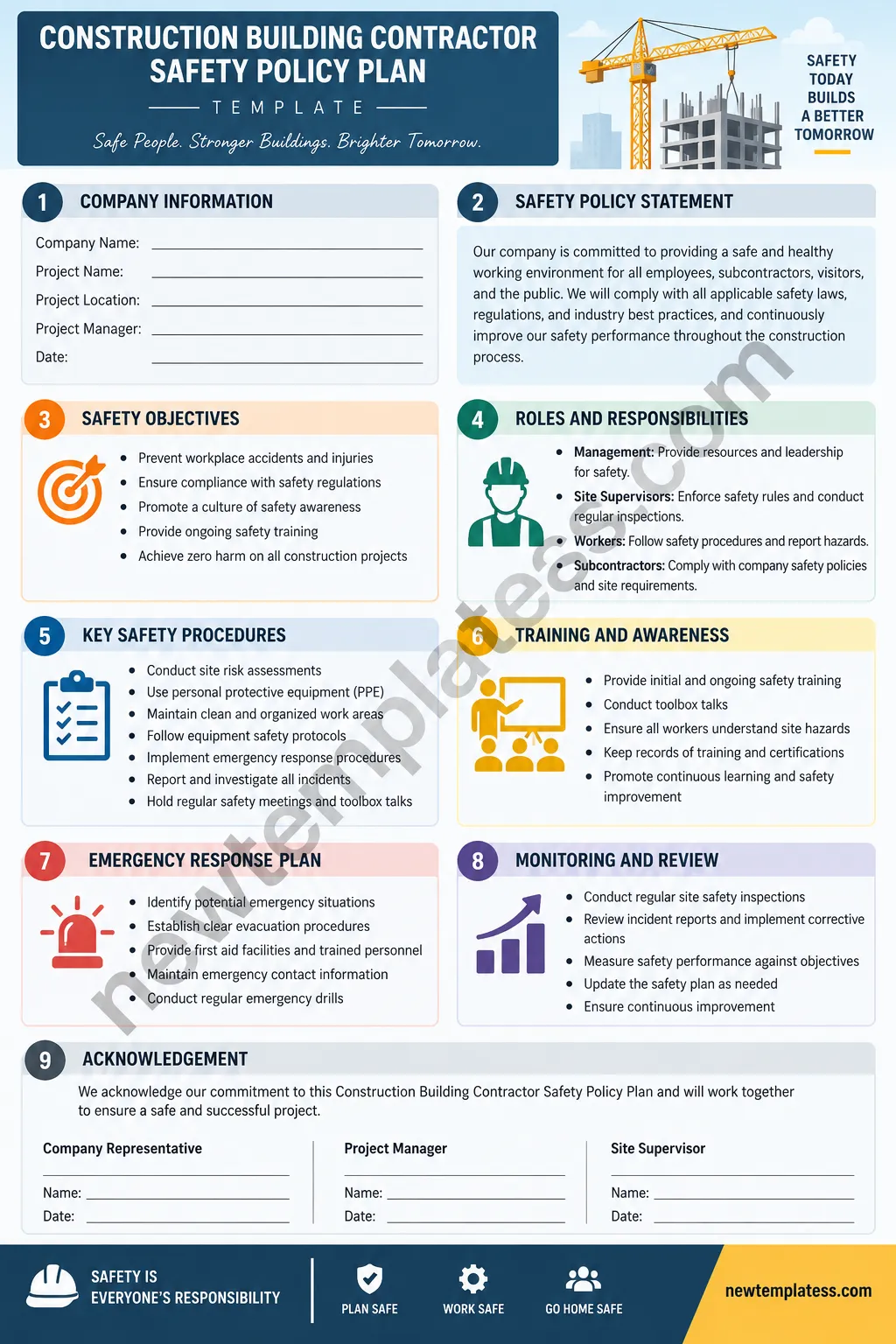
Emergency Response Planning
Every construction project should have procedures for responding to reasonably foreseeable emergencies. The emergency section should be easy for workers to understand and should reflect actual site conditions.
Depending on the project, emergency planning may address:
- Medical emergencies and serious injuries.
- Fire and evacuation.
- Severe weather.
- Electrical incidents.
- Equipment failures.
- Structural or excavation emergencies.
- Hazardous material releases.
- Communication and emergency contact procedures.
Post important emergency information where workers can easily see it. Emergency drills can also help identify gaps in communication, evacuation routes, access, and response procedures.
Incident Reporting and Corrective Action
Workers should know how to report injuries, near misses, property damage, unsafe conditions, and other incidents according to the project’s requirements. Prompt reporting allows supervisors to investigate what happened and determine whether corrective measures are needed.
An effective incident review should focus on identifying contributing factors and preventing recurrence. Corrective actions should have clear responsibilities and should be followed up to confirm that they have been completed.
Monitoring and Reviewing the Safety Plan
A construction safety policy should not remain unchanged throughout the entire project. Construction conditions evolve, and new activities may introduce new hazards.
Schedule regular safety inspections and review findings with relevant supervisors and workers. Consider updating the plan when:
- A new construction phase begins.
- Work methods or equipment change.
- A significant incident or near miss occurs.
- New hazards are identified.
- Project requirements change.
- Inspection findings reveal recurring problems.
Practical Tips for Creating an Effective Safety Policy
Keep the Document Easy to Use
A safety policy should be practical for real construction environments. Use clear headings, short sections, checklists, and straightforward language. Workers should be able to quickly locate essential information.
Customize the Plan for Each Project
A generic construction safety policy can provide a useful starting point, but every project has different hazards and operating conditions. Customize the document according to the building type, site layout, construction methods, equipment, workforce, subcontractors, and applicable requirements.
Communicate Changes Quickly
When the safety plan is updated, make sure affected workers and subcontractors receive the relevant information. Discuss significant changes during toolbox talks, site meetings, or other established communication channels.
Encourage Hazard Reporting
Workers are often the first people to notice changing site conditions. Encourage them to report hazards, near misses, and unsafe conditions without unnecessary barriers. A strong reporting process can help management identify issues before they result in an incident.
Construction Safety Policy Plan Checklist
Before approving a construction building contractor safety policy plan, check that it covers the project’s most important safety requirements.
- Company and project information is complete.
- Safety policy statement is clearly written.
- Safety objectives are defined.
- Management and worker responsibilities are assigned.
- Hazard identification procedures are included.
- PPE requirements are addressed.
- Equipment and machinery safety procedures are documented.
- Training requirements are explained.
- Emergency response procedures are available.
- Incident and hazard reporting procedures are established.
- Inspection and monitoring procedures are defined.
- Review and revision requirements are established.
- Responsible personnel have acknowledged the plan.
Conclusion
A well-prepared construction building contractor safety policy plan provides a practical foundation for managing safety throughout a construction project. It brings together responsibilities, hazard controls, training, emergency response, inspections, reporting, and continuous improvement in one organized framework.
The most effective safety plan is one that reflects the actual project and is actively communicated to the people performing the work. Use a clear template as a starting point, customize it for the site’s specific hazards and requirements, and review it regularly as construction activities change.
For contractors, project managers, and site supervisors, a well-organized safety policy can make safety expectations easier to communicate and easier to follow every day.
