An acquisitions transaction cost tracking Template is a structured way to record, classify, review, and reconcile the expenses associated with evaluating and completing a business acquisition. The strongest version is more than a list of invoices. It connects each cost to a deal, vendor, service category, timing, budget, accounting treatment, payment status, and supporting documentation so finance teams can see where money is going throughout the transaction.
Search interest around this subject often reflects a practical need: someone wants a spreadsheet structure that can handle legal fees, financial diligence, tax work, valuation, investment banking, regulatory costs, financing-related charges, integration spending, and miscellaneous deal expenses without losing control of the underlying records. A useful tracker should therefore work from the first indication of interest through diligence, signing, closing, and post-close review.
The accounting treatment of acquisition costs also makes disciplined tracking important. Under U.S. GAAP, acquisition-related costs for a business combination generally are recognized as expenses when the services are received, with costs associated with issuing debt or equity securities following other applicable guidance. Asset acquisitions can have different treatment, including capitalization of certain direct and incremental transaction costs. The classification of a deal therefore needs to be established before a tracker is used to determine its accounting outcome.

What an acquisitions transaction cost tracking Template should accomplish
The primary purpose of a transaction-cost tracker is to create one dependable record of deal-related spending. Instead of relying on scattered invoices, email approvals, accounting entries, and notes from advisers, the finance team can maintain a transaction register containing one row per cost item. Each row can identify the target, vendor, service, invoice reference, incurred date, expected amount, actual amount, responsible owner, and accounting classification.
A second purpose is budget control. Acquisition teams often begin with estimates before advisers have issued final invoices. A tracker can preserve the original estimate while separately recording revised forecasts and actual amounts. This makes it possible to identify unfavorable variances early rather than discovering them only when the transaction closes. A budget-to-actual view is particularly useful when several professional firms are working simultaneously.
The third purpose is auditability. A good tracker should let a reviewer move from a summarized category to the underlying transaction and supporting record. This means retaining invoice identifiers, service periods, purchase-order references where relevant, approval status, and notes about unusual charges. The objective is not merely to produce a total; it is to make the total explainable.

Separate deal economics from transaction expenses
One of the most important design choices is keeping the purchase consideration separate from acquisition-related expenses. The purchase price represents the consideration transferred for the acquired business, while transaction expenses represent costs incurred to execute the transaction. Combining these amounts can obscure both deal economics and accounting treatment.
For a business combination, ASC 805 guidance identifies categories such as finder fees, advisory fees, legal fees, accounting and valuation services, other professional services, and certain internal acquisition-related costs. These generally are recognized separately from the consideration transferred. Financing costs associated with issuing debt or equity securities require separate consideration under the relevant accounting literature.
A tracker should therefore contain a dedicated classification field rather than relying on the description of an invoice. For example, a legal invoice might contain both transaction advisory work and financing documentation. The finance team should determine whether the invoice needs to be split before posting it, rather than assuming the entire amount belongs to one accounting category.

Core fields to include in the tracking template
A practical tracker begins with identifying fields that remain stable across the life of the deal. Basic deal information can include acquiring entity, target entity, transaction name, internal deal code, transaction type, expected signing date, expected closing date, and reporting currency. These fields establish the context for every subsequent transaction record.
The transaction register should then capture the financial details. Useful fields include vendor, invoice number, invoice date, service period, cost category, description, original estimate, revised forecast, actual amount, tax, currency, exchange rate, and converted reporting amount. Adding a separate payment status helps distinguish an incurred expense from a paid expense, which is important during month-end reconciliation.
Control fields add another layer of reliability. Consider including purchase-order reference, responsible department, deal-stage classification, accounting classification, capitalization or expense indicator where relevant, approval status, payment date, supporting-document reference, and reviewer notes. The exact fields should reflect the company’s accounting policies and transaction workflow rather than blindly copying another spreadsheet.
- Deal identification: target, acquirer, deal code, transaction type, and reporting period.
- Vendor information: adviser, law firm, accounting firm, valuation specialist, lender, consultant, or other supplier.
- Cost classification: legal, financial advisory, accounting, tax, valuation, diligence, regulatory, financing, integration, or other categories.
- Financial fields: budget, forecast, actual amount, tax, currency, exchange rate, and variance.
- Control fields: invoice reference, approval status, payment status, accounting treatment, and supporting documentation.

How to organize acquisition transaction cost categories
Category design determines how useful the final analysis will be. If every invoice is assigned to a broad category called “professional services,” management may know the total but still lack visibility into which work is driving the cost. A more useful structure separates legal, financial advisory, accounting, tax, valuation, commercial diligence, operational diligence, regulatory, financing, insurance, travel, communications, and integration-related costs where those distinctions matter.
Legal costs may cover transaction documentation, negotiation, regulatory matters, intellectual property review, employment issues, contracts, and closing work. Financial advisory costs may include investment banking or other transaction advisers. Accounting and tax categories can capture financial diligence, tax diligence, purchase-accounting support, and related technical work. The categories should be sufficiently detailed for management review without becoming so granular that users cannot classify invoices consistently.
Another useful field is deal stage. A cost incurred during initial evaluation is different from a cost incurred during confirmatory diligence or closing. Stages such as screening, preliminary diligence, confirmatory diligence, negotiation, signing, closing, and post-close integration can reveal where spending accelerates. This can help management understand the cost profile of the transaction process even when the accounting treatment remains unchanged.

Use a consistent coding structure
Each category should have a short internal code or standardized label. For example, LEG can represent legal services, FIN can represent financial advisory, TAX can represent tax work, VAL can represent valuation, and DD can represent diligence. A controlled list reduces inconsistent descriptions such as “legal,” “lawyer,” “attorney,” and “legal adviser” being treated as unrelated categories.
Vendor names should also follow a consistent convention. The same firm should not appear under several spellings because of differences between invoices and internal records. A separate vendor reference field can help normalize the reporting name while preserving the original invoice description in another field.
If multiple currencies are involved, store both the original currency amount and the reporting-currency amount. Never overwrite the original value simply to make the report easier to read. Retaining the original transaction amount provides an audit trail and allows the finance team to explain exchange-rate effects separately from genuine spending changes.

Budget versus actual tracking for acquisition costs
A strong cost tracker should distinguish at least three financial views: the original approved budget, the latest forecast, and the actual amount incurred. The original budget should remain unchanged after approval so that management can later measure the quality of the initial estimate. The latest forecast can change as new information becomes available. Actuals should come from invoices or reliable accounting records rather than informal estimates.
Variance analysis can then be calculated at the line-item and category levels. A simple absolute variance is actual cost minus budget. A percentage variance can be calculated against budget when the denominator is meaningful. For example, a positive variance may indicate an amount above budget, while a negative variance may indicate spending below budget. The sign convention should be documented because different finance teams use different presentations.
Forecast-to-complete is equally important. Suppose a transaction has incurred several legal invoices but additional negotiation work remains. The tracker should not compare actual spending only with the original budget. It should also estimate remaining costs and produce an expected final total. This gives management a forward-looking view of the likely transaction cost before the closing date.

Handling invoices, accruals, and payment status
Transaction cost tracking should not be confused with cash tracking. An invoice can be incurred but unpaid, and services can be received before an invoice arrives. The tracker should therefore distinguish the service date or service period from the invoice date and payment date. This distinction becomes especially important around month-end and acquisition closing.
For accrued services, finance teams should follow their normal accounting process and use the tracker as supporting operational information. A row can show an estimated accrual, the expected vendor invoice, the period covered, and the eventual true-up. Once the invoice arrives, the original estimate should not simply disappear; the adjustment should remain understandable.
Payment status can be represented with controlled values such as pending approval, approved, scheduled, paid, disputed, or cancelled. These statuses make it easier for treasury and accounts-payable teams to identify outstanding obligations. They also prevent management from interpreting an unpaid amount as an unrecorded expense or assuming that every recorded cost has already been settled.

Due diligence costs and supporting records
Due diligence is often one of the largest groups of acquisition-related activities, but its costs can be spread across legal, financial, tax, commercial, technology, cybersecurity, operational, and human-resources specialists. A useful tracker can preserve the relationship between the cost and the underlying diligence work so that management can determine whether an unusual invoice relates to a specific workstream.
For each diligence cost, record the provider, workstream, service period, invoice reference, amount, and internal owner. If the engagement has a negotiated cap or fee structure, retain the relevant budget or fee ceiling separately. This allows the finance team to compare actual billing with the commercial terms of the adviser engagement rather than merely comparing the invoice with a generic budget.
Supporting documentation should be referenced without embedding sensitive material directly into the tracker unless company policy permits it. A document identifier, accounting-system reference, or controlled repository reference can provide a traceable path. The tracker should remain useful even when supporting records are stored elsewhere.

Link cost tracking to diligence milestones
Cost data becomes more informative when connected to transaction milestones. For example, management may want to see spending incurred before a preliminary indication, after signing a letter of intent, during confirmatory diligence, and immediately before closing. A milestone field makes these comparisons possible without changing the underlying accounting records.
A milestone field can also help explain unexpected spending. If legal costs rise sharply during a particular period, the tracker can show whether the increase coincided with contract renegotiation, regulatory review, financing changes, or another identifiable event. The result is a narrative that explains the numbers rather than merely displaying them.
For recurring acquisition programs, consistent milestone definitions make deals easier to compare. One transaction may be larger than another, so absolute cost alone is not always meaningful. Management can examine cost by stage, vendor, category, or transaction while keeping the definitions consistent across the portfolio.

Dashboard views that improve management reporting
The transaction register is the source record, but executives generally need a concise dashboard. A dashboard can show total budget, actual costs, forecast final cost, remaining forecast, variance, and the largest spending categories. Charts can then show the relationship between budget and actual amounts without requiring management to inspect individual invoices.
A category view is useful for identifying cost concentration. A timeline view can show how spending changes across the deal lifecycle. A vendor view can highlight which external advisers account for the largest portion of spending. A stage view can reveal whether most costs arise during diligence, negotiation, closing, or integration.
Dashboards should not replace the underlying register. Every summarized number should be traceable to detailed records. If a dashboard shows an unexpected variance, the reviewer should be able to move from the summary category to the relevant transaction rows and supporting records without rebuilding the calculation manually.

Choose charts that answer specific questions
A bar chart is effective for comparing budget and actual costs by category. A line chart can show spending by month. A stacked chart can show how several cost categories contribute to total spending over time. A variance chart can focus attention on categories where actual costs differ materially from expectations.
Visual design should remain secondary to data integrity. Too many charts can make a finance dashboard harder to interpret. The best dashboard usually contains a small number of clearly labeled views that answer recurring management questions such as “What have we spent?”, “What remains?”, “Where are we above budget?”, and “Which vendors or workstreams require review?”
Dashboard calculations should also be protected from accidental edits where the spreadsheet system supports cell protection. Input fields should be visually distinct from calculated fields, and formulas should use consistent references. This reduces the risk that a user changes a calculation while updating a transaction record.

Spreadsheet design for Excel and Google Sheets
An Excel-oriented tracker can use separate worksheets for setup, transaction records, category definitions, vendor information, dashboard reporting, and reconciliation. This structure prevents the main transaction register from becoming overloaded with formulas and reference lists. A setup sheet can contain standardized categories and status values used by validation controls.
A Google Sheets version can follow the same logical structure. The important distinction is not the brand of spreadsheet software but the quality of the data model. Both environments can support structured rows, formulas, validation lists, filtering, charts, and collaborative review. The design should therefore focus first on data integrity and reporting requirements rather than on a particular platform.
When selecting between spreadsheet formats, consider the number of transactions, number of users, review controls, sensitivity of the information, collaboration requirements, and integration with the accounting system. A simple single-deal tracker may require only a few worksheets, while a portfolio-level M&A process may need stronger governance and more controlled data architecture.

Accounting considerations under acquisition accounting
Transaction-cost tracking and acquisition accounting are related but should not be treated as the same process. The tracker records the commercial and operational details of costs. The accounting team determines the appropriate recognition based on the transaction structure, applicable accounting framework, and nature of each cost.
For a business combination under U.S. GAAP, acquisition-related costs are generally expensed in the periods in which the costs are incurred and services are received, except for costs associated with issuing debt or equity securities, which follow other applicable guidance. This is why a tracker should include an accounting-treatment field and not assume that every acquisition-related payment becomes part of the purchase price.
Asset acquisitions require a different analysis. Under ASC 805-50, certain direct and incremental transaction costs can be included in the cost of an asset acquisition, while indirect costs are treated differently. The distinction between acquiring a business and acquiring an asset or group of assets can therefore materially affect the treatment of transaction costs.
Debt and equity issuance costs need separate treatment
Financing costs deserve a separate field because they can follow accounting guidance different from ordinary advisory or diligence costs. Costs associated with issuing debt or equity securities are not simply grouped with legal or consulting expenses when determining the accounting treatment of a business combination.
The tracker can distinguish financing-related charges by instrument, lender or underwriter, issuance date, amount, and accounting treatment. This helps the finance team reconcile the transaction-cost register with debt and equity records without losing the connection to the acquisition.
This separation also improves management reporting. Executives may want to know the cost of executing the acquisition itself separately from the cost of financing the consideration. Keeping these categories distinct makes both views possible without maintaining duplicate records.

Common mistakes when tracking acquisition costs
One common mistake is recording costs only when cash leaves the bank. That approach misses accrued services and makes period reporting difficult. The tracker should record when services are received and separately record when invoices are paid, allowing the accounting process to handle accruals and settlements appropriately.
Another mistake is overwriting the original budget whenever an estimate changes. Doing so eliminates the ability to measure how the deal performed against the initial expectation. Preserve the original approved budget and maintain a separate latest forecast field so management can distinguish planning changes from genuine overspending.
A third mistake is using vague categories. A tracker in which every transaction is labeled “M&A expense” cannot support meaningful analysis. Categories should reflect the actual services and management questions relevant to the deal, while a standardized category list should prevent users from inventing slightly different labels for the same type of cost.

Practical Solution
Start by creating one master transaction register for each deal or one controlled portfolio register if several acquisitions are managed together. Establish the deal identifier, reporting currency, category list, vendor list, stage definitions, and status values before entering financial records. This prevents inconsistent data from appearing during the most active part of the transaction.
Next, create the financial control fields: original budget, latest forecast, actual amount, variance, and forecast remaining. Add accounting classification and payment status as separate fields. Require each transaction to have a supporting reference, such as an invoice number or approved accrual reference. Reconcile the tracker regularly against the general ledger and accounts-payable records so that the spreadsheet does not become a separate, outdated version of the financial truth.
Finally, build a compact management dashboard that summarizes total cost, budget variance, forecast final cost, category concentration, and spending by transaction stage. Review the dashboard at a consistent cadence during active deals and perform a final reconciliation after closing. Retain the original budget, revisions, actuals, and explanations of material variances so the final record can support accounting review, internal controls, management reporting, and lessons learned for future acquisitions.

A practical workflow from setup to close
During setup, define the deal code, reporting currency, cost categories, vendors, owners, and approval rules. During diligence, enter commitments and expected costs as forecasts while recording invoices and accruals as they arise. During negotiation and closing, increase the review frequency because legal, advisory, financing, and regulatory costs may change quickly.
After closing, reconcile every material open item. Compare actual spending with the original budget and latest forecast. Investigate unexplained differences rather than simply accepting them. Confirm that financing-related costs and acquisition-related expenses have been classified according to the applicable accounting guidance and company policy.
For recurring acquisitions, archive the completed deal in a standardized format and use its category structure to improve future estimates. Historical data can help management understand which categories consistently vary from early estimates, which adviser engagements tend to exceed expected scope, and which transaction stages create the greatest administrative workload.

How to evaluate a template before using it
A template is suitable only when its structure matches the transaction workflow. Check whether it separates budget, forecast, and actual amounts; whether it supports multiple vendors and categories; whether it can distinguish incurred and paid amounts; and whether it provides enough fields for accounting classification. A visually attractive worksheet can still be unsuitable if it lacks these controls.
Also examine whether formulas are transparent. A reviewer should understand how totals and variances are calculated. Avoid models where important totals depend on hidden logic that only one person understands. Clear formulas, controlled inputs, and documented assumptions are more valuable than elaborate visual effects.
Finally, consider scalability. A small acquisition may involve a few dozen cost lines, while a complex transaction can produce hundreds of invoices and accrual entries. The chosen structure should remain usable as transaction volume increases. If the tracker becomes difficult to filter, reconcile, or review, it may be time to move the detailed transaction record into a more controlled financial system while retaining the dashboard for management reporting.

Using reporting views for decision support
Transaction-cost reporting can support decisions beyond bookkeeping. During an active acquisition, management can use the tracker to identify whether professional fees are approaching agreed limits, whether diligence spending is aligned with transaction progress, and whether unexpected costs require approval or renegotiation.
After the transaction, the same data can support post-deal review. Comparing estimated and actual costs helps determine whether the original transaction budget was realistic. Reviewing costs by adviser and workstream can also reveal where scope definitions or engagement controls could be improved in future deals.
The most useful reporting view is therefore not necessarily the most detailed one. A senior reviewer may need five or six key measures, while the finance team needs transaction-level records. A well-designed model serves both audiences by keeping detailed records underneath concise, traceable management summaries.

Reference Examples
An acquisitions transaction cost tracking Template is easiest to understand when viewed as a structured financial control document rather than as a simple spreadsheet. Useful visual references typically show a transaction register, cost categories, budget and actual columns, variance calculations, monthly reporting, and summary dashboards. These elements illustrate how detailed records can feed management reporting without mixing the purchase consideration with the costs of executing the transaction. They also demonstrate why consistent categories, clear input fields, and calculated totals matter when several advisers and internal departments contribute costs during the same acquisition.
The following visual references show related acquisition-cost, diligence, deal-structuring, integration, and financial-transaction layouts. They can help readers compare different ways of organizing fields, dashboards, cost categories, milestones, and reporting views around an acquisitions transaction cost tracking Template. The examples should be treated as design references rather than accounting instructions: the appropriate categories, formulas, controls, and recognition decisions depend on the transaction structure, accounting framework, company policy, and the nature of each underlying cost.

Finance Mergers & Acquisitions Cost-Benefit Analysis Template
Source: Template.net

Finance Mergers & Acquisitions Deal Structuring Template
Source: Template.net

Finance Mergers & Acquisitions Deal Structuring Template Anatomy
Source: Template.net

Finance Mergers & Acquisitions Synergy Realization Monitoring Template
Source: Template.net

Finance Mergers & Acquisitions Synergy Realization Monitoring Template Setup
Source: Template.net

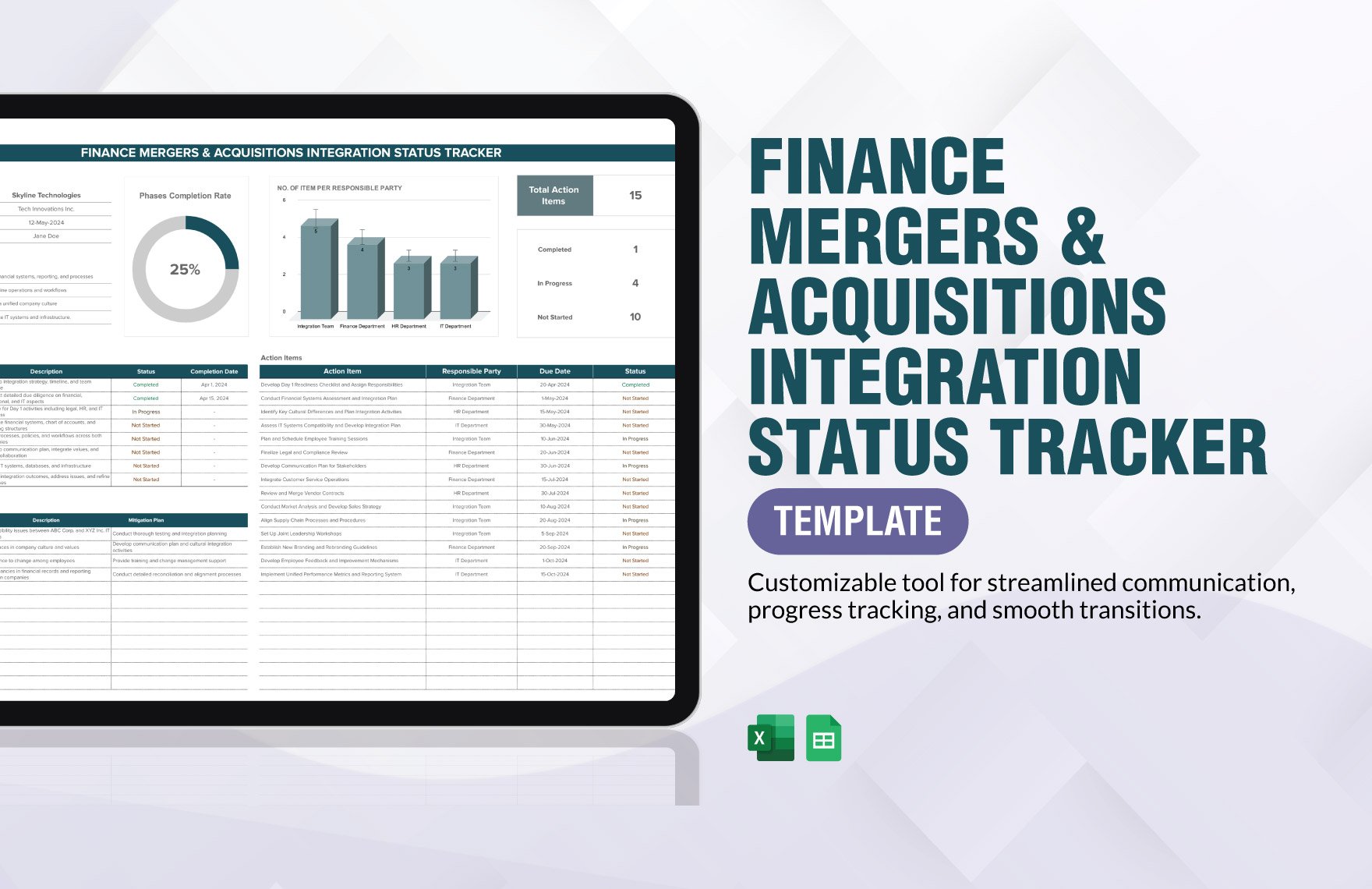
Finance Mergers & Acquisitions Integration Status Tracker Template
Source: Template.net

Finance Mergers & Acquisitions Integration Status Tracker Benefits and Functions
Source: Template.net

Finance Mergers & Acquisitions Acquisition Cost Analysis Template
Source: Template.net

Financial Transactions Recording Template
Source: Template.net
