A short term rental analysis calculator helps property owners and investors estimate whether a vacation rental or Airbnb-style property can generate enough income to justify its costs. Instead of relying on optimistic nightly-rate estimates, you can use a structured analysis to examine revenue, occupancy, operating expenses, financing, cash flow, and potential returns.
Whether you are considering your first vacation rental or comparing several properties, a consistent calculation method makes it easier to understand the numbers. The goal is not simply to estimate revenue. It is to determine how the property may perform under realistic assumptions and identify which variables have the greatest effect on profitability.
What Is a Short Term Rental Analysis Calculator?
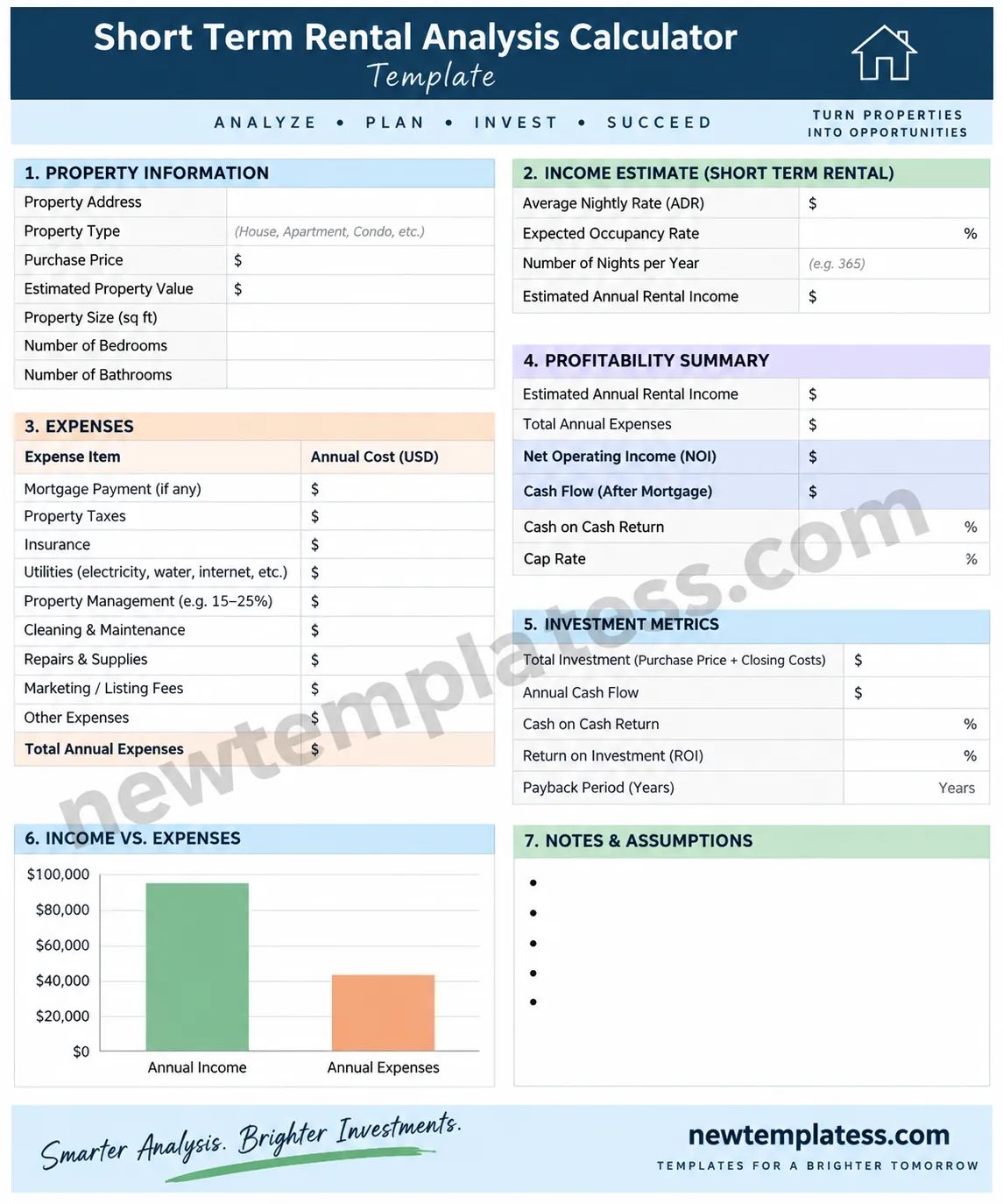
A short term rental analysis calculator is a financial planning tool designed to estimate the potential performance of a property rented for short stays. It typically combines information such as purchase price, average daily rate, occupancy, cleaning costs, management fees, utilities, taxes, insurance, financing, and other operating expenses.
A useful calculator can help you estimate several important metrics, including:
- Estimated annual rental income
- Total annual operating expenses
- Net operating income (NOI)
- Annual cash flow
- Cash-on-cash return
- Return on investment (ROI)
- Capitalization rate (cap rate)
- Estimated payback period
These figures give you a clearer picture of how a property could perform before you commit significant capital.
Why Short Term Rental Analysis Matters
Short term rentals can have attractive revenue potential, but their financial performance can change substantially from one property to another. A property with a high nightly rate may not produce strong cash flow if occupancy is low or expenses are unusually high.
Likewise, a property with a lower nightly rate may perform well if it has consistent demand, manageable operating costs, and a reasonable acquisition price.
Look Beyond Gross Rental Revenue
Gross rental revenue is only the starting point. A realistic analysis should account for expenses that reduce the amount available to the owner.
Common costs include:
- Mortgage payments or other financing costs
- Property taxes
- Insurance
- Electricity, water, gas, and internet
- Cleaning and turnover expenses
- Property management fees
- Repairs and maintenance
- Furniture and replacement items
- Platform and payment processing fees
- Licensing or permit costs
- Supplies and consumables
- Marketing and professional services
Including these expenses can make your rental property analysis much more realistic.
How to Use a Short Term Rental Analysis Calculator
The process is straightforward when you work through the numbers in a logical order.
1. Enter the Property Information
Start with the basic property details. Record the purchase price, estimated property value, property type, size, bedrooms, bathrooms, and expected closing or acquisition costs.
If you are comparing properties, use the same categories for every property. Consistent inputs make the final comparison much easier.
2. Estimate the Average Daily Rate
The average daily rate (ADR) represents the average amount charged for an occupied night. Your estimate should be based on comparable short term rentals, property characteristics, seasonality, location, amenities, and local demand.
Avoid assuming that the highest advertised nightly rate is achievable throughout the year. A property may command different rates during holidays, weekends, peak seasons, and slower periods.
3. Estimate Occupancy
Occupancy is one of the most important assumptions in a vacation rental calculator. It represents the percentage of available nights that are booked.
For example, if a property is available for 365 nights and you estimate 70% occupancy, the expected number of booked nights would be approximately:
365 × 70% = 255.5 booked nights
Use local market data and comparable properties when developing your assumption. It can also be useful to model conservative, base, and optimistic scenarios rather than relying on one occupancy estimate.
4. Calculate Estimated Rental Income
A basic annual revenue calculation can be expressed as:
Estimated Annual Rental Income = Average Daily Rate × Available Nights × Occupancy Rate
For example, an ADR of $180 with an estimated 70% occupancy over 365 days would produce approximately $45,990 in gross room revenue before expenses and applicable taxes or fees.
5. Add Operating Expenses
Next, enter your expected annual expenses. Separate fixed expenses from variable expenses where possible.
Fixed expenses may include property taxes, insurance, certain subscriptions, and some financing costs. Variable expenses can include cleaning, utilities, maintenance, supplies, and platform-related charges.
For short term rentals, turnover costs deserve special attention because frequent guest stays can create significantly more cleaning, linen, supply, and maintenance activity than a traditional long-term lease.
Key Metrics to Review
Net Operating Income
Net Operating Income (NOI) measures property income after operating expenses but generally before debt service and income taxes.
NOI = Gross Operating Income − Operating Expenses
NOI is useful because it focuses on the property’s operating performance without making the result dependent on a particular financing structure.
Cash Flow
Cash flow measures the amount remaining after operating expenses and applicable financing payments.
Cash Flow = Rental Income − Operating Expenses − Debt Service
A positive result indicates that the modeled property generates more cash than the expenses included in the calculation. A negative result indicates that additional cash would be required under those assumptions.
Cash-on-Cash Return
Cash-on-cash return compares annual cash flow with the cash invested in the property.
Cash-on-Cash Return = Annual Pre-Tax Cash Flow ÷ Total Cash Invested × 100
This metric can be particularly useful when comparing properties that require different amounts of upfront capital.
Capitalization Rate
The capitalization rate is commonly calculated by dividing NOI by the property’s value or purchase price, depending on the analysis.
Cap Rate = NOI ÷ Property Value × 100
Because cap rate does not directly account for financing, it can provide a useful view of operating performance independent of the mortgage structure.
Build Conservative, Base, and Optimistic Scenarios
One of the most useful features of a short term rental investment calculator is the ability to test multiple assumptions.
Conservative Scenario
Use a lower occupancy rate, moderate nightly rates, and higher-than-average operating costs. This scenario helps you understand how the property might perform under less favorable conditions.
Base Scenario
Use your best-supported estimates based on comparable properties, market conditions, expected expenses, and realistic operating assumptions.
Optimistic Scenario
Use stronger occupancy and pricing assumptions, while still keeping the scenario within a plausible range. Avoid using unusually high revenue figures simply to make a property appear attractive.
Comparing these scenarios can reveal whether the investment depends heavily on one aggressive assumption.
Important Costs That Investors Often Miss
A rental analysis becomes less useful when important expenses are left out. Before relying on your projected cash flow, review the following items carefully:
- Vacancy: Not every night will be booked.
- Cleaning: Frequent turnovers can create substantial costs.
- Maintenance: Guest usage may increase wear and tear.
- Furniture: Beds, seating, appliances, and décor eventually require replacement.
- Utilities: Short term rentals commonly include utilities in the guest experience.
- Management: Professional management can materially affect net income.
- Platform fees: Booking and payment-related charges should be included when applicable.
- Licensing: Local permits, registration, or compliance costs may apply.
- Taxes: Property, lodging, income, and other applicable taxes should be reviewed separately.
- Capital expenditures: Major replacements should be considered even if they do not occur every year.
Practical Tips for Better Rental Property Analysis
Use Comparable Properties
Research similar properties in the same market. Compare bedrooms, bathrooms, amenities, location, guest capacity, reviews, pricing, and apparent seasonality.
Test Your Break-Even Occupancy
Calculate how much occupancy is required to cover your expected expenses. This can help you understand how sensitive the property is to changes in demand.
Separate Revenue From Profit
A high projected annual revenue number does not automatically mean a strong investment. Always move from gross revenue to operating expenses, NOI, debt service, and cash flow.
Update Your Analysis Regularly
Rental markets change. Cleaning costs, insurance, taxes, interest rates, regulations, nightly rates, and occupancy can all change over time. Revisit your assumptions instead of treating your original spreadsheet as permanent.
Short Term Rental Calculator vs. Long Term Rental Analysis
Short term and long term rentals require different assumptions. A long-term rental often has fewer tenant turnovers and more predictable monthly rent, while a short-term rental may have more variable pricing, occupancy, cleaning costs, and operating demands.
For a short term rental, your analysis should therefore pay particular attention to daily pricing, booking frequency, seasonality, turnover costs, guest-related expenses, and management requirements.
What a Good Rental Analysis Should Tell You
A useful analysis should help answer practical questions rather than produce a single attractive number.
-
- What revenue could the property generate under realistic assumptions?
- What are the largest operating expenses?
- How much cash could remain after expenses and financing?
- How sensitive is the property to lower occupancy?
- How much cash is required upfront?
- Which assumptions have the greatest impact on profitability?
- What level of occupancy is required to reach break-even?
If you cannot explain where the major numbers come from, the analysis probably needs more research before you rely on it.
Conclusion
A short term rental analysis calculator provides a structured way to evaluate the financial potential of a vacation rental. By combining realistic nightly rates, occupancy assumptions, operating expenses, financing costs, and investment metrics, you can build a clearer picture of how a property may perform.
The most useful approach is to treat the calculator as a decision-support tool rather than a guarantee of future results. Use comparable market data, account for overlooked expenses, test multiple scenarios, and update the analysis as your information improves.
With a disciplined approach to rental property analysis, you can move beyond headline revenue estimates and understand the numbers that actually drive short term rental performance.
