Managing intellectual property can become complicated when patents, trademarks, copyrights, licensing agreements, and royalty payments are spread across multiple products, markets, and business partners. An intellectual property royalty management system provides a structured way to organize these assets, monitor licensing terms, calculate royalty obligations, and track payments.
For businesses that generate revenue from intellectual property, effective royalty management is more than an accounting task. It helps teams understand which assets generate income, whether licensees are meeting their obligations, and when agreements require review or renewal. A well-organized system can also reduce administrative errors and make important information easier to access.
This guide explains what an intellectual property royalty management system is, what information it should contain, how to use a royalty tracking template, and practical steps for improving intellectual property revenue management.
What Is an Intellectual Property Royalty Management System?
An intellectual property royalty management system is a process or software-based solution used to manage intellectual property licensing agreements and the royalties associated with them. It brings important information into one organized framework so businesses can track assets, contracts, sales data, royalty calculations, payments, and compliance requirements.
Intellectual property royalties may be generated from patents, copyrighted content, trademarks, technology licenses, software, designs, formulas, or other protected assets. Depending on the agreement, royalties may be calculated as a percentage of sales, a fixed amount per unit, a minimum guaranteed payment, or another agreed formula.
A centralized management system helps connect the intellectual property asset with its licensing agreement and related financial activity.
Why Intellectual Property Royalty Management Matters
Royalty arrangements often involve detailed contractual terms. Without a consistent tracking process, businesses can overlook payment dates, renewal deadlines, reporting requirements, or changes in royalty rates.
An effective intellectual property royalty management system can help organizations:
- Maintain accurate records of intellectual property assets.
- Organize licensing agreements and key contract terms.
- Track royalty rates and calculation methods.
- Monitor royalty payments and outstanding balances.
- Identify upcoming contract renewals and important deadlines.
- Compare revenue performance across assets and markets.
- Improve communication between legal, finance, sales, and licensing teams.
- Create a clearer audit trail for royalty-related transactions.
The goal is not simply to record payments. A useful system should make it easier to understand the financial and operational performance of an intellectual property portfolio.
Key Components of an Intellectual Property Royalty Management System
1. Intellectual Property Asset Information
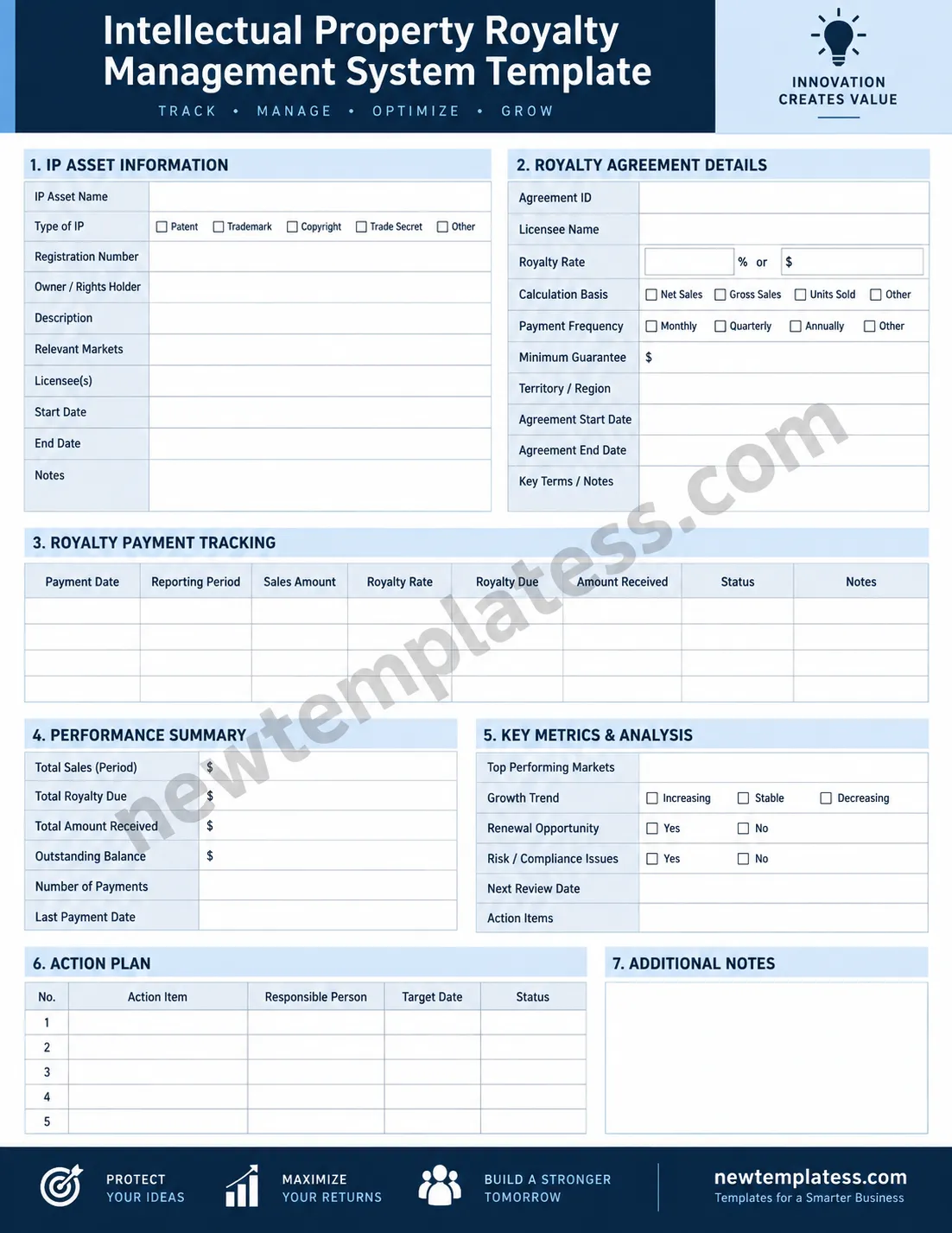
The first section should identify the intellectual property being managed. Useful fields include the asset name, IP type, registration number, rights holder, description, relevant markets, licensees, and important dates.
Common IP categories include patents, trademarks, copyrights, trade secrets, software, and proprietary technologies. Keeping these records together makes it easier to connect each asset with its licensing and financial information.
2. Royalty Agreement Details
Every licensing agreement should have a clear record containing its essential commercial terms. Depending on the agreement, this may include the licensee, royalty rate, calculation basis, payment frequency, minimum guarantee, territory, agreement dates, and special conditions.
Recording these details in a consistent format reduces the need to repeatedly search through contracts when preparing royalty reports or reviewing payments.
3. Royalty Payment Tracking
Payment tracking is a central part of royalty administration. A royalty payment log can record the payment date, reporting period, sales amount, applicable royalty rate, royalty due, amount received, payment status, and notes.
This information helps finance teams identify unpaid amounts and compare reported royalties against contractual expectations.
4. Performance and Revenue Analysis
A royalty management system becomes more useful when it goes beyond basic record keeping. Performance data can show which intellectual property assets generate the most revenue and which markets or licensees contribute to overall royalty income.
Useful metrics may include total sales, total royalties due, total royalties received, outstanding balances, number of payments, growth trends, and renewal opportunities.
5. Compliance and Review Tracking
Licensing agreements may contain reporting, payment, audit, territory, product, or usage requirements. A management system can provide a central place to note potential compliance issues and upcoming reviews.
Businesses should still consult the underlying agreements and appropriate legal or financial professionals when interpreting contractual obligations. A tracking template is an organizational tool, not a substitute for professional advice.
How to Use an Intellectual Property Royalty Management Template
A template can be a practical starting point for businesses that need a simple royalty tracking workflow without immediately implementing specialized software. The key is to keep information consistent and update it regularly.
Step 1: List Your Intellectual Property Assets
Start by creating a complete inventory of the intellectual property included in the royalty program. Assign each asset a clear name or internal identifier and record its ownership and registration information.
Step 2: Connect Each Asset to Its License Agreement
For every licensed asset, record the relevant agreement details. Include the licensee, effective dates, territory, royalty rate, payment schedule, minimum guarantees, and other important commercial terms.
Step 3: Establish a Royalty Calculation Process
Document how royalties are calculated. For example, an agreement may apply a percentage to net sales or use a fixed amount per unit sold. The calculation basis should be clearly recorded so that reported royalties can be reviewed consistently.
Step 4: Record Payments as They Occur
Update the payment tracking section whenever a royalty report or payment is received. Record both the amount expected and the amount actually received when applicable. This makes outstanding balances easier to identify.
Step 5: Review Performance Regularly
Set a regular review schedule for royalty performance. Monthly, quarterly, or annual reviews can help identify changes in revenue, payment patterns, market performance, or agreement status.
Step 6: Track Follow-Up Actions
Use an action list to record unresolved questions, missing reports, payment issues, renewal discussions, compliance reviews, or other tasks. Assign responsible people and target dates to improve accountability.
Practical Tips for Better Royalty Management
- Use consistent naming: Give every IP asset and agreement a unique identifier.
- Keep contract terms accessible: Record key commercial terms while maintaining access to the full agreement for detailed review.
- Separate expected and received amounts: This makes outstanding royalties easier to detect.
- Set renewal reminders: Review agreements before important expiration or renewal dates.
- Document calculation methods: Clearly identify whether royalties are based on net sales, gross sales, units, or another measure.
- Review unusual changes: Significant increases or decreases in royalty revenue may warrant further investigation.
- Limit unnecessary data duplication: Keep a reliable source of truth and define who is responsible for updates.
- Protect confidential information: Licensing agreements and financial data should be handled according to your organization’s security policies.
Spreadsheet vs. Dedicated Royalty Management Software
A spreadsheet-based intellectual property royalty management system can work well for a small portfolio with relatively straightforward agreements. It is inexpensive, flexible, and easy to customize.
However, larger portfolios may require dedicated royalty management software. A specialized platform can provide automated calculations, workflow management, reporting, integrations, audit trails, notifications, and centralized access controls.
When deciding between a template and dedicated software, consider the number of intellectual property assets, number of licensees, complexity of royalty formulas, reporting frequency, number of users, audit requirements, and volume of financial transactions.
Common Royalty Management Challenges
Incomplete Contract Information
Missing royalty rates, territories, reporting periods, or payment terms can make accurate tracking difficult. Establishing a standardized agreement summary can reduce this problem.
Manual Calculation Errors
Complex royalty formulas can create errors when calculations are performed manually. For higher-volume programs, consider controlled spreadsheet formulas or dedicated software with appropriate validation.
Late or Missing Reports
Licensees may have contractual reporting obligations. A tracking system can help teams identify missing reports and follow up according to the applicable agreement.
Disconnected Teams
Legal, finance, licensing, and sales teams may each hold different pieces of information. A centralized royalty management process can make responsibilities and data ownership clearer.
What to Look for in a Royalty Tracking Template
A useful royalty tracking template should be easy to understand and flexible enough to accommodate different licensing arrangements. Look for sections covering IP asset information, agreement details, payment tracking, performance metrics, action items, and notes.
The template should also make it easy to answer practical questions such as:
- Which intellectual property assets are currently licensed?
- Which licensees are associated with each asset?
- What royalty rate applies?
- When is the next payment or report due?
- How much royalty income is outstanding?
- Which agreements are approaching renewal?
- Are there unresolved compliance or reporting issues?
Conclusion
An intellectual property royalty management system provides a structured approach to organizing IP assets, licensing agreements, royalty calculations, payments, and performance information. Whether you manage a small number of licenses or a larger intellectual property portfolio, consistent tracking can make royalty administration easier to understand and review.
A well-designed template is a practical starting point for creating that structure. By recording essential agreement terms, monitoring payments, reviewing performance, and assigning follow-up actions, businesses can build a clearer process for managing intellectual property revenue.
The most effective system is one that matches the complexity of the portfolio and is updated consistently. As the number and complexity of licensing relationships grow, organizations can also evaluate whether dedicated royalty management software would provide additional automation, reporting, and control.
