A strong security technician resume Template should make technical capability easy to understand within a short review. Security technicians may work with CCTV, access control, intrusion detection, alarm systems, fire alarm equipment, low-voltage wiring, networking, system testing, maintenance, documentation, and customer support. Because the role combines hands-on technical work with communication and problem-solving, a resume needs to show both what systems a candidate understands and how that knowledge has been used in real work.
Current resume guidance for security technician roles consistently emphasizes clear professional summaries, relevant technical skills, work history, education or credentials, and evidence of troubleshooting and system maintenance. Security technician duties commonly include installing, configuring, maintaining, diagnosing, and repairing security equipment.
The best format is therefore not simply a visually attractive page. It should organize technical information so a recruiter or hiring manager can quickly recognize the candidate’s specialization. A clean structure also helps automated resume screening systems interpret familiar headings and technical terms. A reverse-chronological structure is often useful when the candidate has a consistent work history, while a combination structure can help career changers emphasize transferable technical abilities.

What a Security Technician Resume Needs to Communicate
The first purpose of the resume is to establish professional identity. The headline should make the target position obvious, such as Security Technician, Security Systems Technician, CCTV Technician, Electronic Security Technician, or another title that genuinely matches the candidate’s background. Using a familiar job title can make the document easier to interpret, particularly when the employer uses similar terminology in the vacancy description.
The professional summary should then connect experience with technical specialization. Instead of saying only that a candidate is hardworking or reliable, the summary can mention years of experience, system categories, troubleshooting capability, installation work, maintenance, and customer-facing responsibilities. A concise summary gives the reader a reason to continue into the detailed work history.
The work history should demonstrate practical responsibility. Strong entries explain what the technician installed, configured, tested, repaired, inspected, documented, or maintained. When genuine measurements exist, they can add useful evidence, such as the number of sites supported, systems maintained, service calls handled, installations completed, or downtime reduced. Hypothetical numbers should never be presented as real achievements.
Technical vocabulary should be specific enough to demonstrate competence without turning the document into a disconnected keyword list. Examples include CCTV, IP cameras, access control, intrusion detection, alarm systems, fire alarms, low-voltage wiring, networking, system configuration, diagnostics, preventive maintenance, technical documentation, and remote monitoring. These are recurring terms in security technician role descriptions and resume guidance.
A useful resume also separates technical skills from personal strengths. Technical skills can describe systems, tools, protocols, equipment, and diagnostic methods. Professional strengths can describe communication, attention to detail, customer service, teamwork, planning, adaptability, and problem-solving. Keeping these categories clear prevents the skills section from becoming too broad.
The document should also be honest about the level of expertise. A technician who has only assisted with CCTV installation should not describe that experience as advanced system engineering. Likewise, a candidate who has configured IP cameras but has not managed complex network infrastructure should avoid claiming deep network administration expertise. Accuracy improves credibility and gives interviewers a realistic basis for technical questions.
Choosing the Right Resume Structure
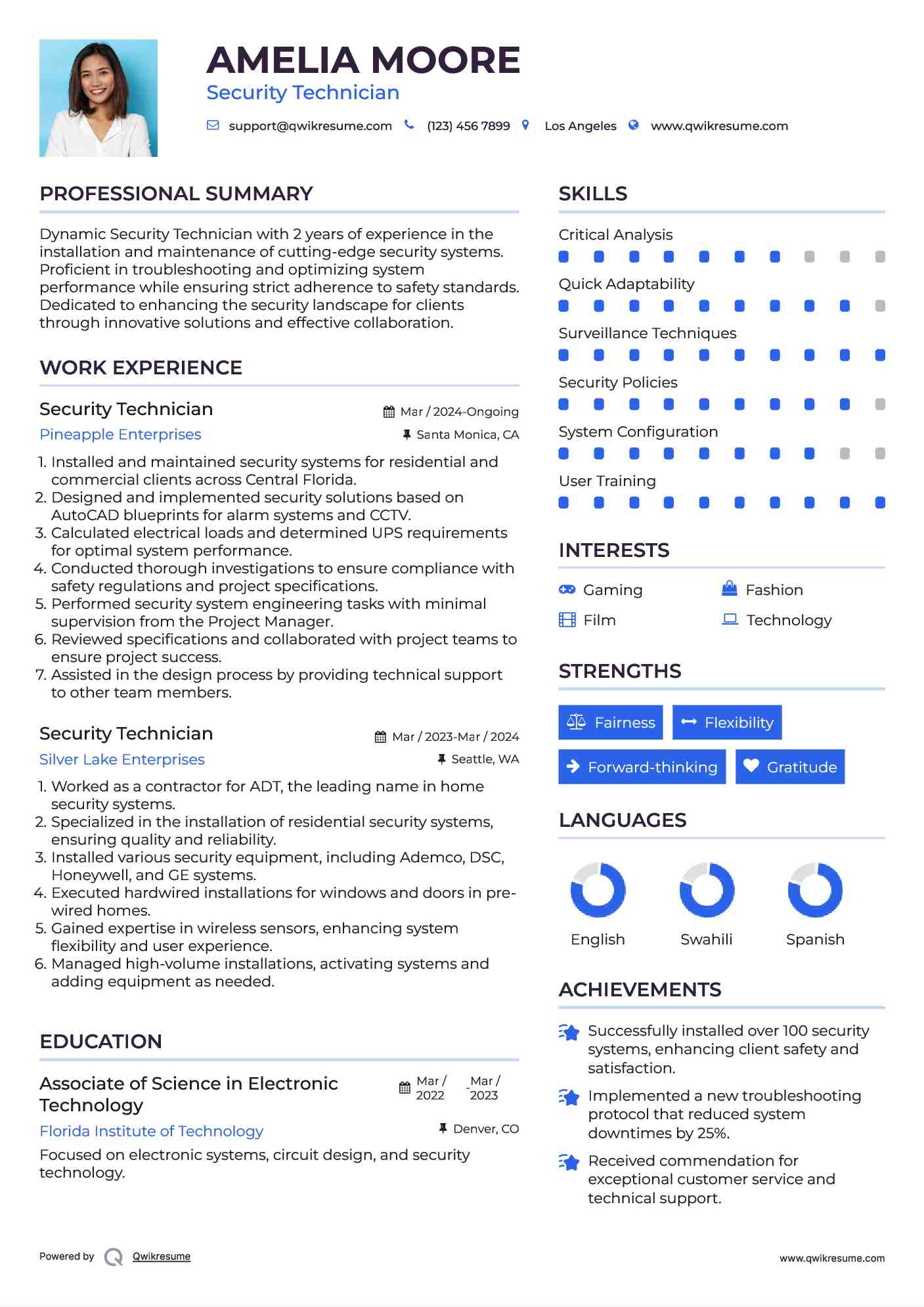
A reverse-chronological format is generally effective for experienced technicians because it places the most recent and relevant employment first. Each position can include the job title, employer, location where useful, dates, and several concise achievement-oriented bullets. This structure lets the reader follow the candidate’s development from earlier technical responsibilities toward more advanced assignments.
A combination format can work better when the candidate has experience in electrical work, telecommunications, IT support, facilities maintenance, or another technical field before moving into security systems. The upper portion can emphasize relevant capabilities, followed by employment history that demonstrates how those capabilities were developed. This approach is useful when the job titles in earlier positions do not fully represent the security-related work performed.
A simple single-column layout is often a sensible choice when compatibility with automated screening is important. Clear headings such as Professional Summary, Skills, Experience, Education, Certifications, and Projects are easy for both software and human readers to interpret. Complex decorative graphics can consume valuable space without adding evidence of technical ability.

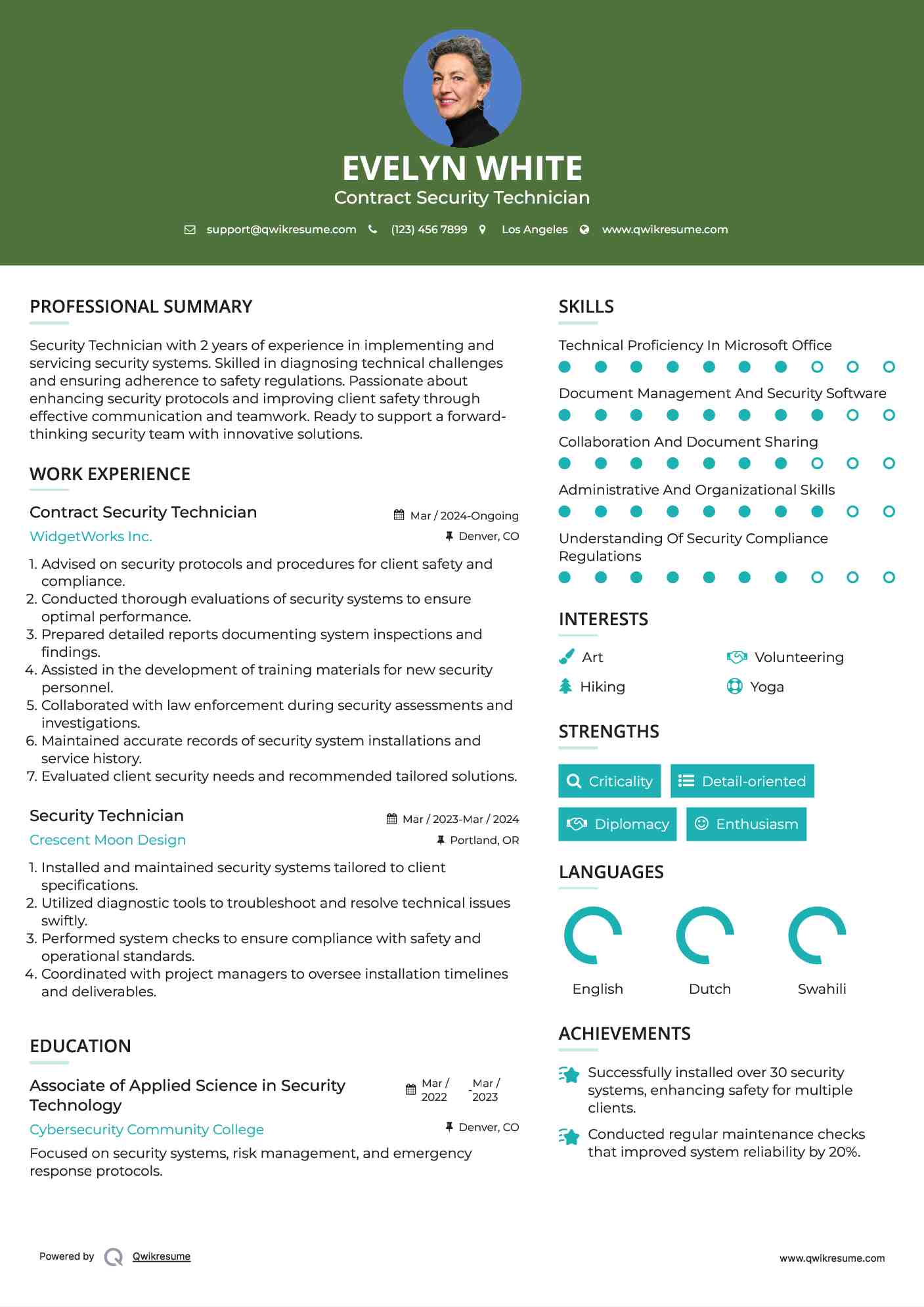
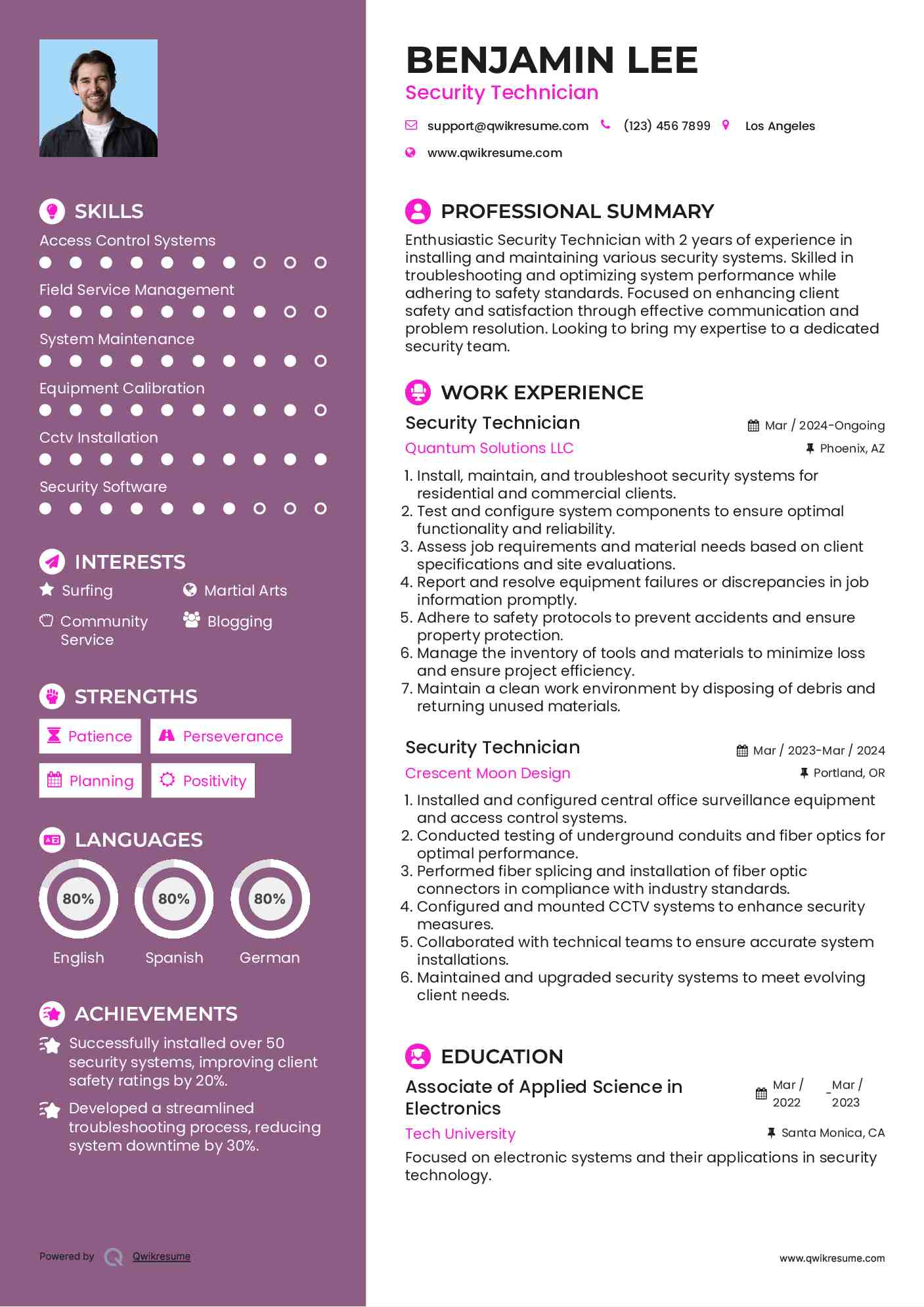
Visual examples show that two-column designs can also present information effectively when the sections remain legible. A sidebar can hold skills and supporting information while the main column carries the summary and employment history. However, candidates should test the text extraction of a visually complex resume before relying on it for online submissions.
For a security technician resume template word document, the priority should be editable structure rather than decorative formatting. A practical template can contain consistent headings, predictable spacing, standard fonts, and clearly separated sections. The candidate can then tailor the content for each role without rebuilding the entire document.
The same principle applies when considering a security technician resume template pdf. A PDF is useful as a fixed presentation format because it preserves the visual arrangement, but the underlying content should first be checked carefully for spelling, dates, contact information, technical terminology, and section order. The final format should serve the hiring process rather than become the main focus.

Writing a Strong Professional Summary
A good summary answers three questions quickly: what kind of technician is this candidate, what systems does the candidate know, and what value can the candidate bring to the role? For example, a technician with several years of CCTV and access-control experience can mention installation, configuration, preventive maintenance, diagnostics, and customer support in two or three focused sentences.
Entry-level candidates can emphasize technical education, practical training, projects, internships, or supervised field work instead of pretending to have years of professional experience. A concise objective can also explain the target role and the technical areas the candidate is prepared to use. The strongest statements remain factual and connect directly to the position being pursued.
Experienced technicians should use the summary to show progression. A senior candidate may mention leadership, complex troubleshooting, system integration, project coordination, documentation, or mentoring junior technicians. The summary should not repeat every skill found later in the resume; it should highlight the most valuable combination of expertise.

Avoid vague statements such as “hardworking professional seeking a challenging opportunity.” Such wording uses valuable space without explaining technical capability. A more useful statement identifies the systems handled and the type of work performed. Resume guidance from Indeed similarly recommends a concise summary that highlights relevant experience, skills, education, credentials, and achievements.
The summary should also reflect the target vacancy. A CCTV-heavy role deserves different emphasis from an electronic security service position involving access control, alarms, and networking. The candidate does not need to rewrite the entire resume for every vacancy, but the opening section should make the most relevant specialization immediately visible.
A sample security resume template can therefore be useful as a structural reference, but the wording should be rebuilt around the candidate’s actual history. Copying generic duties can make two resumes look nearly identical and may create claims that the candidate cannot defend during an interview.
How to Present Security Technician Skills
Technical skills should be selected according to the actual job requirements. Common security technician capabilities include CCTV installation, IP camera configuration, access control systems, alarm systems, fire alarm equipment, intrusion detection, network troubleshooting, cabling, system testing, preventive maintenance, and technical documentation. Current resume keyword research also identifies access control, CCTV, IP cameras, alarm systems, fire alarms, troubleshooting, physical security, networking, and low-voltage work as recurring terms.
Do not list every technology ever encountered. A long skills section can weaken the strongest qualifications by giving equal visual importance to minor abilities. Instead, group related skills so the reader can understand the candidate’s specialization. For example, “Video Surveillance: IP cameras, CCTV, NVR/DVR configuration, remote monitoring” communicates more than a random sequence of disconnected terms.
Software and manufacturer experience should be included when it is genuine and relevant. Examples can include security management platforms, video management systems, access-control software, network diagnostic utilities, CAD tools, or documentation systems. The candidate should identify specific platforms only when they have meaningful hands-on exposure and can explain what they used them for.

Soft skills should support technical claims rather than dominate the resume. Communication matters because technicians often explain faults, maintenance requirements, system operation, and repair decisions to clients or coworkers. Problem-solving matters because technicians diagnose equipment faults and connectivity problems. Attention to detail matters because wiring, configuration, testing, documentation, and system commissioning can depend on precise work.
The phrase security skills for resume template is best understood as a starting point for organizing relevant capabilities, not as a reason to create a giant keyword block. The final skills section should reflect the candidate’s genuine strengths and mirror the terminology of the target role where that terminology accurately describes the candidate’s experience.
For candidates whose background overlaps with information technology, a resume template for it and computer security may provide useful structural ideas, especially for networking, operating systems, cybersecurity, technical documentation, and troubleshooting. However, a physical security technician resume should still emphasize electronic security systems rather than becoming a general cybersecurity resume.

Turning Work Experience Into Strong Evidence
Work experience is usually the most important section for an experienced technician because it demonstrates actual technical responsibility. Each bullet should begin with a strong action verb and describe a specific task, system, problem, or outcome. “Installed and configured IP CCTV systems” is more informative than “Worked with security equipment.” The first statement tells the reader what was actually done.
Installation work can be described through system type, environment, configuration responsibility, testing, and documentation. Maintenance work can explain preventive inspections, fault diagnosis, component replacement, firmware updates, system testing, or service reporting. Troubleshooting bullets are particularly valuable because they demonstrate diagnostic thinking rather than simple equipment handling.
Where reliable measurements exist, quantify the result. A candidate might state the number of client sites supported, systems installed, service tickets completed, devices maintained, or technicians trained. The metric must come from the candidate’s real record. Invented percentages can make a resume appear polished but create a credibility problem if questioned.

For a CCTV-focused role, useful experience can include site surveys, camera placement, lens selection, cabling, NVR or DVR configuration, network connectivity, remote viewing, image testing, maintenance, and fault diagnosis. CCTV technician examples commonly emphasize installation, configuration, networking, surveillance software, camera calibration, and troubleshooting.
For access-control work, describe credential systems, door hardware, readers, controllers, request-to-exit devices, wiring, programming, testing, and user configuration when those tasks are genuinely part of the candidate’s background. Access-control technician guidance also emphasizes inspections, credential management, system maintenance, and security protocols.
For alarm-focused positions, experience can include control panels, sensors, backup batteries, wiring, programming, testing, inspections, fault diagnosis, and customer instruction. Alarm technician role descriptions commonly include installation, programming, maintenance, troubleshooting, documentation, and system testing.

Education, Certifications, and Technical Training
Education should be concise but relevant. Technical diplomas, associate degrees, electronics training, electrical studies, information technology education, networking coursework, and security technology programs can all provide useful context when they relate to the position. Candidates with substantial professional experience usually do not need to give education more space than work history.
Certifications should be listed only when they are genuine and current enough to be relevant. The resume can state the credential name, issuing organization, and completion or expiration information when useful. If a certification is required by a particular employer or jurisdiction, the candidate should verify the current requirement directly rather than assuming that a general industry credential satisfies it.
Hands-on training can be valuable when professional experience is limited. Relevant laboratory work, supervised installations, equipment configuration exercises, structured technical training, and documented projects can demonstrate practical exposure. The key is to label training accurately so it is not mistaken for paid professional experience.

A project section can also strengthen an early-career resume. A project might describe the design of a small CCTV network, a simulated access-control configuration, an electronics troubleshooting exercise, or a supervised installation. The description should explain the candidate’s role, equipment or systems involved, technical process, and result without exaggeration.
Experienced technicians can use projects to highlight work that does not fit neatly under one employer. Large system upgrades, multi-site deployments, integration projects, documentation improvements, or specialized troubleshooting assignments can demonstrate technical breadth while keeping the normal employment history concise.
Education and training should reinforce the story told by the skills and experience sections. If the resume says the candidate specializes in networked video surveillance, relevant networking education or hands-on IP camera experience strengthens that claim. If the candidate emphasizes fire alarm work, related technical training can provide additional context.
Formatting and Readability Principles
Resume formatting should make technical information easy to scan. Use consistent headings, dates, bullet styles, spacing, and capitalization. Keep contact information visible without allowing it to dominate the page. The reader should be able to identify the target role, professional summary, technical skills, most recent job, and education almost immediately.
Avoid overcrowding. Security technicians can have many technical competencies, but attempting to list every system, tool, certification, responsibility, and task on one page can reduce readability. Prioritize information according to the target vacancy and move secondary details into shorter sections.
Color can be used sparingly, but the resume should remain readable when printed or viewed on a basic screen. Strong contrast, clear typography, and logical section hierarchy matter more than elaborate visual effects. A technical resume should look professional without competing visually with its content.

Before submitting the document, check dates, job titles, employer names, telephone numbers, email addresses, certification names, technical abbreviations, and spelling. A single incorrect date can create an unnecessary question about employment history, while an incorrectly written technology name can weaken confidence in technical accuracy.
For candidates seeking resume templates for security jobs, the most useful design is one that can be adapted without damaging the content hierarchy. The template should help the candidate present evidence, not dictate unsupported wording. A simple structure with strong technical detail is usually more valuable than a highly decorated page with little substance.
A candidate searching for a security job resume sample should compare several structures rather than copy one document. Look for how different examples organize summaries, skills, experience, certifications, education, and achievements. Then select the structure that best matches the candidate’s experience level and target specialization.

Tailoring the Resume to a Security Technician Vacancy
Start by reading the target job description carefully. Identify the systems, responsibilities, credentials, and technical terms that genuinely match the candidate’s experience. Current resume guidance recommends researching the hiring organization and role before writing the resume so the summary and qualifications can reflect the employer’s priorities.
Next, compare the vacancy terminology with the resume. If the role specifically mentions access control, IP CCTV, alarm systems, troubleshooting, network security, and fire alarm systems, those concepts should appear naturally in the resume when the candidate has relevant experience. This does not mean repeating the same phrase many times. One precise mention supported by a work-history example is usually stronger than several unsupported repetitions.
Finally, review the resume from the perspective of someone who has never met the candidate. Can that person identify the candidate’s main technical specialty? Can they see evidence of hands-on work? Can they understand the candidate’s level of responsibility? Can they distinguish genuine achievements from generic duties? If any answer is unclear, revise the relevant section.

Common Mistakes to Avoid
One common mistake is creating a resume that lists responsibilities without outcomes or technical detail. “Maintained security systems” does not explain which systems, what maintenance involved, or what level of responsibility the technician held. A stronger bullet describes the equipment and work performed, such as inspecting, testing, configuring, repairing, or documenting a specific system.
Another mistake is using one generic resume for every security role. CCTV installation, access control, alarm service, fire alarm maintenance, and networked security positions can overlap, but their technical priorities differ. Tailoring the summary, skills order, and strongest experience bullets helps the resume communicate relevance more quickly.
Overstating expertise is another serious problem. Security technology can involve safety-sensitive equipment, regulated systems, client property, network infrastructure, and detailed documentation. Claims should therefore remain accurate. A candidate can say “assisted with access-control configuration” when that is true instead of claiming to have led complete system engineering.

Another issue is excessive visual complexity. Heavy graphics, multiple decorative columns, tiny fonts, and crowded skill meters can make technical information harder to locate. Resume examples aimed at ATS compatibility commonly recommend straightforward sections and clear wording rather than complicated layouts.
Do not add technologies simply because they appear frequently in online examples. A candidate should be able to discuss every important technical skill during an interview. A shorter list of genuine competencies is more persuasive than a long inventory of tools that the candidate barely recognizes.
Finally, do not overlook documentation. Security technicians often produce service reports, inspection records, installation records, maintenance notes, as-built documentation, and other technical records. When documentation is genuinely part of the candidate’s work, mentioning it can distinguish a technician who understands the complete service process from someone who only performs physical installation.

Practical Solution
The practical way to build a strong resume is to begin with a master record of the candidate’s actual experience. Write down every security system handled, type of installation performed, maintenance responsibility, troubleshooting task, software platform used, certification earned, technical training completed, and meaningful project supported. Do not worry about page length during this first stage. The purpose is to create a factual source from which the final resume can be selected.
Next, compare that master record with the target vacancy. Mark the experience that directly matches the role and move the strongest matches toward the top of the resume. Build a concise summary from the same evidence, then create a focused technical skills section. For each important skill, ask whether the work history contains a supporting example. If there is no evidence, remove the claim or investigate whether the skill is genuinely part of the candidate’s background.
Then rewrite the work history using action-oriented bullets. Each bullet should communicate a technical action and, when available, a useful result. A practical formula is action + system or task + technical detail + outcome. For example, a factual candidate statement could describe configuring IP cameras, testing network connectivity, documenting system settings, and completing commissioning at client sites. The exact details should come from the candidate’s real record.

After the content is complete, perform a technical accuracy review. Confirm every equipment name, acronym, certification, software platform, date, and achievement. Remove claims that cannot be defended. Then perform a readability review at normal screen size and as a printed document. The goal is a resume that can be understood quickly without sacrificing technical depth.
The final review should also compare the document with the vacancy one more time. The strongest relevant systems should be visible near the top, the most relevant experience should receive the most detail, and less relevant information should take up less space. This workflow produces a document that is both technically credible and closely aligned with the role.
A useful security technician resume template word format should therefore function as a repeatable framework: contact information, target title, professional summary, technical skills, experience, education, certifications, and selected projects or achievements. The structure can remain stable while the evidence changes for each position.

Using Resume Examples Without Copying Them
Visual examples can help candidates understand how much information fits on a page and how sections can be prioritized. A security technician example may place technical skills beside work history, while another may use a conventional single-column structure. The important lesson is not the exact design but the hierarchy: the reader should quickly see the candidate’s specialization and evidence of practical work.
Examples are especially useful for comparing experience levels. An entry-level resume may give more space to education, technical training, projects, and foundational skills. A mid-career technician should normally give more space to employment history and specialized systems. A senior technician can emphasize leadership, complex troubleshooting, project coordination, system integration, mentoring, and measurable operational improvements when those achievements are real.
The same approach applies to visual references for CCTV, alarm, and security systems roles. These adjacent examples can reveal how technical skills are phrased and how work history is organized, but the candidate should always return to the actual target position. A CCTV-heavy resume should not become an alarm-focused resume merely because the visual design looks attractive.

For someone searching for a security resume template free resource, the more important consideration is whether the structure contains the sections needed to explain technical experience clearly. The usefulness of a template comes from organization, not from decorative styling. Candidates should also verify the terms and capabilities represented in any example before incorporating them into their own resume.
A candidate can also use a security job resume sample to study bullet construction. Strong bullets normally begin with a clear action and then identify the equipment, process, or responsibility involved. The best bullets make the reader understand the technician’s contribution without requiring a long paragraph.
Ultimately, the resume should represent one coherent professional story. The title, summary, skills, work history, education, and credentials should all support the same technical identity. When these elements agree, the result is easier to scan, easier to discuss during an interview, and more credible to a technical hiring manager.

Reference Examples
A security technician resume Template is most useful when it provides a clear visual model for presenting technical experience without distracting from the evidence. Good examples typically show a recognizable professional title, concise summary, relevant skills, detailed work history, education, and selected achievements. For security technology roles, the examples are particularly helpful because they demonstrate how terms such as CCTV, access control, alarm systems, troubleshooting, system maintenance, networking, and technical documentation can be placed into a professional resume structure rather than presented as an isolated list.
The following visual references show different resume structures for security technicians and closely related technical roles. They can help readers compare single-column layouts, sidebar designs, skills sections, achievement areas, and different ways of organizing technical experience. The visuals should be treated as structural references rather than text to copy. The most effective security technician resume Template remains the one that accurately represents the candidate’s own systems knowledge, work history, training, credentials, and measurable achievements.
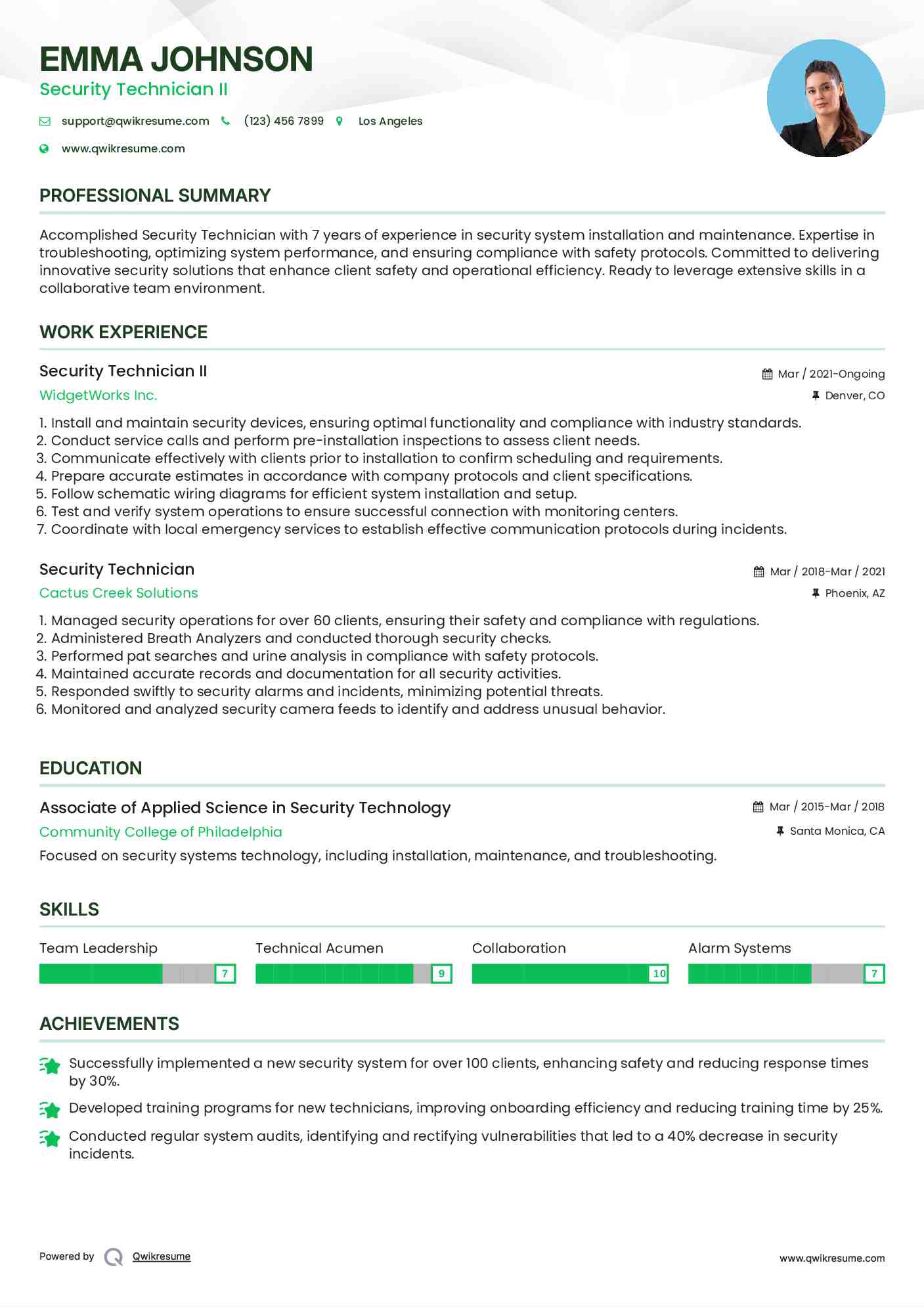
Security Technician II Resume Template
Source: QwikResume
Security Systems Technician Resume
Source: QwikResume

Security Alarm Technician Resume
Source: QwikResume

Security Alarm Technician Resume Example
Source: QwikResume
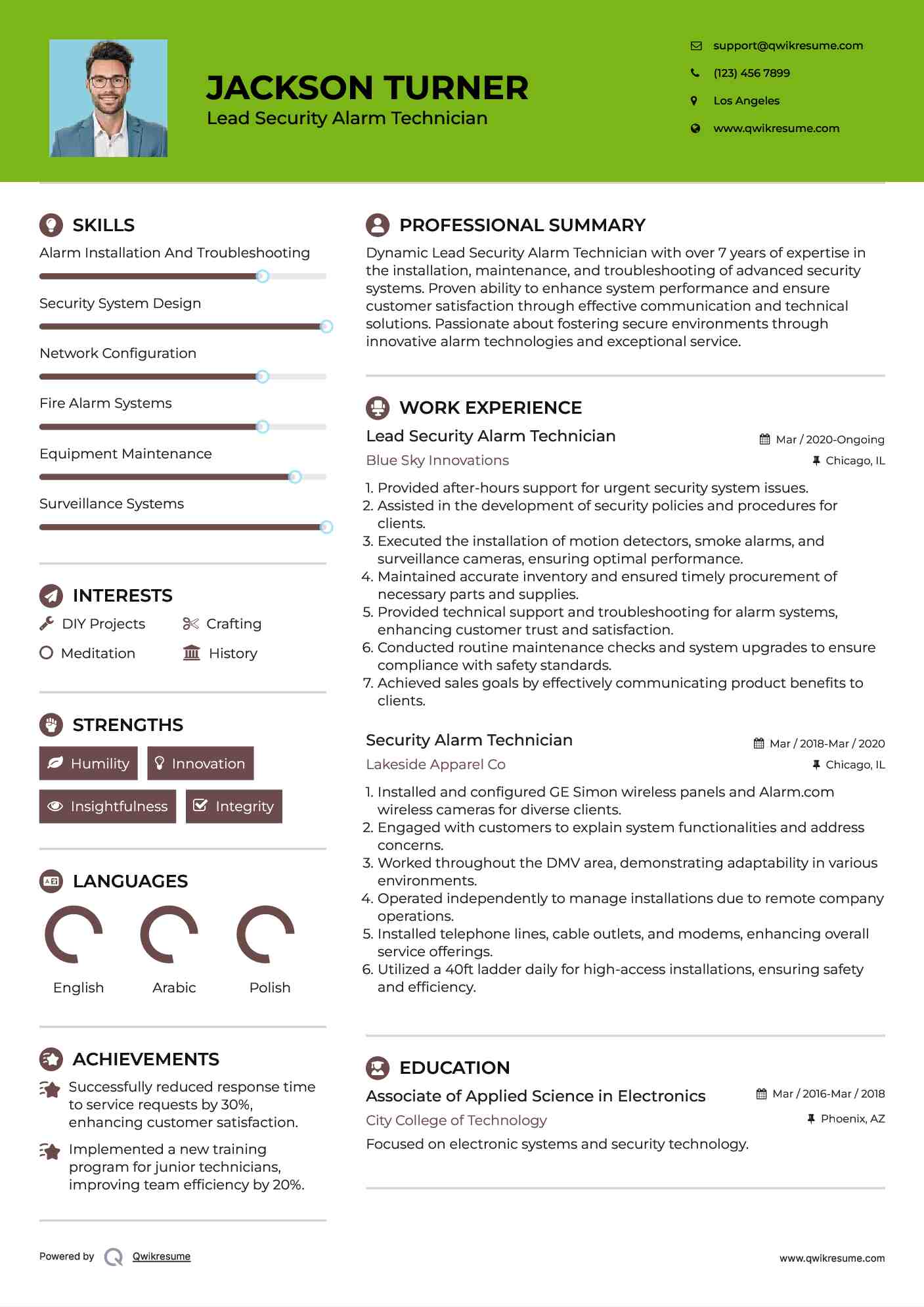
Lead Security Alarm Technician Resume
Source: QwikResume
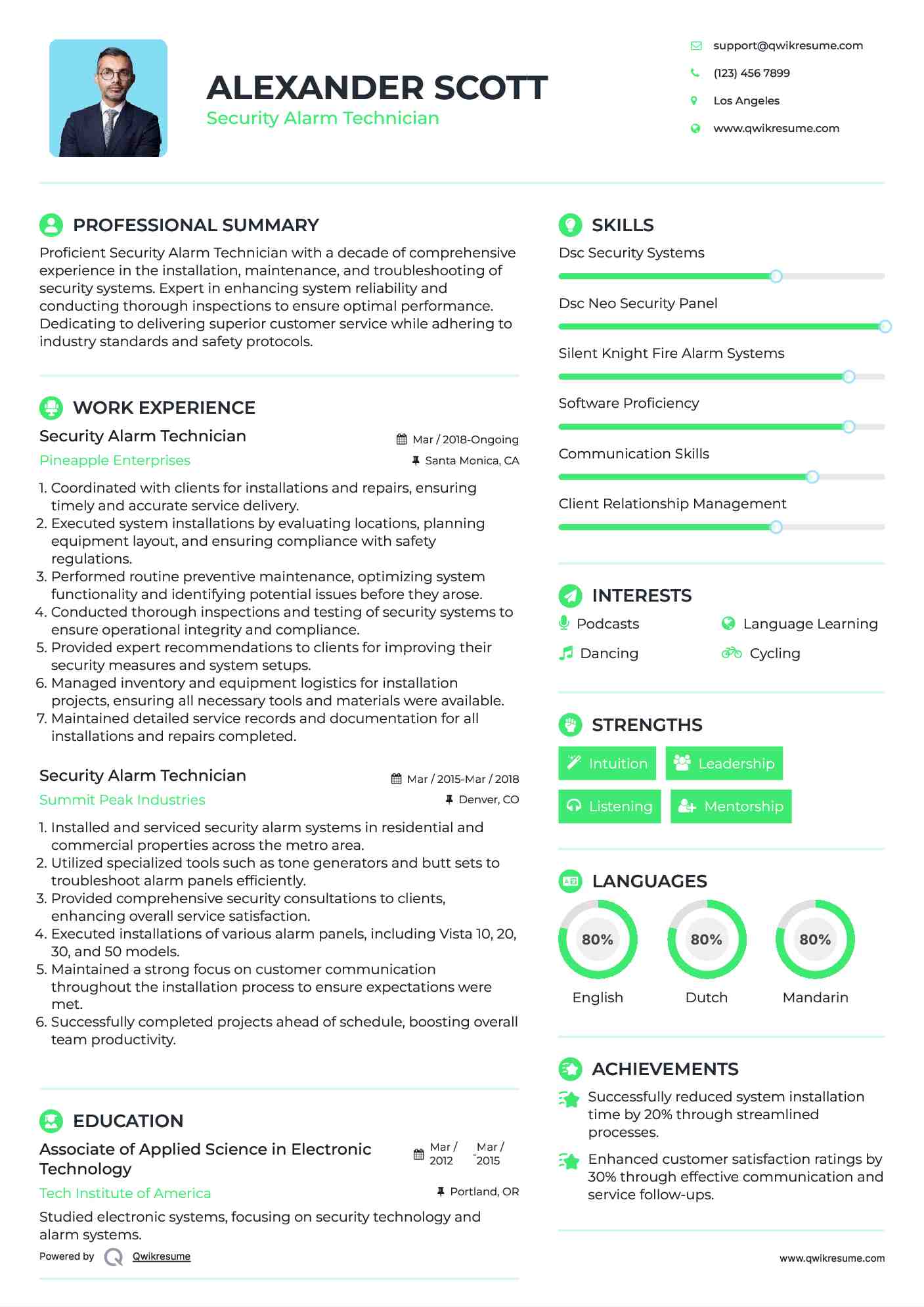
Security Alarm Technician Resume Format
Source: QwikResume
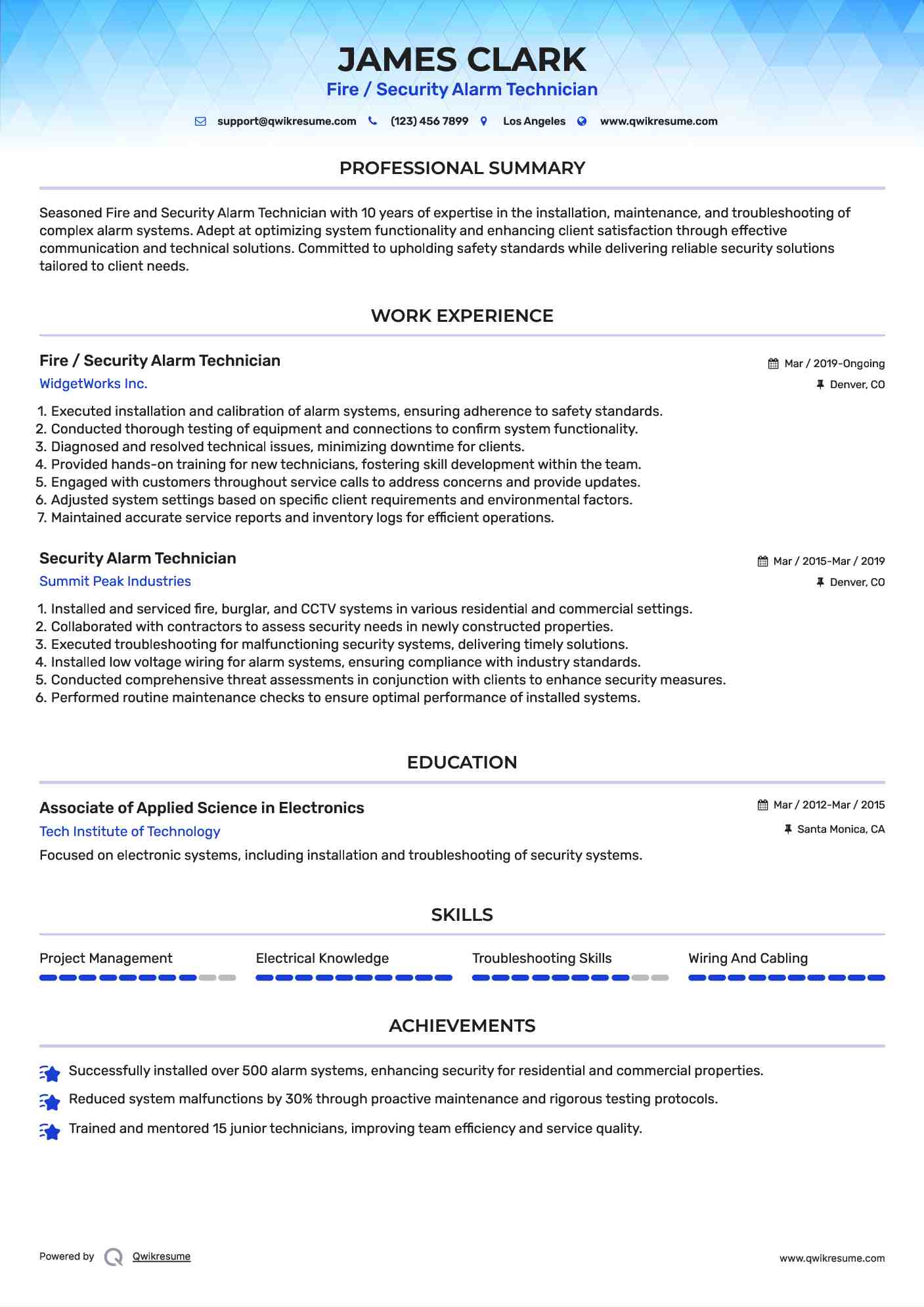
Fire / Security Alarm Technician Resume
Source: QwikResume
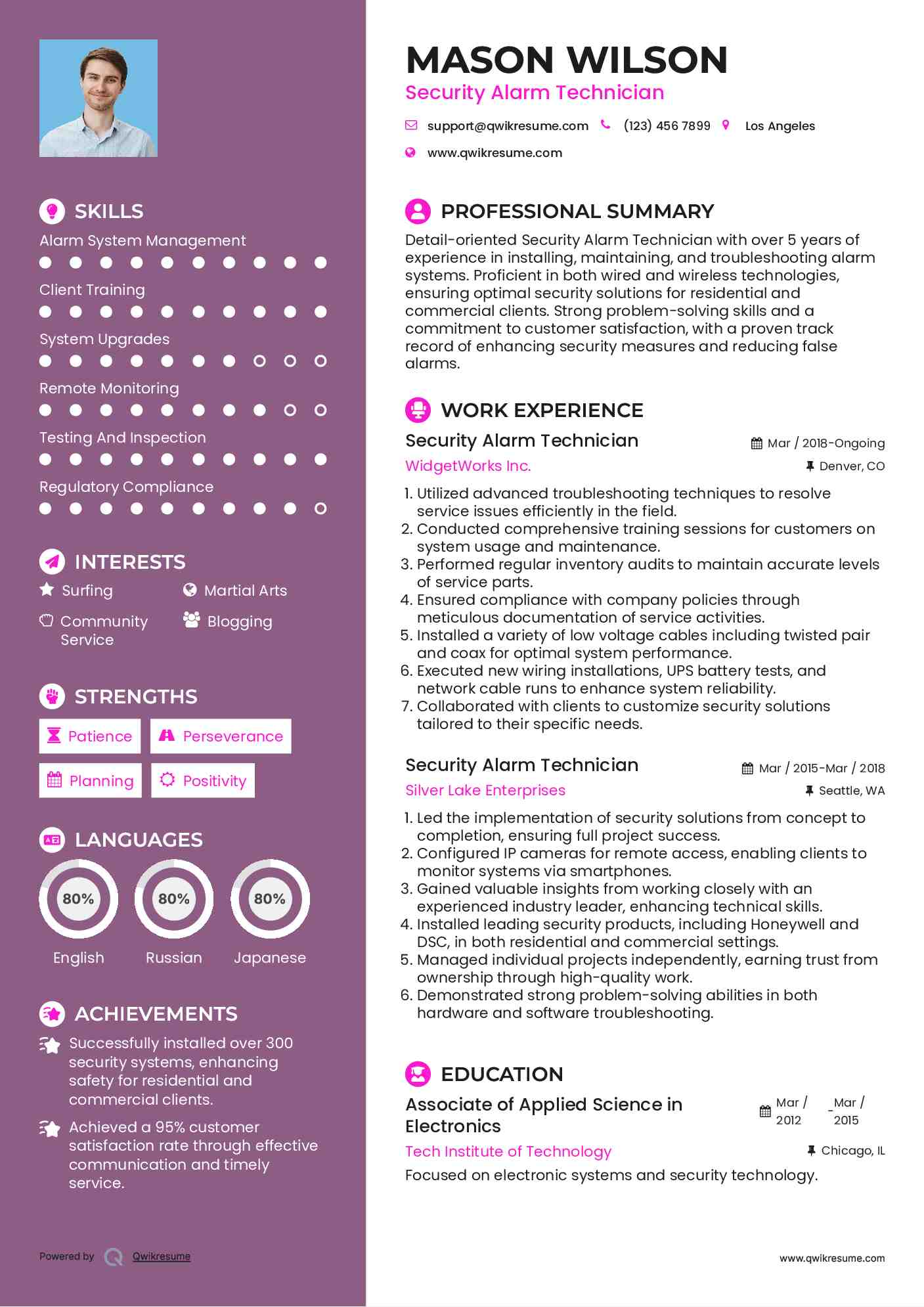
Security Alarm Technician Resume Model
Source: QwikResume

Alarm Technician Resume
Source: QwikResume
