A professional business invitation is more than a simple announcement. It is often the first impression guests receive about your company, event, brand, or organization. Whether you are planning a corporate networking event, business meeting, product launch, conference, seminar, opening ceremony, or formal dinner, a well-designed invitation can communicate professionalism before the event even begins.
A good business invitation should provide essential information clearly while also reflecting the personality and standards of your organization. The right combination of professional wording, attractive design, consistent branding, and useful event details can encourage recipients to respond and attend.
In this guide, you will learn how to create an effective professional business invitation, what information to include, how to choose the right tone, and how to make your invitation look polished and credible.
What Is a Professional Business Invitation?
A professional business invitation is a formal or semi-formal invitation designed for a corporate or professional audience. It can be distributed digitally through email, messaging platforms, or social media, or printed and delivered as a physical invitation.
Unlike casual invitations, business invitations usually focus on clarity, credibility, and brand consistency. The design and wording should make the recipient immediately understand who is hosting the event, what the event is about, when and where it will happen, and how to confirm attendance.
Common occasions for a business invitation include:
- Corporate networking events
- Business conferences and seminars
- Company anniversaries
- Product launches
- Grand openings
- Executive meetings
- Corporate dinners and receptions
- Workshops and training sessions
- Business award ceremonies
- Client appreciation events
- Partnership and collaboration events
Why a Professional Business Invitation Matters
An invitation sets expectations before your guests arrive. A thoughtfully prepared invitation can make an event feel organized, credible, and worth attending.
For businesses, this first impression can be particularly important. Clients, partners, investors, employees, and industry professionals may judge the level of attention given to an event based on the communication they receive beforehand.
It Communicates Professionalism
Clean typography, accurate information, appropriate colors, and polished wording can create a professional impression. Even a simple invitation can look sophisticated when its elements are carefully organized.
It Strengthens Brand Identity
Your invitation can reinforce your company identity through your logo, brand colors, typography, imagery, and tone of voice. Consistency helps recipients recognize your organization and associate the event with your brand.
It Makes Important Information Easy to Find
Guests should not have to search through long paragraphs to discover the event date or venue. A strong invitation presents the most important information in a clear visual hierarchy.
Essential Elements of a Professional Business Invitation
Before designing your invitation, prepare all of the information your guests need. Missing details can create confusion and lead to unnecessary questions.
1. Company or Organization Name
Start with the name of the hosting company or organization. Add a logo when appropriate. This immediately establishes who is responsible for the event.
2. Invitation Statement
Use a clear opening such as “You Are Cordially Invited” or “We Are Pleased to Invite You.” The wording should match the formality of the occasion.
3. Event Name
Make the event title prominent. For example, “Business Networking Event,” “Annual Corporate Dinner,” or “Product Launch 2026.” The event name should be one of the first things readers notice.
4. Date and Time
Include the complete date and starting time. If the event has a scheduled ending time, include that as well. For international audiences, consider adding the time zone.
5. Venue or Location
Provide the complete venue name and address. For larger events, you may also include parking information, a map link, room details, or directions.
6. RSVP Information
Tell guests how and when to confirm attendance. An RSVP email address, telephone number, registration page, or QR code can make the process easier.
7. Host or Contact Person
For formal business events, identifying the host or contact person can add credibility and make communication easier if guests have questions.
8. Additional Event Information
If necessary, mention dress code, special requirements, speakers, agenda highlights, refreshments, parking, or other useful information. Keep this section concise so the invitation does not become overcrowded.
Professional Business Invitation Template Design
A good template saves time while providing a consistent structure for your event communication. The best templates are flexible enough to accommodate different event details without losing their professional appearance.
For a corporate event, consider using a restrained color palette such as navy, white, charcoal, gray, or subtle metallic accents. Elegant typography and generous spacing can create a sophisticated appearance without making the invitation difficult to read.
A professional template can also include separate visual areas for the event title, date, time, venue, RSVP information, and a short message from the host.
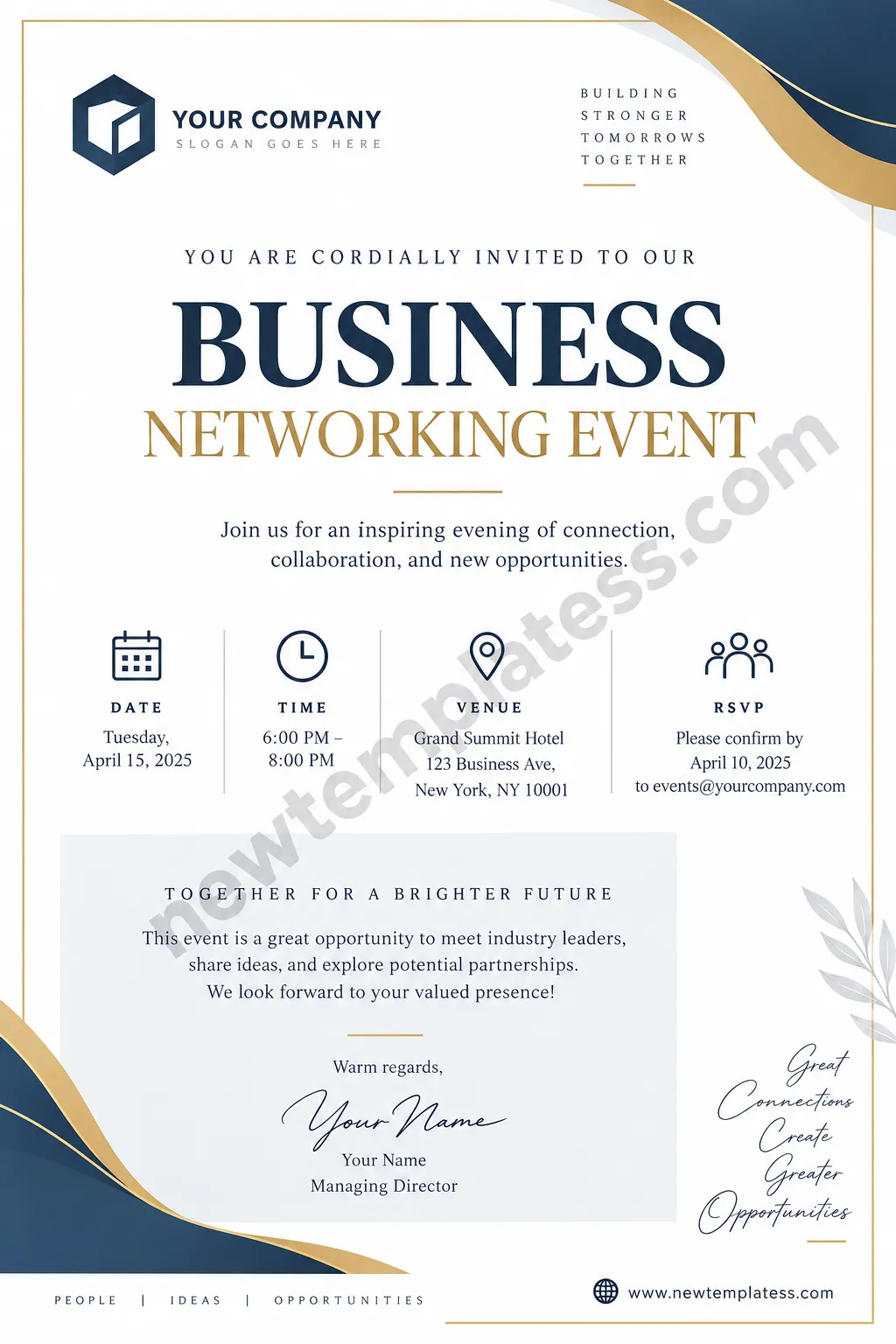
Here is an example of the type of layout that works well for a corporate invitation:
Header: Company logo and organization name
Main section: Invitation statement and event title
Details section: Date, time, venue, and RSVP
Message section: Short description or welcome message
Footer: Contact details, website, and brand information
How to Write Professional Business Invitation Wording
The wording of your invitation should be clear, confident, and appropriate for your audience. Avoid unnecessarily complicated language. Professional does not mean difficult to understand.
Use a Clear Opening
Begin with a direct invitation. For a formal event, phrases such as “You are cordially invited to” can work well. For a modern corporate gathering, “We are pleased to invite you to” may sound more natural.
Explain the Purpose
Give recipients a brief reason to attend. For example, explain that the event provides an opportunity to connect with industry professionals, discover new products, exchange ideas, or celebrate an important company milestone.
Keep the Message Concise
The invitation itself should not contain an entire event brochure. Provide the essential information and direct guests to a registration page or additional resource when more details are required.
Tips for Creating an Effective Corporate Invitation
Small design and content decisions can make a significant difference in how your invitation is received.
- Use a strong visual hierarchy: Make the event name and key details easy to identify.
- Keep the layout balanced: Avoid filling every available space with text or graphics.
- Use readable fonts: Decorative fonts can work for accents, but important information should remain easy to read.
- Maintain brand consistency: Use your organization’s established colors, logo, and visual style.
- Check every detail: Confirm names, dates, addresses, email addresses, and phone numbers before sending.
- Make RSVP instructions obvious: Guests should know exactly what action they need to take.
- Optimize for mobile: Many recipients will view digital invitations on smartphones.
- Use high-quality images: Blurry graphics can make an otherwise professional invitation look unfinished.
- Leave enough white space: Empty space helps separate sections and improves readability.
Formal vs. Modern Business Invitation Styles
The appropriate style depends on your audience and event. A formal executive dinner may require a different presentation from a creative industry networking session.
Formal Business Invitation
A formal invitation often uses elegant typography, restrained colors, traditional wording, and a structured layout. It is suitable for executive functions, awards ceremonies, corporate dinners, and high-level business receptions.
Modern Corporate Invitation
A modern invitation can use bold typography, minimalist layouts, contemporary graphics, and concise wording. This approach can work particularly well for technology companies, startups, workshops, networking events, and product launches.
Digital and Printable Business Invitations
Today, businesses often need invitations that work across multiple formats. A design created for printing should also remain effective when shared digitally.
For printed invitations, use a high-resolution design and an appropriate page size. Pay attention to margins and ensure important text is not placed too close to the edges.
For digital invitations, optimize the file for quick loading and mobile viewing. A clickable RSVP button, registration link, or QR code can make it easier for recipients to respond.
Using one consistent design across email invitations, printable cards, social media announcements, and event signage can also strengthen the overall event branding.
Common Mistakes to Avoid
Even a visually attractive invitation can be ineffective if basic communication principles are overlooked.
- Using too much text
- Choosing fonts that are difficult to read
- Forgetting the RSVP deadline
- Leaving out the complete venue address
- Using inconsistent branding
- Including outdated contact information
- Making the event date difficult to locate
- Using low-resolution images
- Adding too many decorative elements
- Failing to proofread the final version
Before distribution, review the invitation from the recipient’s perspective. Ask whether someone unfamiliar with the event could understand the purpose, schedule, location, and RSVP process within a few seconds.
How to Make Your Business Invitation More Engaging
A professional invitation does not need to be boring. You can make it engaging while maintaining a polished appearance.
Start with a strong headline that immediately communicates the event. Follow it with a short message explaining why the gathering matters. Use visual elements to separate information rather than adding decoration simply for its own sake.
You can also personalize invitations for important clients, partners, or speakers. Addressing recipients appropriately and highlighting the value of their participation can create a more welcoming experience.
Add a Clear Call to Action
Every invitation should guide the recipient toward the next step. Examples include “RSVP Today,” “Reserve Your Seat,” “Register Now,” or “Confirm Your Attendance.” A clear call to action reduces uncertainty and can simplify event management.
When to Send a Professional Business Invitation
The ideal timing depends on the type and scale of your event. Larger conferences or events involving travel generally require more advance notice. Smaller business gatherings may need less time.
Consider sending an initial invitation early enough for guests to reserve the date. A reminder can then be sent closer to the event, particularly when an RSVP deadline is approaching.
For important corporate events, a useful communication sequence may include:
- Save-the-date announcement
- Official professional business invitation
- RSVP reminder
- Final event reminder
- Post-event thank-you message
Final Checklist for a Professional Business Invitation
Before publishing or sending your invitation, use this quick checklist:
- Is the company name clearly displayed?
- Is the event title easy to see?
- Are the date and time correct?
- Is the venue address complete?
- Is the RSVP method clearly stated?
- Is the RSVP deadline included?
- Does the design match your brand?
- Is all text easy to read?
- Has the invitation been proofread?
- Does the final file look good on both desktop and mobile?
Conclusion
A professional business invitation combines clear communication, thoughtful design, and consistent branding. Whether you are inviting clients to a networking event, partners to a corporate dinner, or professionals to a conference, the invitation should make the event information easy to understand while creating a positive first impression.
The most effective approach is to keep the design clean, organize information logically, use professional wording, and provide a simple RSVP process. A well-designed invitation template can make this process faster and help your business maintain a consistent visual identity across different events.
With the right structure and attention to detail, your business invitation can do more than announce an event. It can create anticipation, reinforce your brand, and encourage the right people to take the next step.
