Payroll budget planning is an essential part of managing a healthy and sustainable business. Employee compensation is often one of the largest operating expenses, so having a clear payroll budget helps businesses control costs, prepare for future hiring, and make better financial decisions.
A well-structured payroll budget goes beyond calculating employee salaries. It should account for wages, salaries, overtime, bonuses, commissions, payroll taxes, employee benefits, expected raises, and other workforce-related expenses. By bringing these costs together in one plan, business owners and managers can understand the true cost of their workforce and avoid unexpected expenses.
Whether you run a small business, manage a growing company, or oversee a larger organization, a payroll budget template can make the planning process easier. It provides a simple framework for estimating annual payroll expenses and comparing planned costs with actual spending.
What Is Payroll Budget Planning?
Payroll budget planning is the process of estimating and organizing all employee-related costs for a specific period, usually a month, quarter, or year. The purpose is to create a realistic workforce spending plan that supports business goals while keeping labor costs under control.
A payroll budget may include both direct and indirect compensation expenses. Direct costs include salaries and hourly wages, while indirect costs can include employer payroll taxes, health insurance, retirement contributions, paid time off, bonuses, and other employee benefits.
Effective payroll planning also considers changes that may occur during the budget period. These changes can include new hires, promotions, salary increases, employee turnover, overtime requirements, and changes in benefits costs.
Why Is Payroll Budget Planning Important?
Without a clear payroll budget, businesses can underestimate labor expenses and experience cash flow problems. A detailed plan gives management a better understanding of how staffing decisions affect the overall financial position of the organization.
1. Improves Cash Flow Management
Payroll is a recurring financial obligation. Planning payroll expenses in advance helps businesses estimate how much cash will be needed to meet upcoming compensation commitments.
2. Supports Hiring Decisions
A payroll budget can show whether the company has room to hire additional employees. Instead of looking only at a candidate’s salary, management can consider the complete employment cost, including taxes, benefits, equipment, and other expenses.
3. Helps Control Labor Costs
Budgeting makes it easier to identify areas where payroll expenses are increasing faster than expected. Management can then investigate overtime, staffing levels, compensation changes, or other cost drivers.
4. Makes Financial Forecasting Easier
Payroll projections can be incorporated into broader financial forecasts. When compensation expenses are estimated accurately, businesses can create more reliable income statements, cash flow forecasts, and operating budgets.
What Should Be Included in a Payroll Budget?
A complete payroll budget should include more than base salaries. The exact categories depend on the organization, but most businesses should consider the following expenses:
- Base salaries and wages: Regular compensation paid to employees.
- Overtime: Additional wages for employees who work beyond standard hours.
- Bonuses: Performance, holiday, annual, or discretionary bonuses.
- Commissions: Variable compensation for sales and other performance-based roles.
- Payroll taxes: Employer-paid payroll taxes and required contributions.
- Health benefits: Medical, dental, vision, and related insurance contributions.
- Retirement contributions: Employer contributions to retirement or pension plans.
- Paid time off: Vacation, sick leave, holidays, and other paid leave.
- Training and development: Courses, certifications, workshops, and employee development programs.
- Other employee costs: Allowances, stipends, insurance, and workforce-related expenses.
How to Create a Payroll Budget
Step 1: List Current Employees
Start by creating a complete employee list. Record each employee’s position, department, compensation type, and current salary or hourly rate.
For salaried employees, calculate annual compensation based on their current salary. For hourly employees, estimate annual wages using the expected number of working hours and the applicable hourly rate.
Step 2: Calculate Base Payroll Costs
Add the expected compensation for every employee to determine the baseline payroll cost. This figure provides the starting point for your payroll budget.
For example, if a company has ten employees with different annual salaries, the total of those salaries represents the basic annual salary budget before additional payroll expenses are included.
Step 3: Estimate Salary Increases
Consider planned raises, promotions, merit increases, and cost-of-living adjustments. If increases are expected during the year, calculate the additional expense based on when each increase is likely to take effect.
This is important because a salary increase beginning in January has a different annual budget impact from an increase beginning in July.
Step 4: Add Variable Payroll Expenses
Estimate overtime, bonuses, commissions, shift differentials, and other variable compensation. Use historical payroll data whenever possible rather than relying entirely on guesswork.
If overtime varies significantly by season, create monthly estimates instead of applying one flat annual percentage.
Step 5: Include Employer Taxes and Benefits
Calculate employer-paid payroll taxes and employee benefits separately from base compensation. These expenses can significantly increase the total cost of employment.
Review current benefit rates and plan for known changes. If insurance premiums or retirement contribution rates are expected to change, incorporate those changes into the forecast.
Step 6: Account for New Hires
If the company plans to expand its workforce, add anticipated positions to the payroll budget. Estimate the expected start date, salary, benefits, taxes, and other associated costs.
Using start dates is particularly useful because a new employee hired halfway through the year will not create a full year’s payroll expense during the first budget period.
Step 7: Review the Total Payroll Budget
Finally, add all payroll categories together. Compare the projected payroll cost with the company’s revenue expectations, operating expenses, and financial goals.
It can also be useful to create multiple scenarios, such as a conservative plan, expected plan, and growth plan. Scenario planning helps management understand how different hiring or compensation decisions could affect the budget.
How to Use a Payroll Budget Planning Template
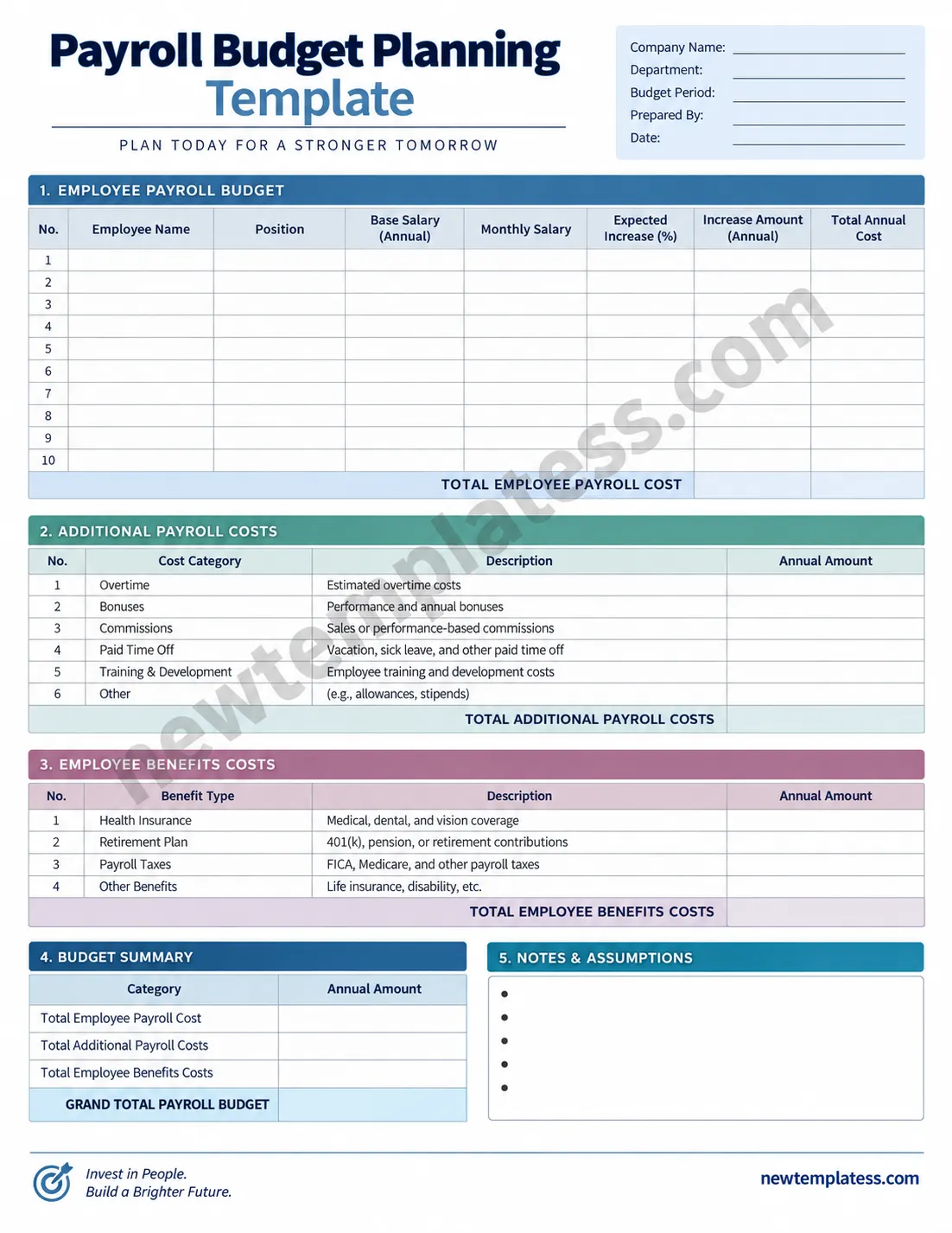
A payroll budget planning template provides a structured way to organize workforce expenses. Instead of building a new spreadsheet from scratch, you can enter employee information, additional payroll costs, benefits, and assumptions into predefined sections.
A useful template should make it easy to separate the major components of payroll expenses. For example, you can organize the budget into employee payroll, additional payroll costs, employee benefits, and a final budget summary.
When using a template, make sure to update the figures regularly. A budget is most useful when it reflects current staffing levels, compensation changes, and actual spending patterns.
Practical Payroll Budget Planning Tips
- Use current payroll data: Historical payroll records can provide a reliable starting point for future estimates.
- Separate fixed and variable costs: This makes it easier to understand which expenses are predictable and which may fluctuate.
- Budget for employee turnover: Hiring, onboarding, and temporary staffing can affect payroll-related expenses.
- Review overtime carefully: Unexpected overtime can cause actual payroll expenses to exceed the original budget.
- Plan for raises: Include scheduled salary increases and promotions before finalizing the budget.
- Review benefits annually: Insurance and retirement costs can change from year to year.
- Maintain a contingency amount: A reasonable reserve can help cover unexpected workforce expenses.
- Compare budget versus actual costs: Regular variance reviews help identify problems early.
Common Payroll Budget Planning Mistakes
Ignoring Employer Payroll Taxes
One common mistake is budgeting only for employee wages or salaries. Employers may also be responsible for payroll taxes and other statutory contributions. These expenses should be included when calculating the full cost of employment.
Forgetting Benefits
Health insurance, retirement contributions, paid leave, and other benefits can represent a significant portion of total compensation. Excluding these expenses can make a payroll budget appear artificially low.
Using a Static Budget
A payroll budget should not necessarily remain unchanged throughout the year. Hiring, turnover, promotions, overtime, and business growth can all change projected expenses.
Failing to Compare Actual Results
Creating a budget is only the first step. Businesses should periodically compare actual payroll expenses with budgeted amounts. Significant differences can reveal inaccurate assumptions or changes that require management attention.
Payroll Budget Planning for Small Businesses
Small businesses often have fewer employees but less room for unexpected expenses. A simple payroll budget can therefore be especially valuable.
Start with a list of current employees and their expected annual compensation. Then add employer taxes, benefits, overtime, bonuses, and planned hiring. If the business has seasonal fluctuations, create monthly projections to show when payroll expenses are likely to increase.
Small business owners should also consider whether each planned hire fits within the company’s expected cash flow. Looking at the complete employment cost rather than salary alone provides a more realistic picture of affordability.
Payroll Budget Planning for Growing Companies
As a company grows, payroll planning becomes more complex. New departments, changing compensation structures, additional benefits, and larger teams can make manual calculations difficult.
Growing organizations can benefit from dividing payroll expenses by department or cost center. This makes it easier to identify which teams are driving changes in workforce spending.
Companies can also connect payroll planning with headcount planning. For each planned position, document the expected start date, salary range, benefits, and other employment costs. This creates a clearer relationship between workforce growth and financial requirements.
How Often Should You Review a Payroll Budget?
Payroll budgets should be reviewed regularly rather than only at the end of the financial year. A monthly review is often useful because it allows management to compare projected and actual expenses while there is still time to make adjustments.
At minimum, review the budget whenever there is a major staffing change, salary adjustment, benefit change, or significant shift in overtime or commission expenses.
A simple monthly review can include:
- Budgeted payroll versus actual payroll.
- Changes in employee headcount.
- Overtime and variable compensation.
- Employer taxes and benefits.
- New hires and employee departures.
- Unexpected payroll-related expenses.
Final Thoughts on Payroll Budget Planning
Payroll budget planning gives businesses a clearer view of one of their most important operating expenses. By accounting for salaries, wages, taxes, benefits, overtime, bonuses, hiring plans, and other workforce costs, organizations can build a more realistic financial plan.
The best payroll budget is not simply a list of employee salaries. It is a practical financial tool that connects workforce decisions with business objectives. Using a structured payroll budget planning template can simplify calculations, improve consistency, and make it easier to review changes throughout the year.
Start with accurate employee data, include the full cost of employment, plan for future changes, and regularly compare your budget with actual payroll spending. With these practices in place, payroll planning becomes a valuable part of responsible financial management and long-term business growth.
