Government and small-business organizations generally describe a business plan as a document covering objectives, strategies, marketing, sales, operations, and financial forecasts. GOV.UK explains that a plan can help clarify an idea, identify potential problems, establish goals, and measure progress. The U.S. Small Business Administration likewise describes a business plan as a roadmap for starting, managing, and growing a business. :contentReference[oaicite:0]{index=0}
The best template is not necessarily the longest one. A useful template gives you enough structure to ask difficult questions without forcing irrelevant sections into your business. A local service company, online retailer, consultancy, café, trades business, and technology startup may need different levels of detail even though their plans share common foundations.
This guide explains how to choose and use a business plan template, what each section should contain, how to research the market, how to build realistic financial projections, how to adapt a plan for funding, and how to decide between Word, PDF, and spreadsheet-based formats. It also explains how to avoid the common mistake of treating a template as a finished business plan.
The objective is simple: by the end, you should understand how to turn a blank framework into a decision-making document that reflects your actual customers, costs, competitive environment, operating model, and financial assumptions.

What Is a Business Plan Template for a Small Business?
A business plan template is a pre-structured document that organizes the major questions a business owner needs to answer. Instead of opening a blank document and wondering what to write first, the owner works through predefined sections such as the company overview, products or services, target market, marketing strategy, operations, management, financial plan, and milestones.
A template is therefore a framework rather than a business plan itself. The blank fields, prompts, tables, and headings have little value until they are filled with information specific to the business. A strong plan should explain why the opportunity exists, what the business will do about it, and why its assumptions are credible.
For a small business, the template should also reflect the realities of limited resources. A plan that requires dozens of pages of unnecessary industry research may consume time without improving decisions. The useful level of detail is the level that helps the owner understand customers, costs, sales opportunities, operational requirements, risks, and financial sustainability.
Traditional plans tend to be comprehensive and may be appropriate when seeking conventional financing or when several stakeholders need detailed information. Lean plans are shorter and concentrate on the most important assumptions, objectives, customers, channels, resources, costs, and revenue streams. The SBA recognizes both traditional and lean approaches and notes that the appropriate format depends on the business’s needs. :contentReference[oaicite:1]{index=1}
For most small businesses, the practical solution is to start with a concise template and expand sections where uncertainty or financing requirements justify more detail. This keeps the planning process manageable while preserving the information needed for serious decision-making.

Why Small Businesses Benefit From Using a Template
Starting from a template reduces the friction involved in planning. Entrepreneurs often know their product or service extremely well but have not yet organized their thoughts about customers, competitors, pricing, staffing, cash requirements, or measurable objectives. A structured document forces those topics into the same planning conversation.
Templates also expose missing information. If the market section cannot be completed without guessing, that is a signal that additional research is needed. If the financial section depends on an unexplained sales assumption, the forecast needs further testing. In this way, the template becomes a diagnostic tool rather than merely a formatting convenience.
Another benefit is consistency. When business owners, partners, accountants, advisers, or lenders review the plan, clearly labeled sections make it easier to locate the information they need. A consistent structure also makes future revisions simpler because changes can be made in the relevant section without rebuilding the entire document.
Templates are particularly useful for comparing scenarios. A small business might prepare a base case, a conservative case, and an expansion case. Each version can use the same structure while changing assumptions about customer volume, pricing, staffing, rent, advertising, or capital investment.
The most valuable benefit, however, is disciplined thinking. Writing a plan forces the owner to connect strategy with resources. A goal to double sales, for example, should connect to customer acquisition, capacity, inventory, staffing, marketing expenditure, and cash flow. A good template makes those relationships visible.

Core Sections Every Small Business Plan Should Consider
1. Executive Summary
The executive summary gives the reader a high-level explanation of the business. It normally identifies the business concept, target customer, core offering, competitive position, objectives, management, and major financial or funding considerations.
Although the executive summary appears first, it is often easier to write it last. Once the other sections have been completed, the owner can summarize the strongest and most relevant points instead of making broad claims before the underlying research is complete.
A useful summary should answer several questions quickly: What does the business do? Who does it serve? What problem does it solve? Why will customers choose it? How will it generate revenue? What are the most important goals? If funding is required, how much is needed and what will it accomplish?
For example, a hypothetical neighborhood meal-preparation company might state that it prepares refrigerated weekly meals for time-constrained households, sells through subscriptions and individual orders, competes through flexible menus and local delivery, and intends to reach operational break-even after establishing a repeat-customer base.
Avoid turning the executive summary into advertising copy. The strongest summary is concise, specific, and supported by the detailed sections that follow. It should create confidence that the owner understands both the opportunity and the challenges.

2. Company Description
The company description explains what the business is, how it is structured, where it operates, and what it intends to accomplish. Depending on the stage of the business, it may include the business history, legal structure, ownership, location, current stage, and major milestones.
For a new business, describe the origin of the idea and the problem that led to its creation. For an established business, explain the current position and why a particular growth initiative, new product, location, or market is being considered.
The company description should also explain the business model at a practical level. State what customers pay for, when they pay, how the product or service reaches them, and what resources are necessary to deliver the promised value.
Competitive advantages belong here when they are fundamental to the business. These might include specialized expertise, a convenient location, proprietary technology, established supplier relationships, a distinctive service process, strong local reputation, or a specific customer niche.
Do not confuse a mission statement with a complete company description. A mission can express purpose, but the business description must show how that purpose becomes an economically viable operation.

3. Products and Services
This section describes exactly what the business sells. Each major product or service should be explained in terms of customer benefit, pricing approach, delivery method, production requirements, and expected contribution to revenue.
Customer benefits should be stated in practical terms. Instead of simply saying that a product is “high quality,” explain what quality means to the customer and how it differs from competing alternatives. For a service, explain the outcome, process, turnaround time, scope, and limitations.
Pricing should be connected to the value delivered and the cost structure. A low price may attract customers but can create a difficult operating model if gross margins are insufficient. A premium price may work when the customer receives a sufficiently differentiated benefit and the business can consistently deliver it.
Businesses with several offerings should identify their primary products rather than treating every item as equally important. A small retailer might categorize products into core sellers, complementary items, seasonal items, and experimental products. A consultant might distinguish recurring retainers from project-based work.
When future products are included, label them as planned rather than presenting them as established revenue sources. This distinction helps keep financial projections realistic and makes the plan easier to evaluate.

How to Research the Market Before Completing the Template
Market research should answer questions that materially affect business decisions. The purpose is not to collect impressive statistics for a document; it is to reduce uncertainty about customers, demand, competitors, pricing, channels, and market conditions.
Start with the customer. Define who is most likely to buy, what problem they are trying to solve, how frequently the problem occurs, what alternatives they currently use, and what factors influence purchasing decisions. Demographics may help, but behavior and buying context are often more actionable.
Use several information sources when possible. Direct customer conversations can reveal motivations that published reports miss. Competitor websites can show positioning, service packages, pricing structures, delivery promises, and customer reviews. Industry publications can provide broader context. Government or institutional sources can help with regulatory, economic, or demographic information.
Primary research can be as simple as a structured interview or a short questionnaire. Ask questions that produce evidence rather than compliments. “Would you buy this?” often produces weaker information than “How do you solve this problem today?” or “What did you pay the last time you purchased a solution?”
Record assumptions separately from verified observations. If ten people interviewed say they dislike an existing service, that is useful qualitative evidence. It does not automatically prove that a large market will pay for a replacement. The business plan should distinguish observations, estimates, assumptions, and confirmed financial data.

Building a Practical Customer Profile
A useful customer profile goes beyond age and location. It should describe the situation in which the customer experiences the problem, how they discover solutions, what prevents purchase, and what makes them choose one provider over another.
For a local cleaning company, for example, the target customer might be a household that values predictable scheduling, easy booking, trusted staff, and transparent pricing. The business plan can then connect those needs to its service design and marketing channels.
For a business-to-business consultancy, the economic buyer may not be the person who uses the service. The plan should distinguish the user, decision-maker, budget holder, and other stakeholders when those roles differ.
Customer segmentation becomes valuable when different groups have meaningfully different needs or economics. If one group produces higher repeat purchases while another requires expensive acquisition, the business may need separate pricing or marketing strategies.
The customer section should ultimately support decisions. If the profile does not affect the product, price, marketing channel, sales process, or service experience, it may be too generic to be useful.

Competitive Analysis: Turning Research Into Strategy
Competitive analysis should identify alternatives rather than merely listing companies. A competitor may be a direct business offering a similar product, an indirect solution, an internal process, or even the customer’s decision to do nothing.
Compare competitors using consistent criteria. Relevant categories can include price, quality, convenience, location, speed, product range, customer service, reputation, technology, guarantees, delivery, and specialization. The right criteria depend on what customers actually value.
A simple comparison table can reveal strategic gaps. Suppose three competitors offer similar services at similar prices but have slow response times. A small business could compete on responsiveness if it can deliver that promise profitably.
Do not claim that the business has no competition. A market with no visible alternatives may indicate that demand is unproven rather than that the business has discovered an uncontested opportunity. Strong plans acknowledge competing solutions and explain the intended differentiation.
Competitive information should also be treated as time-sensitive. Prices change, competitors launch products, new businesses enter markets, and customer expectations evolve. Review the competitive section whenever major strategic assumptions change.

Marketing and Sales Strategy
The marketing section explains how potential customers will discover the business and why they should consider buying. It should connect directly to the customer research instead of listing every possible promotional channel.
Start with the customer journey. Consider awareness, consideration, purchase, delivery, repeat purchase, and referral. Different channels may be useful at different stages. Search visibility can capture existing demand, social content can build awareness, referrals can support trust, and email can encourage repeat purchases.
Sales planning should include a realistic path from prospect to customer. A service company might generate leads through local search, qualify prospects by phone, provide a quote, schedule the work, and request a review afterward. Each stage creates measurable activity that can be incorporated into the operating plan.
Marketing budgets should be connected to expected outcomes rather than arbitrary percentages. If a hypothetical campaign costs $1,000, the business should identify the number of leads expected, conversion assumptions, average transaction value, gross margin, and repeat-purchase potential before deciding whether the investment makes sense.
A good plan also explains what will happen if the preferred marketing channel performs poorly. Having a second acquisition route, a retention strategy, or a referral mechanism can reduce dependence on a single source of customers.

Operations and Management Planning
The operations section translates the business promise into daily activities. It should describe the facilities, equipment, suppliers, technology, staffing, inventory, production, delivery, customer support, and other processes required to serve customers.
Small businesses often underestimate operational complexity because the founder can personally perform many tasks during the early stage. The plan should identify what happens when demand increases. If the owner is the salesperson, manager, delivery driver, bookkeeper, and service provider, capacity becomes a strategic constraint.
Supplier dependencies should be documented where they could materially affect the business. Consider lead times, minimum order quantities, alternative suppliers, payment terms, quality requirements, and potential disruptions.
Management planning should explain who is responsible for important decisions. Even a solo business can benefit from defining responsibilities for finance, sales, operations, customer service, compliance, and strategic review.
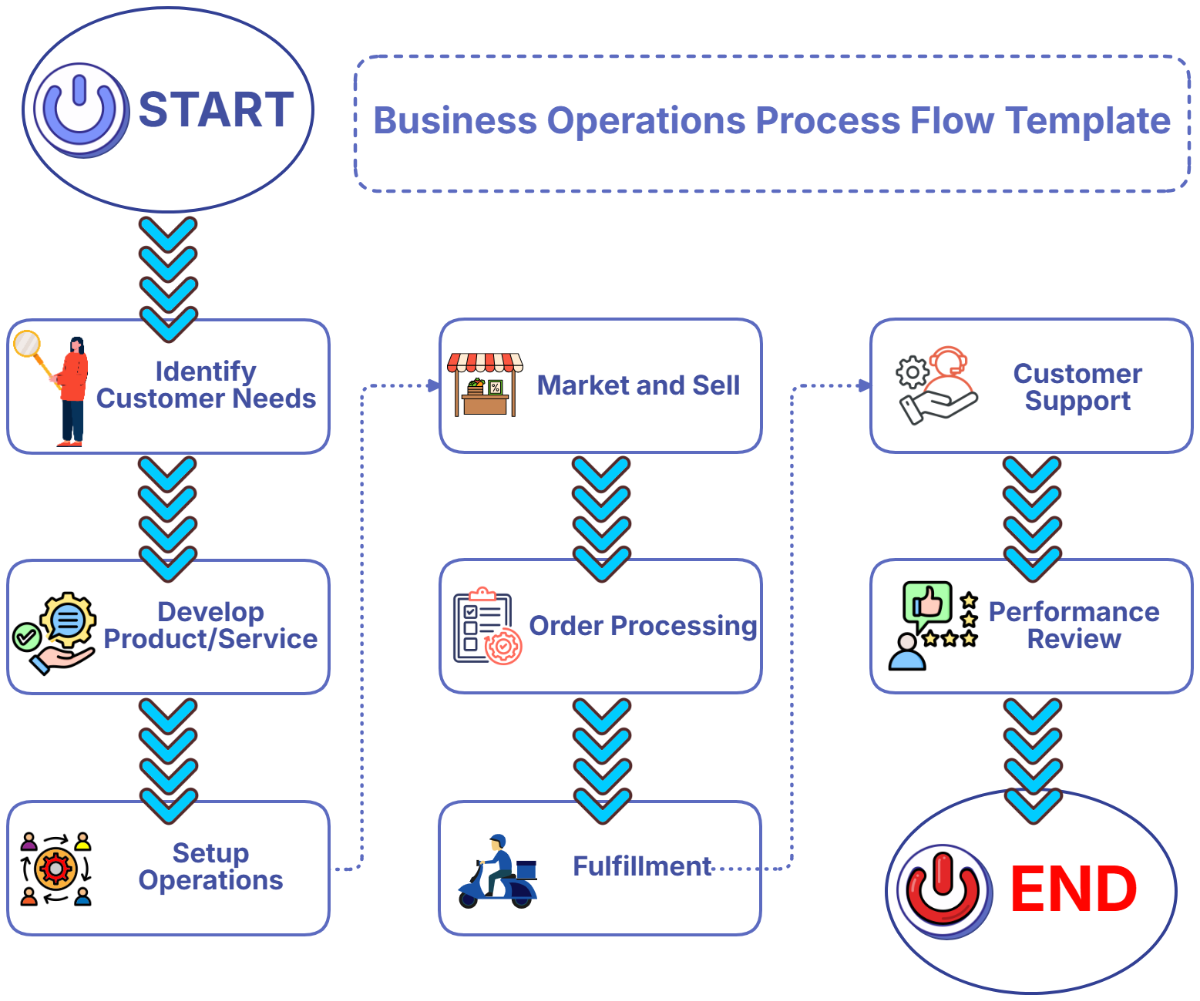
Processes do not need to be complicated. A small business can document a few critical workflows using checklists or simple diagrams. The objective is consistency, accountability, and scalability rather than bureaucracy.

Financial Planning: The Section That Tests the Business Model
The financial plan converts strategic assumptions into numbers. It should normally cover startup costs, operating expenses, revenue assumptions, cash flow, profitability, and funding requirements where applicable.
Revenue forecasting should begin with operational drivers. Instead of simply entering a desired annual revenue figure, calculate how the number might be produced. For example, a hypothetical service business could estimate leads, conversion rate, average transaction value, repeat frequency, and available service capacity.
Expense forecasting should distinguish fixed and variable costs. Rent, software subscriptions, insurance, and some salaries may remain relatively stable within a certain operating range, while materials, transaction fees, shipping, packaging, or commissions may rise with sales.
Cash flow deserves separate attention from profit. A profitable business can still experience cash pressure when customers pay slowly, inventory must be purchased before sales occur, or large equipment payments arrive before sufficient cash has accumulated.
The financial plan should explain major assumptions. If projected revenue grows rapidly, identify the customer or capacity assumptions behind the growth. If gross margin improves, explain why. Transparent assumptions make forecasts easier to challenge, update, and improve.

Using Break-Even Analysis in a Small Business Plan
Break-even analysis helps determine the level of sales required for revenue to cover relevant costs. The basic concept is straightforward: fixed costs must be covered by the contribution generated from each sale after variable costs are deducted.
For example, suppose a hypothetical business has $4,000 in monthly fixed costs and earns a contribution of $40 per transaction after variable costs. Its simplified monthly break-even volume would be 100 transactions. This is an example for illustrating the method, not a prediction for any particular business.
The calculation becomes more useful when paired with capacity. If the business can physically complete only 70 transactions per month, a forecast requiring 100 transactions cannot be accepted without a capacity change. The owner would need to raise prices, reduce variable costs, increase capacity, lower fixed costs, or redesign the offering.
Break-even analysis can also support pricing decisions. By modeling different prices and contribution margins, the owner can see how a small pricing change affects the number of customers required to cover fixed expenses.
Use break-even analysis as a decision tool rather than a guarantee. It depends on assumptions about pricing, volume, costs, and product mix, all of which can change.

How to Build a Realistic Financial Forecast
A forecast should begin with assumptions that can be explained. For sales, consider the number of customers, average order value, purchase frequency, conversion rate, seasonality, and capacity. For expenses, consider staffing, rent, utilities, supplies, technology, marketing, insurance, taxes, financing, and one-time costs.
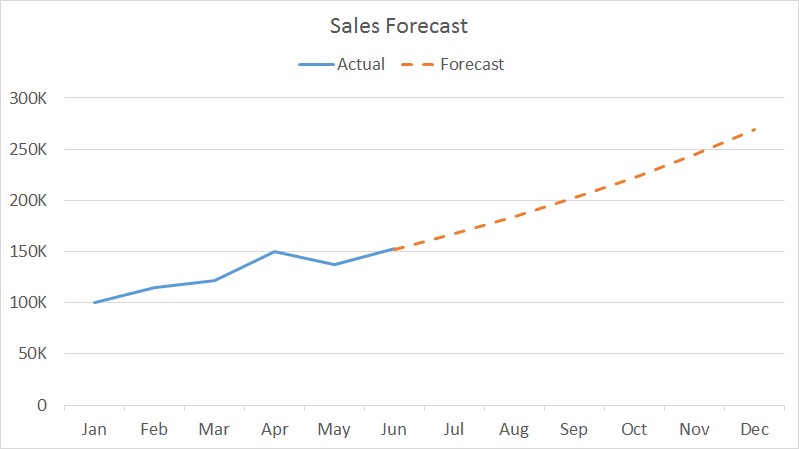
Monthly projections are particularly useful during the early stage because they reveal cash requirements and seasonal patterns. An annual total can hide periods when cash is insufficient, especially when sales and expenses occur at different times.
Scenario analysis improves decision quality. A conservative case might use slower customer acquisition and higher costs. A base case might reflect the owner’s best evidence-based estimate. An upside case can demonstrate what happens if acquisition and retention outperform expectations.
Financial models should be reviewed whenever assumptions change. If the price changes, update revenue and potentially demand. If a supplier changes terms, update cash flow. If staffing increases, update payroll and capacity. The plan should behave like a living model rather than a static document.
For spreadsheet-based planning, separate inputs from calculations where practical. This makes the model easier to audit and allows assumptions to be changed without manually editing dozens of cells.

Word, PDF, and Spreadsheet Formats: Which Should You Use?
Microsoft Word is useful when the business plan is primarily a narrative document. It provides flexibility for headings, tables, branding, page layout, and detailed explanations. Microsoft itself provides business plan templates in Word and suggests combining business planning with market analysis, financial planning, checklists, and startup planning. :contentReference[oaicite:2]{index=2}
PDF is usually best for sharing a finalized plan because it preserves the document’s visual layout across devices. It is particularly useful when sending a completed plan to a lender, investor, partner, adviser, or other stakeholder who should review the final presentation rather than edit the source document.
Excel or another spreadsheet application is especially useful for financial calculations, assumptions, tables, charts, scenario modeling, and cash-flow projections. A practical workflow is to maintain the financial model in a spreadsheet and incorporate selected tables or charts into the narrative business plan.
Some templates combine Word and Excel because the two formats serve different purposes. Vertex42, for example, describes a Word business plan template accompanied by an Excel workbook for financial statements, data tables, charts, and break-even analysis. :contentReference[oaicite:3]{index=3}
The best choice is often not one format but a connected set of files. Keep an editable working document, maintain the financial model separately, and produce a PDF version when the plan is ready to distribute.

How a Startup Should Approach the Plan Differently
A startup usually has less historical information than an established business. As a result, the plan must rely more heavily on assumptions, customer research, market tests, early sales evidence, and clearly explained scenarios.
The startup should focus on validating the most important assumptions first. These may include whether customers have the problem, whether they will pay for the proposed solution, whether acquisition is affordable, whether delivery is operationally feasible, and whether the expected margin can support the business.
A startup plan should avoid false precision. Projecting revenue to the exact dollar several years into the future can create an illusion of certainty. A range supported by clear assumptions may be more useful than an extremely precise figure with little evidence.
Milestones can make startup plans more practical. Instead of simply saying “grow the business,” specify milestones such as completing a prototype, validating a target customer segment, launching a pilot, reaching a defined number of paying customers, establishing a supplier relationship, or achieving a specific recurring revenue level.
SCORE’s startup template, for example, covers areas such as the executive summary, company description, products and services, marketing plan, operational plan, management, startup expenses, capitalization, financial plan, and supporting appendices. :contentReference[oaicite:4]{index=4}

How Established Small Businesses Can Use the Same Framework
An established business does not need a completely different planning method. Instead, historical evidence can replace some of the uncertainty found in a startup plan. Actual sales, margins, customer retention, operating costs, and cash-flow records provide a stronger foundation for forecasting.
The company can use the plan to evaluate a specific strategic decision. Examples include opening another location, adding employees, launching a new service, entering a new geographic market, changing prices, buying equipment, or expanding into e-commerce.
Historical information should be interpreted rather than copied into the plan. If sales increased last year, identify why. Was the growth caused by higher prices, more customers, new products, a temporary event, or a marketing campaign? The reason matters because it affects whether the trend is likely to continue.
Established businesses should also compare forecast performance with actual performance. A monthly review can show whether customer acquisition, average order value, gross margin, staffing costs, and cash flow are developing as expected.
This turns the business plan into a management system. Instead of preparing it once and storing it in a folder, the owner uses it to compare expectations with reality and decide what needs to change.

Common Mistakes When Using a Business Plan Template
One common mistake is filling every field with generic language. Phrases such as “we provide excellent customer service” or “the market is growing rapidly” have little value unless they explain what the business actually does and what evidence supports the claim.
Another mistake is copying competitor descriptions or template examples without adapting them. A template should guide thinking, not replace it. Every important section should reflect the actual business model, customer, market, costs, resources, and objectives.
Overly optimistic financial forecasts are another problem. High growth can be possible, but the plan should explain the mechanism behind it. If sales are expected to double, the plan should identify the additional customers, channels, capacity, pricing, or partnerships that make that outcome possible.
Some owners also focus on revenue while neglecting cash. Revenue does not automatically mean cash is available to pay employees, suppliers, rent, taxes, debt, or other obligations. The financial plan should therefore include timing and cash-flow considerations.
Finally, many plans become outdated. A plan written before launch may contain assumptions that change after the first few months. Updating the document is not a sign that the original plan failed; it is evidence that the owner is learning from actual business conditions.
Best Practices for Making the Plan Professional
Use consistent terminology throughout the document. If the target customer is described as “local independent retailers” in one section, avoid switching to a completely different definition elsewhere unless the segmentation has intentionally changed.
Keep assumptions visible. A reader should be able to understand where major numbers came from. Label hypothetical figures as examples, distinguish forecasts from historical results, and explain major changes between periods.
Use tables and charts where they improve comprehension. A five-year financial table may be easier to understand when paired with a simple revenue and expense chart. A competitive comparison can be clearer as a matrix than as several dense paragraphs.
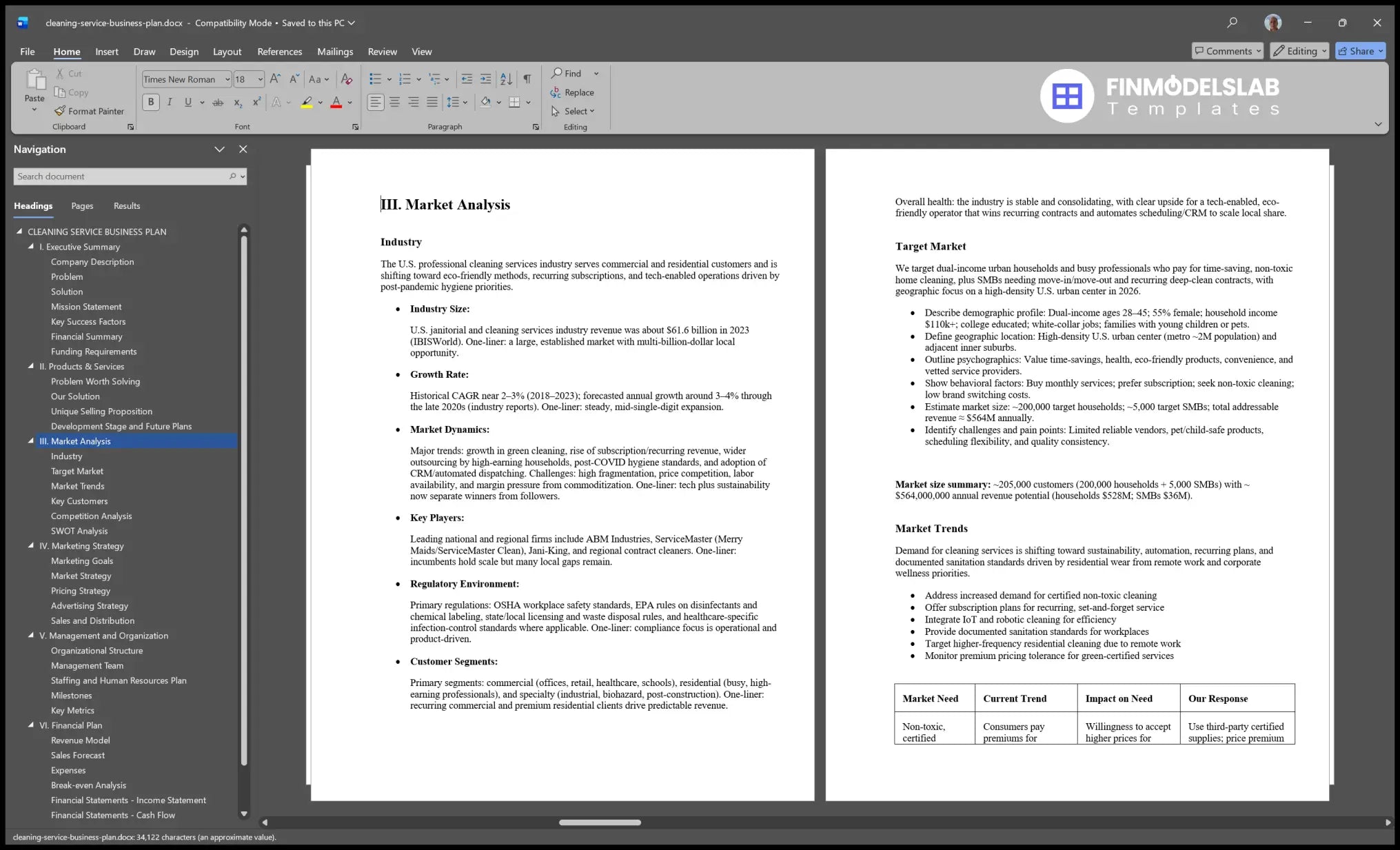
Make the document easy to navigate. Use a table of contents for longer plans, descriptive headings, consistent page formatting, and concise tables. Microsoft Word’s structured templates can help standardize headings and formatting while allowing the content to remain customizable. :contentReference[oaicite:5]{index=5}
Finally, review the finished plan as if you were an outside reader. Ask whether the customer is clear, whether the problem is real, whether the solution is differentiated, whether the sales strategy is believable, whether the operations are feasible, and whether the financial assumptions support the stated goals.
Practical Example: A Hypothetical Local Service Business
Consider a hypothetical mobile bicycle repair business serving commuters and recreational riders in a medium-sized city. The owner plans to travel to customers rather than operating a traditional workshop, reducing the need for a large retail premises.
The company description would explain the mobile operating model and the customer problem: customers may value convenient repairs at home, work, or another agreed location. The products and services section could list tune-ups, puncture repairs, brake adjustments, maintenance packages, and emergency call-outs.
The market analysis would investigate competing repair shops, mobile mechanics, customer willingness to pay for convenience, local cycling activity, service availability, and seasonal demand. Customer interviews could explore when cyclists currently seek repairs and what makes them choose a provider.
The operations plan would document the vehicle, tools, spare parts, scheduling system, payment process, supplier relationships, travel radius, and daily service capacity. The owner could then determine whether the projected number of appointments is operationally possible.
The financial plan could model appointment volume, average service value, parts costs, fuel, insurance, software, marketing, equipment, taxes, and owner compensation. The final plan would not merely say that the business is promising; it would show how the business intends to operate and what assumptions must be true for the model to work.

Practical Solution: A Step-by-Step Workflow for Creating Your Plan
Step 1: Define the purpose of the plan. Decide whether the document is mainly for internal planning, a bank or lender, investors, partners, a grant application, a new location, or another strategic decision. The purpose determines how much detail is appropriate.
Step 2: Gather evidence before writing long sections. Collect customer observations, competitor information, historical financial statements if available, supplier information, pricing data, operating costs, market research, and regulatory information relevant to the business.
Step 3: Complete the business model. Write down the customer, problem, solution, value proposition, revenue sources, sales channels, key activities, resources, partners, and major costs. A business model canvas can be useful as an early-stage visual exercise before writing the full narrative.
Step 4: Build the financial model separately. Create monthly revenue, expense, cash-flow, and break-even calculations. Use conservative assumptions where evidence is weak and create alternative scenarios when uncertainty is significant.
Step 5: Write the narrative around the evidence. Explain what the business will do and why. Every major strategic claim should connect to customer research, operational capability, historical performance, or an explicitly labeled assumption.
Step 6: Connect strategy to numbers. If the marketing plan expects more customers, the sales forecast should reflect that expectation. If sales increase, staffing, inventory, delivery, or service capacity may also need to increase. Make sure the sections tell the same story.
Step 7: Stress-test the assumptions. Ask what happens if sales are lower than expected, costs increase, a supplier fails, a marketing channel stops working, a key employee leaves, or a launch takes longer than planned. The objective is not to predict every problem but to identify important vulnerabilities.
Step 8: Prepare the document for its audience. A lender may focus heavily on repayment capacity and financial assumptions. A partner may care about roles and strategic fit. An internal management plan may emphasize milestones and operating metrics. Keep the underlying facts consistent while adjusting presentation for the reader.
Step 9: Review and update. Set a regular review cycle appropriate to the business. Early-stage businesses may need frequent updates because assumptions change rapidly. Established businesses may review the plan around major planning cycles, budgets, expansions, or strategic decisions.
This workflow prevents the template from becoming a writing exercise disconnected from business reality. It creates a chain from evidence to assumptions, assumptions to strategy, strategy to operations, and operations to financial outcomes.

When to Use a One-Page Plan Instead
A one-page plan can be valuable when the business is at an early idea stage or when the owner needs a quick strategic overview. It can summarize the customer, problem, solution, value proposition, channels, revenue model, major costs, objectives, and milestones.
The one-page format is especially useful for discussions. A founder can use it to explain the concept to an adviser or potential partner before investing time in a longer document.
However, a one-page plan should not replace detailed analysis when the decision requires financial evidence or operational detail. A lender may need more information, and a business owner making a major investment decision may need a full model even if the public-facing summary remains one page.
Think of the one-page version as a compressed view of the business rather than a different business model. The underlying assumptions should still be documented somewhere else when they materially affect the decision.
As the business develops, the one-page version can become an executive overview for a more detailed plan. This gives the owner a concise document for communication while preserving a deeper working model.

Using a Business Plan Template for Funding
If the purpose of the plan is financing, the document should clearly explain the funding requirement. State how much capital is needed, what it will be used for, when it will be required, and how the spending supports the business model.
Funding requests should match the financial model. If the plan requests money for equipment, the equipment should appear in the startup or capital expenditure assumptions. If funds are needed to hire staff, the forecast should show the related payroll expense and the operational reason for the hire.
Financial projections should be explainable. The SBA notes that traditional plans used for financing can include financial projections and that first-year projections may be presented in greater detail, such as monthly or quarterly forecasts. :contentReference[oaicite:6]{index=6}
Supporting documents may strengthen the plan when they are relevant. Depending on the business, these can include resumes, licenses, permits, contracts, supplier information, product photographs, research, leases, or other evidence that supports statements in the main document.
Never inflate the plan simply to make the funding request appear larger or the opportunity appear more attractive. Credibility is more valuable than impressive-looking assumptions, particularly when another party will examine the underlying numbers.

How to Review a Completed Business Plan
Begin with consistency. Read the executive summary, then compare its claims with the company description, market analysis, sales plan, operations, and financial forecast. If the summary promises premium positioning but the pricing model assumes bargain pricing, the strategy needs clarification.
Next, test the customer logic. Can you identify a specific customer group and a meaningful problem? Is the proposed solution actually connected to that problem? Does the marketing strategy reach those customers in a realistic way?
Then test the capacity assumptions. If the forecast expects 500 monthly orders, can the business produce, process, deliver, and support 500 orders? If not, what investment or process change makes the forecast feasible?
Finally, review the financial downside. Identify which assumptions have the greatest impact on cash and profitability. These are the assumptions that deserve the most research and monitoring after launch.
A strong review should result in revisions. If the plan becomes more conservative after review, that can be a positive outcome because the document is becoming more useful for decision-making.

Reference Examples
The following examples are visual references for the exact template-related searches covered in this guide. Availability, format, licensing, and download conditions should always be checked on the original source before using a resource.
business plan template small business free
Source: Pexels
business plan template small business pdf
Source: FinancialModelsLab
business plan template small business startup
Source: Forbes
business plan template small business free download
Source: Medium
business plan template small business word document
Source: Etsy
business plan template small business excel
Source: InGenium Web
business plan template small business word
Source: Pexels
business plan template small business
Source: Indeed
small business business plan template uk
Source: Nihon M&A Center
Frequently Asked Questions
What is the purpose of a business plan template small business document?
Its purpose is to provide a structured framework for documenting the business idea, customers, market, products or services, marketing, operations, management, financial assumptions, risks, and goals. It helps the owner think through important decisions before committing significant resources.
How long should a small business plan be?
There is no universal required length. A lean plan may be only a few pages, while a traditional plan prepared for detailed financing discussions can be substantially longer. The right length is the amount of detail needed to explain the business and support the intended decision.
Should I write my business plan in Word or Excel?
Use Word for the narrative and structured document, and Excel for detailed calculations, financial statements, assumptions, scenarios, and charts. Combining the two is often more practical than forcing all business information into a single file.
Is a business plan necessary for an established small business?
It can be extremely useful when the business is making a significant decision such as expanding, adding employees, changing its pricing model, entering a new market, buying equipment, or seeking financing. The plan can be based on actual historical data rather than startup assumptions.
What financial information should a small business plan include?
Depending on the business and purpose, the financial section may include startup costs, sales forecasts, operating expenses, cash-flow projections, profit and loss projections, break-even analysis, capital requirements, and funding assumptions. Established businesses can also include relevant historical financial information.
Can I use a free template for a bank loan?
A free template can provide a useful structure, but it does not guarantee that a lender will accept the resulting plan. Different lenders can have different requirements. Review the specific lender’s requested information before submitting an application.
What should I do if I do not know my future sales?
Use assumptions and scenarios rather than pretending to know the exact result. Estimate sales from identifiable drivers such as customer volume, conversion rates, average transaction value, purchase frequency, capacity, and seasonality. Explain the assumptions and update them as evidence becomes available.
How often should a business plan be updated?
Update it whenever a major assumption changes and review it periodically as part of normal business management. Startups may revise their plans frequently because they are learning quickly. Established businesses can update them around strategic planning cycles or major changes.
Conclusion
A well-designed business plan template small business framework gives entrepreneurs a practical way to organize ideas, research customers, assess competitors, document operations, model finances, and establish measurable goals. Its real value comes from the thinking and evidence added to the structure, not from the template’s appearance.
Start with the business model and customer problem, then build the market analysis, offering, marketing strategy, operations, management plan, and financial model around those fundamentals. Use realistic assumptions, distinguish facts from estimates, and test the connections between sales expectations, operating capacity, costs, and cash flow.
Choose the format according to the job. Word is useful for narrative planning and presentation, PDF is useful for sharing a finalized version, and Excel is valuable for financial calculations and scenario analysis. A connected set of files can be more effective than trying to make one format do everything.
Most importantly, treat the plan as a living management tool. Review actual performance against the assumptions, investigate major differences, update the forecast, and revise the strategy when evidence changes. A business plan becomes more valuable when it evolves with the business rather than remaining frozen at launch.
The strongest business plan is not the one with the most pages; it is the one that helps a small business owner make better decisions with greater clarity about customers, competition, operations, money, risks, and the practical steps required to turn a business idea into a sustainable operation.
