A Billing Statement Form is a simple and practical way to organize charges, payments, balances, and customer account information in one professional document. Whether you run a small business, provide freelance services, manage recurring accounts, or handle customer billing for a larger organization, a well-designed billing statement can make financial communication much easier.
Unlike a basic receipt or single-service invoice, a billing statement can provide a broader overview of an account. It can show previous balances, recent transactions, payments received, outstanding amounts, due dates, and other important details. This makes it especially useful when customers have multiple transactions within a billing period.
A well-structured billing statement also helps reduce confusion. Customers can quickly see what they owe, why they owe it, and when payment is expected. For businesses, the document creates a consistent record that can support payment collection, account management, and bookkeeping.
What Is a Billing Statement Form?
A Billing Statement Form is a document used to summarize financial activity between a business and a customer during a specific period. It typically contains customer information, transaction details, charges, payments, adjustments, and the current balance.
The form can be used for many types of businesses and services. For example, a consultant may use it for monthly client billing, while a retailer may use it to summarize account activity for a business customer. Service providers can also use a statement to present recurring charges in an easy-to-understand format.
A billing statement is often more comprehensive than an individual invoice because it can combine several transactions into one account summary.
What Should a Billing Statement Include?
A professional billing statement should contain enough information for the customer to understand the account without needing to contact the business for clarification. The exact layout can vary, but several elements are particularly useful.
Business Information
Start with the business name and contact details. Include information such as:
- Business name
- Business address
- Phone number
- Email address
- Website, if applicable
- Business logo
Keeping this information near the top of the form makes it easy for customers to identify the sender and know how to ask questions about their account.
Customer and Account Details
The customer section should clearly identify the person or organization associated with the statement. Useful fields include the customer’s name, billing address, email address, phone number, and account number.
An account number is especially helpful when a business manages many customers. It gives both the customer and billing team a consistent reference for future communication.
Statement Information
Every billing statement should clearly identify the statement period and document details. Common fields include:
- Statement date
- Statement number
- Account number
- Billing period
- Payment due date
- Previous balance
These details help customers understand exactly which period the statement covers and when payment should be made.
Why Use a Billing Statement Template?
Creating every billing statement from scratch can take unnecessary time. A reusable billing statement template provides a consistent structure that can be updated whenever a new billing period begins.
Templates are particularly useful for small businesses and independent professionals because they reduce repetitive administrative work. Instead of designing a new document for every customer, you can enter the relevant information into an established format.
A good template can also improve consistency. When statements follow the same layout each month, customers know where to find transaction information, totals, payment instructions, and contact details.
Other benefits include:
- Faster preparation of recurring statements
- More consistent business documents
- Clearer presentation of account activity
- Reduced risk of missing important fields
- Easier record keeping
- A more professional customer experience
How to Use a Billing Statement Form
Using a billing statement form is straightforward when you follow a consistent process. The goal is to provide accurate information in a format that customers can understand quickly.
1. Enter the Business Information
Add your company name, contact information, logo, and other relevant business details. If you use the form repeatedly, these fields can remain unchanged in your master template.
2. Add Customer Information
Enter the customer’s name, address, account number, and contact details. Double-check spelling and account information before sending the document.
3. Define the Billing Period
Specify the period covered by the statement. For example, you might use a monthly period such as September 1 through September 30. A clearly defined billing period prevents confusion about which transactions are included.
4. List Transactions and Charges
Record each relevant transaction in an organized table. Depending on your business, this may include products, services, quantities, dates, rates, fees, credits, or adjustments.
5. Calculate the Balance
Show the previous balance, new charges, payments, credits, taxes, and other applicable adjustments. Then display the current amount due prominently.
6. Add Payment Instructions
Tell customers how they can pay. You may include accepted payment methods, bank details, online payment instructions, or a link to your payment portal.
7. Review Before Sending
Check every number, date, customer detail, and payment instruction before delivering the statement. A quick review can prevent avoidable billing disputes and follow-up messages.
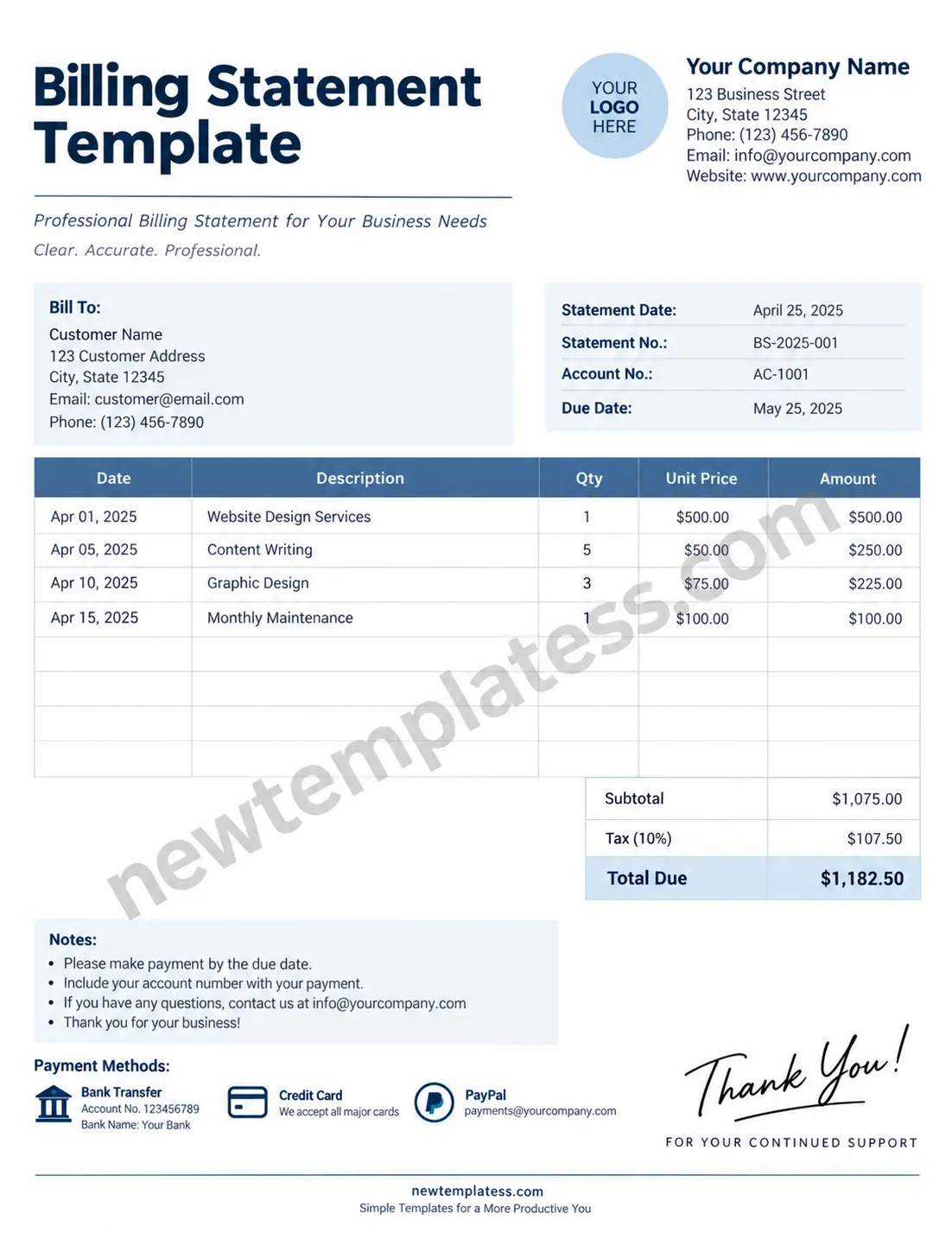
For a visual example of a clean, printable layout, see the template below.
Billing Statement vs. Invoice: What Is the Difference?
Although billing statements and invoices are closely related, they serve different purposes.
An invoice generally requests payment for a specific sale, service, or transaction. It usually identifies what was provided, how much it costs, and when payment is due.
A billing statement provides a broader account summary. It can include multiple invoices or transactions, payments, credits, and the remaining balance for a particular billing period.
For example, a business customer who receives several services during a month may receive one billing statement summarizing all account activity. This makes the statement useful for recurring billing and account management.
Tips for Creating an Effective Billing Statement
A billing document does not need to be complicated to look professional. The most effective forms prioritize clarity and accuracy.
Keep the Layout Simple
Use clear headings, adequate spacing, and logical sections. Avoid adding unnecessary design elements that make important financial information harder to find.
Highlight the Amount Due
The current balance or total amount due should be easy to locate. Using a larger font, bold text, or a lightly highlighted section can help draw attention to this information.
Use Consistent Dates and Currency
Choose a consistent date format and currency format throughout the statement. Consistency makes transaction records easier to read and compare.
Make Payment Instructions Obvious
Customers should not have to search through the document to find out how to pay. Include payment instructions in a clearly labeled section near the bottom or alongside the amount due.
Leave Room for Notes
A notes section can be useful for payment reminders, account messages, service information, or other details that do not belong in the transaction table.
Who Can Use a Billing Statement Form?
A customizable billing statement can be useful across many industries and business models. Common users include:
- Freelancers and independent contractors
- Consultants
- Design and marketing agencies
- Professional service providers
- Subscription businesses
- Property managers
- Repair and maintenance businesses
- Wholesale suppliers
- Small retail businesses
- Educational and membership organizations
The form can be adapted to match different billing cycles, customer relationships, and transaction types.
Printable and Digital Billing Statements
A billing statement template can be prepared for both printed and digital use. Printable statements are useful for physical records, in-person transactions, and customers who prefer paper documents.
Digital statements can be sent through email or stored electronically for easy access. When preparing a digital version, make sure the document remains readable on different screen sizes and that important financial information is easy to locate.
For businesses that maintain electronic records, using a consistent file naming system can also make statements easier to retrieve later. For example, a file name might include the customer’s name, account number, and billing period.
Common Mistakes to Avoid
Even a simple billing form can create problems if important information is missing or inaccurate. Watch for these common mistakes:
- Using an unclear billing period
- Leaving out the account or statement number
- Failing to show the previous balance
- Incorrectly calculating taxes or discounts
- Displaying an unclear amount due
- Providing incomplete payment instructions
- Sending a statement without checking customer information
- Using inconsistent formatting across billing periods
A standardized template can help prevent many of these issues because the essential fields are already built into the document.
Make Your Billing Process More Professional
A professional billing process is about more than collecting money. Clear statements help customers understand their accounts and give businesses a reliable way to communicate financial information.
Using a reusable Billing Statement Form can make recurring billing easier while creating a consistent appearance across customer communications. By including accurate transaction details, clear totals, payment instructions, and customer information, you can create a document that is both practical and professional.
For businesses that issue statements regularly, it is worth creating a master template and keeping a clean copy available for future billing periods. Update only the transaction-specific information while keeping the overall structure consistent.
Conclusion
A Billing Statement Form provides a convenient way to summarize customer account activity, communicate outstanding balances, and organize payment information. With a clear layout and well-organized sections, a billing statement can make financial communication easier for both businesses and customers.
Whether you need a monthly billing statement, customer account summary, printable billing form, or reusable business template, a structured format can save time and improve consistency. Keep the design simple, verify every financial detail, clearly display the amount due, and provide straightforward payment instructions.
With these practices, your billing statements can become a dependable part of an organized and professional billing process.
