A Northern Ireland power of attorney can give someone you trust the legal authority to manage your property and financial affairs if you are unable to do so yourself. Planning ahead can make it easier for a trusted family member, friend, or professional to deal with important financial matters when you need assistance.
In Northern Ireland, the main form used for planning for possible future loss of mental capacity is an Enduring Power of Attorney (EPA). An EPA is different from the Lasting Power of Attorney system used in England and Wales. In Northern Ireland, an EPA relates to property and financial affairs, rather than health and welfare decisions.
This guide explains what a Northern Ireland power of attorney does, who can make one, what powers can be granted, when it becomes effective, and what happens if the donor later loses mental capacity.
What Is a Power of Attorney in Northern Ireland?
A power of attorney is a legal document that allows one person, known as the donor, to give another person, known as an attorney, authority to act on their behalf.
The authority can be useful when someone needs help dealing with financial and property matters. Depending on the document and the restrictions included, an attorney may be able to deal with matters such as bank accounts, property, bills, investments, and other financial affairs.
It is important to distinguish an ordinary power of attorney from an Enduring Power of Attorney. An ordinary power of attorney generally ceases if the donor becomes mentally incapable of managing their affairs. An EPA is designed to continue and can be registered if the donor later becomes mentally incapable.
What Is an Enduring Power of Attorney?
An Enduring Power of Attorney allows a person to appoint someone they trust to deal with their property and financial affairs. The EPA must be made while the donor is over 18 and mentally capable of understanding what the document means.
An EPA can be particularly useful as part of future planning. An accident, illness, or other circumstance could make it difficult or impossible for someone to manage their own financial affairs. Creating an EPA while the person still has capacity can provide a framework for someone trusted to step in when necessary.
The official Northern Ireland guidance also makes clear that an EPA does not necessarily have to give an attorney unlimited authority. The donor can place restrictions or limit the authority to particular areas of their affairs.
Who Can Make a Northern Ireland Power of Attorney?
A person can make an Enduring Power of Attorney if they are over 18 years old and mentally capable of understanding the nature and effect of the EPA.
This requirement makes advance planning important. An EPA should be considered before a person loses the mental capacity needed to understand and create the document.
Choosing an Attorney
Choosing an attorney is one of the most important decisions involved in making an EPA. The attorney may eventually have significant responsibility for managing the donor’s financial affairs.
Consider choosing someone who:
- Is trustworthy and responsible.
- Can manage financial information carefully.
- Understands the donor’s wishes and circumstances.
- Is willing to take on the responsibility.
- Can keep accurate records of financial transactions.
- Can act in the donor’s interests rather than their own.
The official guidance recommends obtaining legal advice because careful consideration should be given to the powers granted to an attorney.
What Powers Can an Attorney Have?
An EPA can give an attorney authority over financial and property matters. However, the donor can decide how broad that authority should be.
For example, a donor may want an attorney to deal with everyday financial matters but may wish to exclude a particular transaction or asset. The Northern Ireland Department of Justice explains that the power can be limited to specific parts of a person’s affairs.
Possible areas to consider when discussing an EPA with a solicitor include:
- Bank and building society accounts.
- Payment of household bills and expenses.
- Management of investments.
- Property and land matters.
- Income and financial administration.
- Other specified property or financial affairs.
Do not assume that a simple template automatically gives an attorney every power that may be needed. The exact wording and legal requirements matter, particularly when significant property or financial assets are involved.
When Does an Enduring Power of Attorney Take Effect?
The timing depends on the terms included in the EPA.
If there are no restrictions or conditions delaying the authority, the attorney’s powers can start when the attorney signs the EPA. A donor can also include conditions stating that the attorney’s authority should begin later or only in specified circumstances.
This is an important point when preparing a Northern Ireland power of attorney template. The document should clearly reflect the donor’s intentions rather than simply copying wording from an unrelated form.
What Happens If the Donor Loses Mental Capacity?
If an attorney has reason to believe that the donor has become mentally incapable of managing their affairs, the EPA must be registered with the High Court’s Office of Care and Protection. The donor is notified of the application.
The Office of Care and Protection has responsibility for registering Enduring Powers of Attorney in Northern Ireland. It can also investigate circumstances where the property or finances of an incapable adult appear to be at risk.
Registration is therefore a key part of the process once the attorney believes the donor has lost the relevant mental capacity. A registered EPA can then provide the legal framework for the attorney to continue managing the donor’s financial and property affairs.
Can You Limit an Attorney’s Authority?
Yes. A donor does not necessarily have to give an attorney unrestricted control over every financial matter.
For example, the donor may want an attorney to manage bank accounts and regular expenses but exclude the sale of a particular property. The official Northern Ireland guidance specifically notes that an EPA can be limited to certain areas of a person’s affairs.
When considering restrictions, think carefully about both present and future circumstances. A restriction that seems appropriate today could create difficulties later if the attorney needs to deal with an unexpected financial issue.
Can You Change or Cancel a Power of Attorney?
An Enduring Power of Attorney can be cancelled or amended while the donor remains mentally capable. This can be relevant if the chosen attorney dies, becomes unable to act, no longer wishes to act, or if the donor’s circumstances change.
Because legal documents can have significant consequences, professional advice may be appropriate before making changes to an existing EPA.
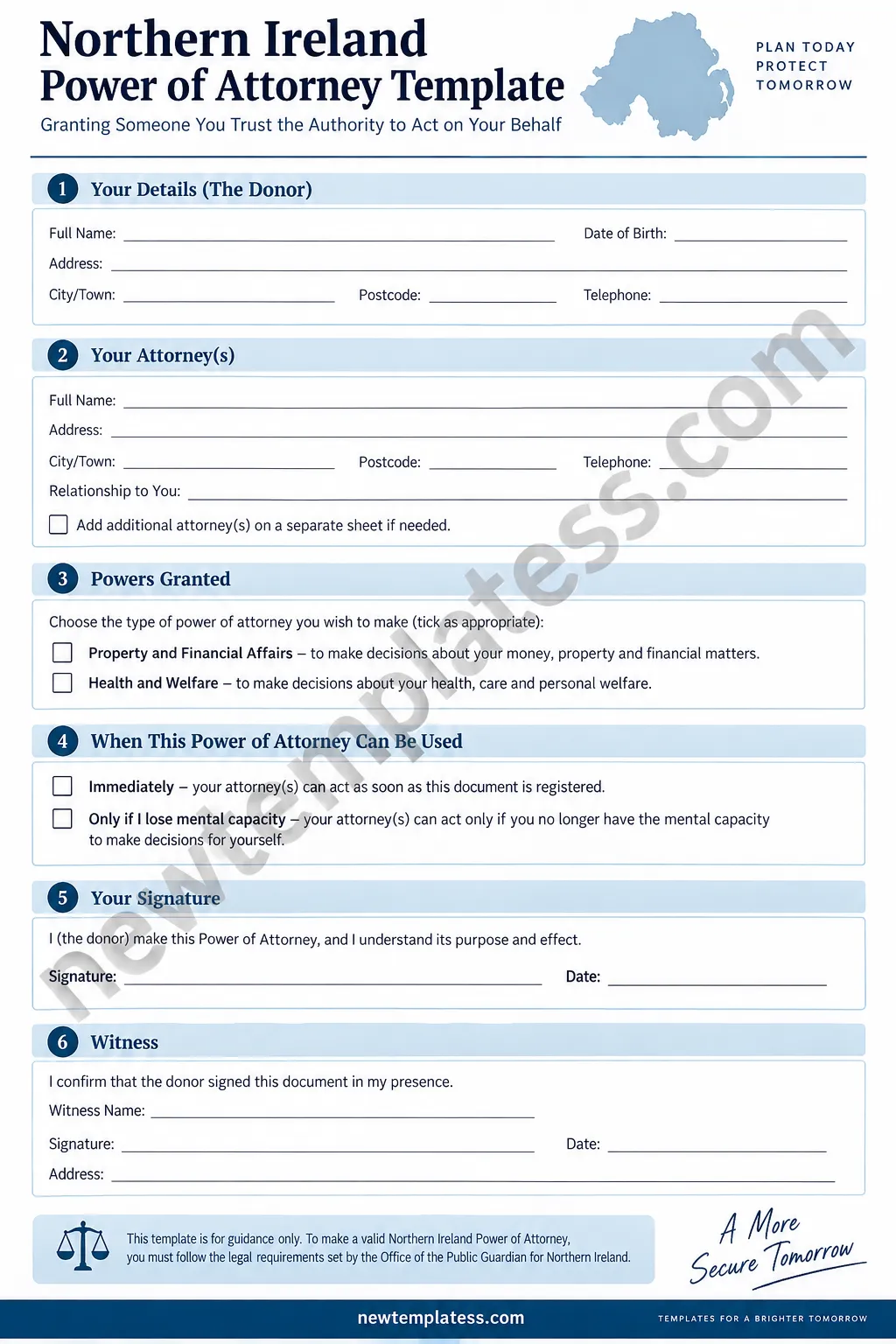
Northern Ireland Power of Attorney Template: What Should You Prepare?
A template can be useful for understanding the information that may need to be considered before completing the appropriate legal documentation. However, a website template should not be treated as a substitute for the official Northern Ireland EPA documentation.
Before preparing an EPA, make a checklist of the information you may need:
- Donor details: full name, address, and other identifying information required by the official documentation.
- Attorney details: the full details of each proposed attorney.
- Scope of authority: consider which property and financial matters the attorney should handle.
- Restrictions: identify any authority the donor specifically wants to limit.
- Timing: consider whether the attorney should have authority immediately or subject to conditions.
- Professional advice: consider speaking with a solicitor where the financial or family circumstances are complex.
The Department of Justice provides official EPA notes and forms, including the EP1 and registration-related EP2, EP3, and EP4 documents. The official publication was updated in January 2026.
Common Mistakes to Avoid
Using the Wrong Type of Power of Attorney
One of the biggest mistakes is assuming that the rules for England and Wales automatically apply in Northern Ireland. They do not. Northern Ireland has its own arrangements for Enduring Powers of Attorney, and an EPA in Northern Ireland covers financial matters.
Waiting Until Capacity Has Been Lost
An EPA must be created while the donor has the mental capacity to understand what they are doing. Waiting until capacity has been lost can mean that an EPA can no longer be created in the normal way.
Giving Too Much or Too Little Authority
Think carefully about the authority required. An overly broad arrangement may provide more control than intended, while an overly restrictive arrangement could make it difficult for an attorney to deal with important financial matters.
Choosing an Attorney Without Discussing the Responsibility
Being appointed as an attorney can involve significant responsibility. Talk openly with the proposed attorney before completing the document so they understand what may be expected of them.
Relying Only on an Online Template
A printable template can help you organise information and understand the basic structure of an EPA, but it should not be assumed to be an official legal document. Always check the current Northern Ireland requirements and official forms before relying on a document.
Where to Find Official Northern Ireland EPA Information
The Northern Ireland Department of Justice provides information about Enduring Powers of Attorney and the Office of Care and Protection. Official guidance and forms are available through the Department of Justice website.
The Office of Care and Protection can also provide general guidance. The published contact details include telephone number 0300 200 7812 and an email address for EPA enquiries.
For personalised advice, particularly where property, investments, family arrangements, business interests, or substantial assets are involved, consider consulting a solicitor who is familiar with Northern Ireland law.
Practical Tips for Using a Power of Attorney Template
- Use the template as a planning and information-gathering tool.
- Check the current official Northern Ireland EPA requirements before signing anything.
- Make sure names and personal details are accurate.
- Discuss the proposed appointment with the attorney in advance.
- Consider carefully whether restrictions are appropriate.
- Keep important documents securely stored and make sure relevant people know where they can be found.
- Review your arrangements if your circumstances or relationships change.
- Seek professional legal advice if you are uncertain about the wording or effect of the document.
Frequently Asked Questions About Northern Ireland Power of Attorney
Does Northern Ireland have a Lasting Power of Attorney?
Northern Ireland’s current system differs from the LPA system used in England and Wales. The Northern Ireland Enduring Power of Attorney covers property and financial affairs. Official Northern Ireland guidance distinguishes this from the health and welfare LPA used in England and Wales.
Does an EPA cover health and welfare decisions?
A Northern Ireland EPA covers financial and property matters. It is not the same as a health and welfare LPA in England and Wales.
Does an EPA need to be registered immediately?
Registration is required when the attorney believes the donor has become mentally incapable of managing their affairs. The official guidance states that registration with the High Court’s Office of Care and Protection is required at that point.
Can an EPA be limited?
Yes. The donor can limit the authority granted to an attorney, including excluding particular areas of their affairs.
Is an online Northern Ireland Power of Attorney template legally sufficient?
A generic online template should not automatically be treated as a legally valid EPA. The safest approach is to use the current official Northern Ireland documentation and obtain professional advice when appropriate.
Conclusion
Creating a Northern Ireland power of attorney can be an important part of planning for the future. An Enduring Power of Attorney allows a person to appoint someone they trust to manage property and financial affairs, including circumstances where the donor later loses mental capacity.
The most important steps are to understand the Northern Ireland-specific rules, choose an appropriate attorney, consider the scope of the authority carefully, and use the current official forms and guidance. A printable template can help you organise your thoughts and information, but it should not replace official documentation or tailored legal advice.
Planning ahead while you still have mental capacity can make future financial administration clearer for both you and the person you trust to act on your behalf.
