A monthly sales framework gives businesses a simple and structured way to turn sales goals into measurable actions. Instead of relying on guesswork or reviewing performance only at the end of the year, a monthly framework helps you set targets, monitor progress, identify problems, and make informed adjustments throughout the month.
Whether you run a small business, manage a sales team, operate an online store, or work in business development, having a clear monthly sales plan can make performance tracking much easier. A good framework connects sales targets with actual results, customer acquisition, conversion rates, revenue, and the actions needed to improve future performance.
This guide explains how to build and use a practical monthly sales framework, which metrics to track, how to analyze monthly performance, and how to turn your findings into an actionable sales plan for the following month.
What Is a Monthly Sales Framework?
A monthly sales framework is a structured system for planning and measuring sales activities over a single month. It typically combines sales targets, weekly performance tracking, customer metrics, product performance, sales channels, and an action plan.
The goal is not simply to record how much money a business made. The framework should help answer important questions such as:
- Did we reach our monthly sales target?
- Which weeks generated the most revenue?
- Which products or services performed best?
- Which sales channels produced the most customers?
- How many new customers did we acquire?
- What was our conversion rate?
- What prevented us from reaching our target?
- What should we change next month?
By answering these questions consistently, businesses can create a repeatable sales management process instead of making decisions based only on intuition.
Why Use a Monthly Sales Framework?
Sales performance can change quickly. A strong month can be followed by a weak month, and overall annual numbers may hide problems that need immediate attention. A monthly sales framework makes performance more visible and gives teams a regular opportunity to respond.
1. Create Clear Sales Goals
A monthly framework begins with a specific sales target. Instead of saying that the business wants to “increase sales,” define a measurable revenue or order goal for the month.
For example, a company might set a monthly revenue target of $25,000. That target can then be divided into weekly milestones so the team can see whether performance is on track.
2. Track Progress Consistently
Weekly tracking makes it easier to identify changes before the month ends. If sales are significantly below target after the second week, the team still has time to adjust its promotional strategy, follow up with prospects, or focus on higher-performing products.
3. Identify Sales Trends
Recording monthly data over time creates a useful sales history. After several months, you can compare revenue, customer acquisition, conversion rates, average order value, and other indicators to identify recurring patterns.
4. Turn Data Into Action
The most useful sales report is not simply a collection of numbers. It should lead to decisions. A monthly sales framework includes an action-planning component so the team can turn performance insights into specific next steps.
Key Components of a Monthly Sales Framework
A useful monthly sales framework should be detailed enough to support decision-making while remaining simple enough to update regularly. The following sections provide a practical structure.
Monthly Sales Target
Start by defining the primary sales goal for the month. Depending on your business model, this could be based on revenue, units sold, number of orders, new customers, or a combination of metrics.
Record both the sales target and actual sales. The difference between these figures shows whether the business exceeded or missed its goal.
Weekly Sales Tracking
Break the monthly target into weekly periods. Track sales for each week and compare actual performance with the expected target.
- Week 1 sales target and actual sales
- Week 2 sales target and actual sales
- Week 3 sales target and actual sales
- Week 4 sales target and actual sales
- Week 5 sales target and actual sales, when applicable
This approach helps sales managers spot performance gaps early rather than waiting for the monthly report.
Top-Selling Products or Services
Not every product contributes equally to revenue. Tracking your top products or services can reveal where customer demand is strongest.
For each product or service, consider recording:
- Product or service name
- Units sold
- Total revenue
- Percentage of overall sales
- Changes compared with the previous month
This information can support decisions about inventory, promotions, pricing, product development, and sales priorities.
Sales by Channel
Customers may purchase through different channels, including a website, physical store, marketplace, social media, email marketing, or direct sales representatives.
Tracking revenue by channel helps identify where sales are coming from. If one channel consistently generates strong results, it may deserve additional attention. If another channel consumes significant resources but produces limited sales, its strategy may need to be reviewed.
Sales Metrics to Track Every Month
A monthly sales framework becomes more useful when it includes a focused set of key performance indicators. You do not need dozens of metrics. Start with the measurements that directly relate to your sales objectives.
Total Revenue
Total revenue shows the amount generated during the month. Compare actual revenue with the monthly sales target to determine overall performance.
Number of Orders
Order volume provides additional context for revenue. Two months may produce similar revenue while having very different numbers of transactions.
New Customers
Tracking new customers helps measure the effectiveness of customer acquisition activities. It also provides an early indicator of future sales opportunities.
Returning Customers
Repeat customers can be an important source of ongoing revenue. Monitor returning customers alongside new customer acquisition to understand the balance between retention and acquisition.
Conversion Rate
Conversion rate measures the percentage of prospects or visitors who complete a desired action, such as making a purchase.
A simple formula is:
Conversion Rate = Number of Conversions ÷ Number of Opportunities × 100
For example, if 500 qualified visitors generate 25 purchases, the conversion rate is 5%.
Average Order Value
Average order value shows how much customers spend per transaction. Increasing this metric can sometimes improve revenue without requiring the same level of customer acquisition.
Average Order Value = Total Revenue ÷ Number of Orders
Customer Acquisition Cost
Customer acquisition cost estimates how much a business spends to acquire a new customer. Tracking this alongside revenue helps determine whether customer acquisition activities are producing sustainable results.
Return on Investment
When possible, measure the return generated by marketing and sales activities. This can help identify which campaigns, channels, and initiatives deserve further investment.
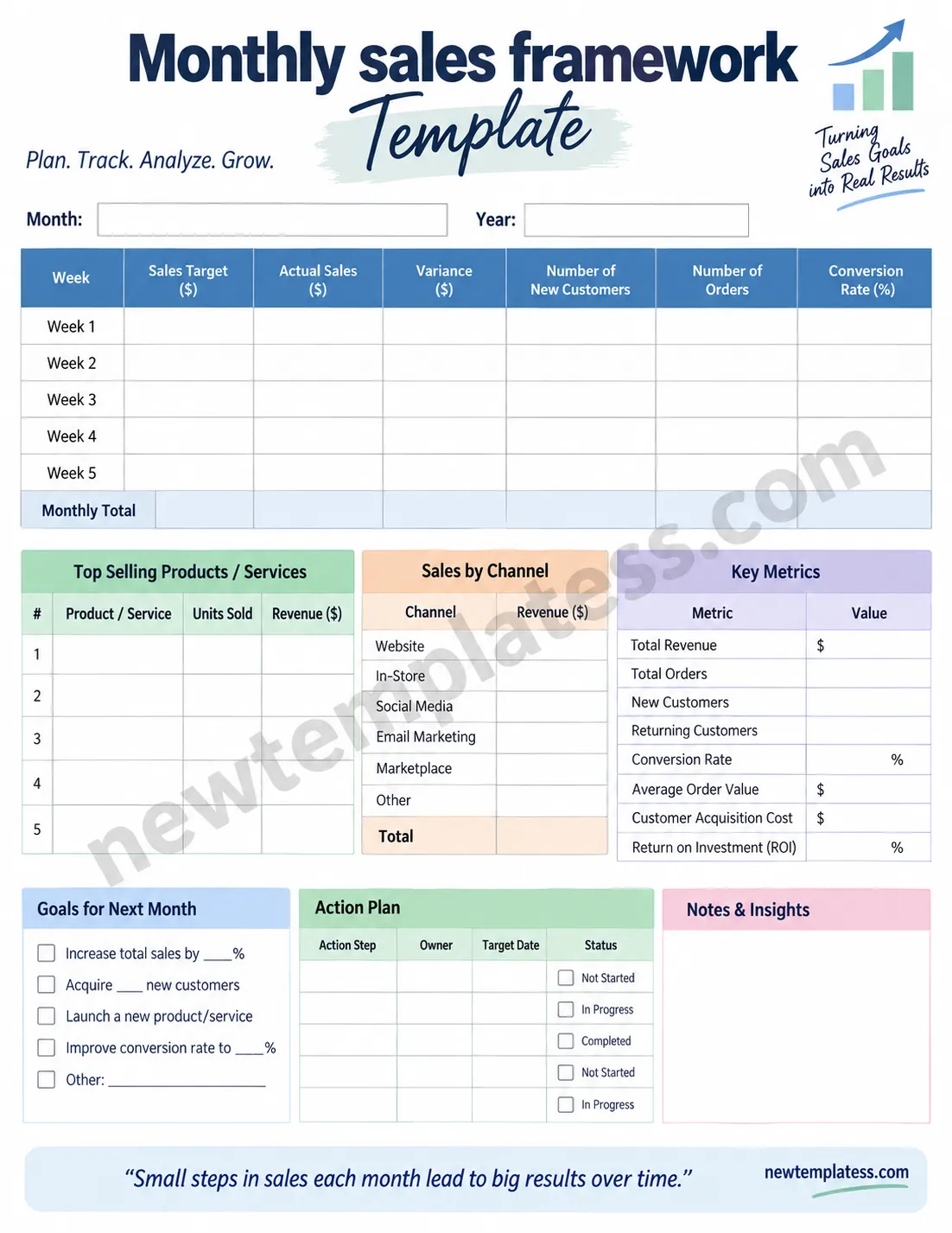
How to Use a Monthly Sales Framework
Creating a framework is only the first step. To get meaningful results, use it consistently throughout the month.
Step 1: Set the Monthly Target
Begin by establishing a realistic but measurable sales target. Review previous performance, seasonal patterns, current opportunities, and business objectives before choosing the target.
Step 2: Divide the Target Into Weekly Goals
Break the monthly target into smaller milestones. The weekly targets do not always need to be identical. For example, a business may expect stronger sales during a promotional week or during a seasonal period.
Step 3: Record Actual Results
Update the framework regularly rather than waiting until the end of the month. Weekly updates are usually sufficient for many small businesses, while larger sales teams may update their figures daily.
Step 4: Analyze the Variance
Compare the target with actual sales. The difference is your sales variance.
Sales Variance = Actual Sales − Target Sales
A negative variance indicates that actual sales are below the target, while a positive variance indicates that actual sales are above the target.
Step 5: Identify the Cause
Do not stop at the number. Investigate why performance changed. Possible causes include changes in customer demand, pricing, inventory availability, marketing performance, seasonality, competition, sales activity, or conversion rates.
Step 6: Create an Action Plan
Convert your findings into specific actions. Each action should ideally have an owner, target date, and measurable outcome.
- Increase follow-up calls with qualified leads.
- Promote high-performing products.
- Improve product pages or sales presentations.
- Test a new promotional campaign.
- Improve email follow-up sequences.
- Review pricing or product bundles.
- Focus sales activity on higher-converting channels.
Tips for Building a More Effective Sales Plan
Keep the Framework Simple
A complicated sales tracking system can become difficult to maintain. Focus on the metrics that directly support your goals. A simple framework that is updated consistently is more useful than a complex dashboard that nobody maintains.
Use Historical Data
Review previous months before setting new targets. Historical sales data can reveal seasonal trends, recurring slow periods, and products that consistently perform well.
Separate Activity From Results
Revenue is an important outcome, but sales activities also matter. Track relevant activities such as qualified leads, sales calls, product demonstrations, proposals, follow-ups, or website inquiries.
This distinction can help explain why results changed. For example, lower sales may be related to fewer qualified opportunities rather than a problem with the sales team’s conversion performance.
Focus on Trends Rather Than One Bad Week
A single weak week does not necessarily indicate a long-term problem. Look for patterns across multiple periods before making major changes.
Review the Framework at Month-End
Reserve time at the end of each month for a structured review. Compare targets with actual results, identify the strongest and weakest areas, document lessons learned, and define priorities for the next month.
Monthly Sales Framework Example
Imagine an online business with a monthly revenue goal of $30,000. The sales manager divides the target into weekly milestones and tracks actual revenue, new customers, orders, and conversion rates.
During the month, the business discovers that its website produces most of its sales, while social media generates many visitors but relatively few purchases. At the same time, one product category produces a large percentage of total revenue.
Instead of simply recording the results, the team uses those findings to create next month’s action plan. It may improve social media landing pages, increase promotion of the high-performing product category, and test a new follow-up campaign for visitors who did not purchase.
This is the main advantage of a monthly sales framework: the data becomes a basis for action.
Common Mistakes to Avoid
- Setting vague goals: Use measurable targets instead of general objectives.
- Tracking too many metrics: Prioritize the indicators that matter most to your business.
- Updating data too late: Regular tracking makes problems easier to identify.
- Ignoring customer retention: Monitor returning customers as well as new customers.
- Looking only at revenue: Include conversion, order volume, acquisition, and product performance where relevant.
- Failing to assign actions: Every important insight should lead to a clear next step when appropriate.
- Not reviewing previous months: Historical comparisons make monthly results more meaningful.
Who Can Use a Monthly Sales Framework?
A monthly sales framework can be adapted to many types of organizations and sales models.
- Small businesses and startups
- E-commerce stores
- Retail businesses
- Sales teams
- Freelancers and consultants
- Service-based businesses
- Marketing agencies
- Business-to-business sales teams
- Independent sales representatives
The framework can also be customized for different goals. A growing company may focus heavily on new customer acquisition, while an established business may pay more attention to repeat purchases, customer lifetime value, and retention.
How to Improve Next Month’s Sales Performance
At the end of each month, turn your results into a short list of priorities. Avoid creating a long list of changes that cannot realistically be completed.
Choose a few high-impact actions and define what success will look like. For example, instead of writing “improve email marketing,” create a measurable objective such as “increase email campaign conversion rate by testing two new calls to action.”
A useful next-month planning process includes:
- Reviewing the previous month’s target versus actual sales.
- Identifying the strongest products and channels.
- Finding the largest performance gaps.
- Reviewing customer acquisition and retention.
- Choosing two or three priority improvements.
- Assigning owners and deadlines.
- Defining measurable targets for the new month.
Conclusion
A monthly sales framework provides a practical structure for turning sales goals into measurable actions. By tracking monthly targets, weekly results, products, channels, customers, conversion rates, and other key metrics, businesses can understand what is working and where improvement is needed.
The most effective framework is not necessarily the most complicated one. It is the one your team can update consistently, understand quickly, and use to make better sales decisions.
Start with a clear monthly target, track progress every week, analyze the reasons behind the numbers, and finish each month with a focused action plan. Over time, this simple process can create a reliable sales management system and provide a stronger foundation for sustainable growth.
