A well-structured childcare center plan turns a promising idea into a document that can guide decisions about services, staffing, facilities, enrollment, marketing, compliance, and finances. The search for a childcare center business Template usually reflects a practical need: the owner wants a reliable structure rather than starting with a blank page. A good template should therefore do more than provide attractive headings. It should prompt the owner to gather evidence, make realistic assumptions, connect operational choices to financial results, and explain how the center will serve families.
Current childcare planning resources commonly organize the plan around an executive summary, business description, market analysis, management, operations, marketing, financial projections, and evaluation. A longstanding child care center business-plan workbook follows a similar section-by-section approach, while newer childcare planning resources emphasize licensing, staffing, enrollment, startup costs, financial projections, and risk planning. :contentReference[oaicite:0]{index=0}
The most useful template is not necessarily the longest one. It is the one that makes missing information obvious. If the proposed tuition has no connection to local competition, the financial section is weak. If the staffing plan does not reflect the ages and capacity of children served, projected payroll can be misleading. If licensing considerations are absent, the opening timeline may be unrealistic. The template should make these connections visible before money is committed.

What a childcare center business template should accomplish
A childcare center business template should function as both a planning framework and a quality-control tool. Its first purpose is to organize the business concept into logical sections that another person can understand. Its second purpose is to force the owner to answer difficult questions before opening: Who are the families being served? Which age groups will be accepted? What capacity is realistic? What services will be offered? How will staff coverage work? What will make the center distinct?
The template should also distinguish between assumptions and verified information. For example, a proposed monthly tuition rate is an assumption until it has been compared with local market evidence. A projected enrollment level is an assumption until supported by demand research, inquiries, waitlist information, or other credible indicators. A licensing requirement should be checked against the relevant authority rather than copied from a generic plan written for another state.
A strong structure also makes revisions easier. Childcare businesses often change their service mix, room capacity, operating hours, staffing schedule, or opening date as new information becomes available. If the business plan is organized logically, changing one assumption should prompt a review of the sections affected by that change rather than requiring the entire document to be rewritten.

The difference between a template and a finished plan
A template contains prompts, headings, placeholders, worksheets, or example structures. A finished business plan contains evidence and decisions specific to one center. This distinction matters because copying a generic plan can create the appearance of preparation without producing useful decision-making information.
For example, a template might ask for “target market,” while the finished plan should explain the actual geographic area, relevant family segments, nearby childcare providers, likely demand patterns, and the reason the proposed center can compete. Similarly, a template might ask for “startup costs,” while the finished plan should contain supplier quotes, lease-related costs, renovation estimates, equipment requirements, professional fees, insurance assumptions, and working-capital needs.
The same principle applies to financial projections. A spreadsheet layout is useful because it establishes relationships between revenue, expenses, enrollment, and cash flow. However, the owner must supply realistic inputs. A visually impressive model with unsupported assumptions is less useful than a simple model built from carefully researched local numbers.
Core sections to include in the plan
A practical childcare center business plan template should cover the complete operating logic of the center. The executive summary should briefly explain the concept, target families, location, age groups, capacity, competitive position, financial requirements, and opening objective. It is usually easier to write this section after the supporting sections have been completed because the summary should reflect the actual plan rather than an early idea.
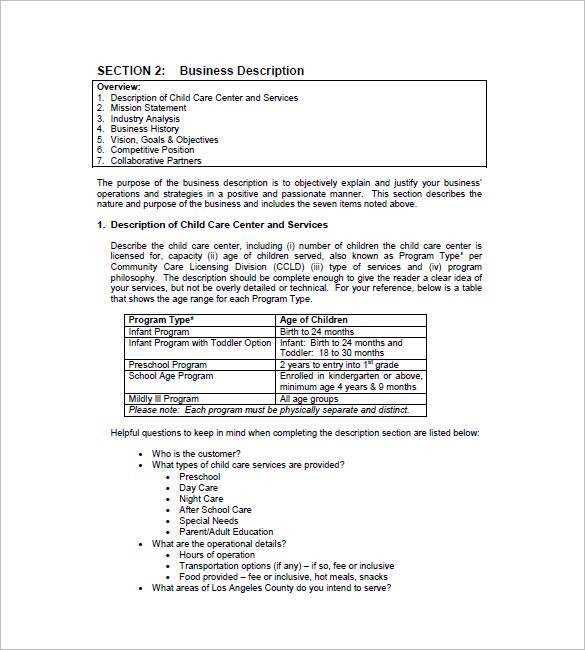
The business description should explain the legal structure, ownership, mission, philosophy of care, services, hours, age groups, planned capacity, and location strategy. It should also explain what problem the center is solving for families. A useful description connects the educational or care philosophy to the actual service design rather than treating the mission statement as a decorative paragraph.
The market section should describe the local environment. Useful research can include competing centers, pricing, age groups served, operating hours, geographic coverage, enrollment availability, nearby employers, housing growth, school patterns, and family characteristics. The objective is not to produce a giant collection of statistics. The objective is to demonstrate why the proposed service is relevant and how the center intends to position itself.

Services, programs, and curriculum
The services section should identify exactly what families are buying. Possible categories include infant care, toddler care, preschool programming, school-age care, extended hours, meals, transportation, enrichment, or seasonal programs. The plan should distinguish services that are confirmed from services that may be introduced later.
Age groups matter because they affect room configuration, staffing, equipment, schedules, tuition structure, and operating costs. A center serving infants may require a substantially different operating model from one focused primarily on preschool-age children. The plan should therefore connect each program to its expected enrollment, staffing requirements, physical space, and revenue contribution.
Curriculum should also be described in practical terms. Rather than making broad claims about educational quality, explain the approach, daily rhythm, learning goals, family communication, and age-appropriate activities. A useful template gives the owner enough space to explain the actual program without forcing every center into the same educational model.
Management, staffing, and operational planning
Staffing is one of the most important parts of a childcare center business plan because labor requirements influence both safety and financial viability. The plan should identify leadership roles, classroom roles, support positions, administrative responsibilities, recruitment needs, qualifications, training, scheduling, and coverage during absences.
Staffing assumptions should be tied to the children served and the rules applicable in the center’s jurisdiction. Generic ratios should not be treated as universal. California, for example, regulates child care centers through the California Department of Social Services Community Care Licensing Division, including staff qualifications, health and safety requirements, capacity, and caregiver requirements. :contentReference[oaicite:1]{index=1}
For a childcare center business template california project, the licensing section should be treated as a planning checkpoint rather than a generic paragraph. California’s official licensing information describes an orientation process and a pre-licensing pathway, while state law requires a current valid license for covered child day care facilities. Local planning should therefore verify current state and municipal requirements before financial commitments are finalized. :contentReference[oaicite:2]{index=2}

Operations and facility planning
The operations section should describe how the center will work on an ordinary day. Include opening and closing procedures, classroom assignments, arrival and departure, meals, rest periods, activities, cleaning, record keeping, family communication, incident procedures, supply management, and emergency planning. The goal is to show that the business can operate consistently rather than relying on informal knowledge held by one person.
Facility planning should connect physical space to the service model. A template can prompt the owner to document location, lease status, usable areas, classrooms, administrative space, food preparation, storage, bathrooms, outdoor areas, entrances, security measures, and required improvements. The exact requirements depend on the jurisdiction and facility type, so the business plan should distinguish confirmed requirements from preliminary assumptions.
Operational policies should also be considered financially. Longer operating hours may increase labor costs. Additional meals may increase food and staffing expenses. Expanded transportation may require vehicles, insurance, maintenance, and additional personnel. A strong business plan therefore avoids treating operations as a separate topic and instead connects operational choices to the financial model.

Choosing between Word, Google Docs, Excel, and PDF formats
People searching for a childcare center business template word version usually need a narrative document that is easy to revise, print, and share with advisors. Word is well suited to sections such as the executive summary, business description, market analysis, policies, operations, and funding narrative. It is less convenient when the document requires extensive financial calculations.
A childcare center business template google docs version can be useful when multiple authorized collaborators need to review the same planning document. It can support comments, revision history, and shared editing. The important consideration is not the brand of the editor but whether the final document maintains clear version control and whether sensitive business information is handled appropriately.
Financial assumptions are usually easier to manage in a spreadsheet. A childcare center business template excel structure can separate enrollment assumptions, tuition, payroll, operating expenses, capital costs, cash flow, and scenario analysis. A narrative document and a financial workbook should be treated as connected components: if enrollment changes in the spreadsheet, the narrative assumptions should be reviewed as well.

When a PDF version makes sense
A childcare center business template pdf can be useful when a stable, non-editable presentation is needed for review, printing, or record keeping. It is particularly useful after the working version has been reviewed and finalized. A PDF should generally be treated as the presentation version rather than the primary working file.
Someone searching for a childcare center business template free pdf may be looking for a printable starting structure. The important distinction is between a blank document that merely looks professional and a substantive planning workbook that prompts the owner to research market demand, staffing, operations, costs, funding, and risks. A printable format has value only when the underlying structure is useful.
Similarly, the phrase childcare center business template free download signals strong intent to locate a ready-made resource. Before relying on any external resource, check whether it actually contains the sections needed for the proposed center, whether its information is current, and whether examples are clearly labeled as examples. Availability of a file does not mean its assumptions or regulatory references apply to every location.

Building the market analysis
The market analysis should begin with a clearly defined service area. For a physical childcare center, this may be based on a practical travel radius rather than an entire city or county. The owner can examine competing centers, age groups, operating hours, tuition structures, available spaces, waiting lists where publicly visible, and the characteristics of nearby neighborhoods and employers.
Competitive analysis should focus on meaningful differences rather than simply listing competitors. A useful comparison might consider location, age groups, schedule, educational philosophy, meals, outdoor space, transportation, extended care, enrollment process, and pricing. The goal is to identify a position that families can understand and that the center can actually deliver.
Market research should also document its sources and dates. Conditions can change as new providers open, existing centers expand, housing patterns shift, or family demand changes. A plan that identifies where its information came from can be updated more easily than a plan containing unsupported claims.

Financial planning and startup costs
The financial section should begin with startup costs. Common categories include facility deposits or acquisition costs, renovations, furniture, classroom materials, outdoor equipment, technology, licensing-related expenses, professional services, insurance, initial marketing, recruitment, training, and working capital. A historical child care startup-cost worksheet illustrates how these costs can be separated into childcare supplies, marketing, furniture and improvements, and administrative expenses.
Do not treat a single startup-cost estimate as universal. Costs vary with location, building condition, capacity, renovation requirements, equipment choices, and opening strategy. A recent childcare financial-planning source similarly emphasizes the need to separate facility costs, licensing and legal fees, equipment, staffing, marketing, insurance, and working capital rather than combining everything into one number. :contentReference[oaicite:4]{index=4}
The financial plan should then move from startup costs to recurring operating costs. Payroll, rent, utilities, insurance, food, supplies, maintenance, professional fees, technology, marketing, and administrative expenses should be modeled separately where practical. This makes it easier to identify which costs change with enrollment and which costs remain relatively stable.

Revenue and enrollment projections
Revenue projections should be based on the actual service model. If tuition differs by age group, the spreadsheet should show those categories separately. If there are registration fees, extended-care fees, meals, subsidies, enrichment programs, or other revenue sources, each should be identified separately rather than hidden inside one total.
Enrollment should usually be modeled as a gradual ramp rather than an assumption that every available place will be occupied immediately. The plan can show opening-month enrollment, expected monthly additions, withdrawals, seasonal changes, and target occupancy. This creates a clearer connection between the marketing plan and the financial plan.
A good model also allows scenarios. For example, the owner might test a slower enrollment ramp, higher payroll, a delayed opening, or a renovation overrun. The purpose is not to predict the future perfectly. It is to understand which assumptions have the greatest effect on cash requirements and operating sustainability.

Using financial worksheets effectively
A financial worksheet becomes much more useful when each line has a clear source or assumption. Tuition should be supported by market research or a defined pricing strategy. Payroll should reflect planned staffing. Rent should be based on an actual proposal or reasonable market evidence. Renovation estimates should be based on contractor information when possible.
The childcare center business template free search intent often reflects the desire to reduce the cost and effort of planning. A no-cost starting structure can be useful, but the owner should spend the saved effort on validating assumptions rather than simply filling empty cells. The real value of the template is the decision process it creates.
When a financial model is connected to the narrative plan, discrepancies become easier to identify. If the narrative says the center will serve 60 children but the spreadsheet calculates revenue using 45, the mismatch should be corrected. If the staffing section describes extended hours but payroll excludes the additional coverage, the model needs revision.
Marketing, enrollment, and retention strategy
The marketing section should explain how prospective families will discover the center and why they will consider enrolling. Possible channels include local search visibility, a website, community partnerships, referrals, local organizations, events, signage, educational content, and targeted outreach. The best channel mix depends on the local market and the families being served.
Enrollment planning should describe the journey from inquiry to enrollment. A useful workflow can include inquiry response, information sharing, tour scheduling, facility visit, program explanation, enrollment paperwork, deposit or registration steps where applicable, orientation, and first-day preparation. The plan should identify who owns each stage and how inquiries will be tracked.
Retention deserves equal attention. A center can spend heavily to generate inquiries while still struggling if families leave quickly. Retention planning can include consistent communication, clear expectations, reliable schedules, responsive issue resolution, family engagement, and a service experience aligned with the promises made during enrollment.

Risk management and contingency planning
A childcare center plan should identify risks before opening. Examples include delayed licensing, construction overruns, slower enrollment, unexpected staff vacancies, higher insurance costs, equipment replacement, changing local demand, or interruptions affecting the facility. The goal is not to predict every event but to identify the events that could materially change the operating plan.
Each significant risk should have an early warning indicator and a response. If enrollment is below target for several months, the response might include a revised marketing plan, schedule adjustment, stronger referral partnerships, or a review of pricing and service design. If staffing becomes difficult, the plan should identify recruitment channels, training priorities, backup coverage, and realistic payroll assumptions.
Contingency planning should also include cash. Working capital is not merely a financial cushion; it provides time to respond when actual performance differs from projections. The business plan should show how long the center could continue operating under a weaker enrollment scenario and which costs could be adjusted without undermining required care and safety.

How to evaluate a business plan template before using it
Start by checking whether the template reflects a childcare center rather than a generic small business. A useful plan should address capacity, age groups, programs, staffing, facility requirements, enrollment, tuition, licensing, safety, marketing, startup costs, operating costs, cash flow, and risk. Childcare-specific planning resources commonly include these areas because the economics and operating constraints are closely connected to enrollment and staffing. :contentReference[oaicite:5]{index=5}
Next, check whether the template encourages evidence. Prompts such as “describe your market” are less useful than prompts asking for the service area, competitor information, pricing evidence, demand indicators, and source dates. A good worksheet should help the reader distinguish facts, estimates, and decisions.
Finally, check whether the template is easy to maintain. Avoid a document that requires excessive duplication between sections. The financial model should use consistent assumptions, while the narrative should explain those assumptions. If a change in enrollment requires updating five unrelated paragraphs and several disconnected spreadsheets, the structure is likely to create avoidable errors.

Practical Solution
The most practical approach is to build the plan in layers. First, define the center concept: location, age groups, capacity, services, operating hours, philosophy, and target families. Second, research the local market and regulatory environment. Third, create the staffing and facility plan. Fourth, build the financial model from those operating assumptions. Finally, write the executive summary after the supporting sections are stable.
Use one master assumption set for enrollment, capacity, tuition, staffing, payroll, rent, and major operating costs. If possible, keep these assumptions in a spreadsheet and use the narrative document to explain the logic behind them. Run at least three scenarios: a conservative opening, a base case, and a stronger enrollment case. The purpose is to reveal how much working capital may be needed and which assumptions deserve additional research.
For someone comparing a business plan template for child care center with a daycare center business plan template, the better choice is the one that matches the actual operating model. A center serving infants and preschoolers needs different staffing and facility assumptions from a small home-based program. Likewise, a lender-facing plan may need more detailed financial schedules than an internal planning document.
As a practical workflow, complete the business description first, then market research, services, staffing, operations, marketing, and financials. Use the completed sections to write the executive summary. Review every number for consistency, label hypothetical examples clearly, verify regulatory information with the applicable authority, and have an accountant, licensing specialist, or experienced childcare advisor review areas outside your expertise.

When a downloadable or printable structure is useful
A childcare center business plan template pdf is useful when a stable review copy is needed, while an editable Word structure is generally better for narrative development. A spreadsheet is preferable for calculations, and a shared document can be useful for collaborative review. There is no requirement that every planning function live inside one file.
For readers searching for a free childcare business plan template, the key question should be whether the structure covers the decisions that matter. For readers searching for a free childcare business plan template in a printable format, the same principle applies: inspect the sections before relying on the document. A simple, well-organized workbook can be more useful than a visually elaborate file with little guidance.
A childcare center business template free download may look attractive in search results because it promises a quick starting point, but the owner should still validate every jurisdiction-specific statement and financial assumption. A template should accelerate organization, not replace research. The finished plan should ultimately describe one specific center, one market, one operating model, and one defensible financial strategy.

Putting the finished plan into practice
Once the document is complete, it should become a working management reference rather than a file that is never revisited. Before signing major contracts, compare actual quotes with the assumptions in the plan. Before hiring, compare the staffing schedule with projected enrollment. Before opening, compare the licensing timeline with the financial runway. These checks help prevent a plan from becoming outdated before the business begins operating.
After opening, compare actual enrollment, revenue, payroll, occupancy, and major expenses against the original assumptions. Variances should be investigated rather than automatically treated as failures. A lower enrollment figure may indicate a marketing issue, a pricing issue, seasonal behavior, or simply a slower ramp than expected. The plan becomes more useful when it helps explain why actual performance differs from expectations.
The same process applies during expansion. If the center considers adding classrooms, extending hours, introducing another age group, or opening another location, update the operational model first and then revise the financial projections. A disciplined planning process makes growth decisions easier to evaluate because the owner can see how a proposed change affects staffing, space, revenue, cash requirements, and risk.

Reference Examples
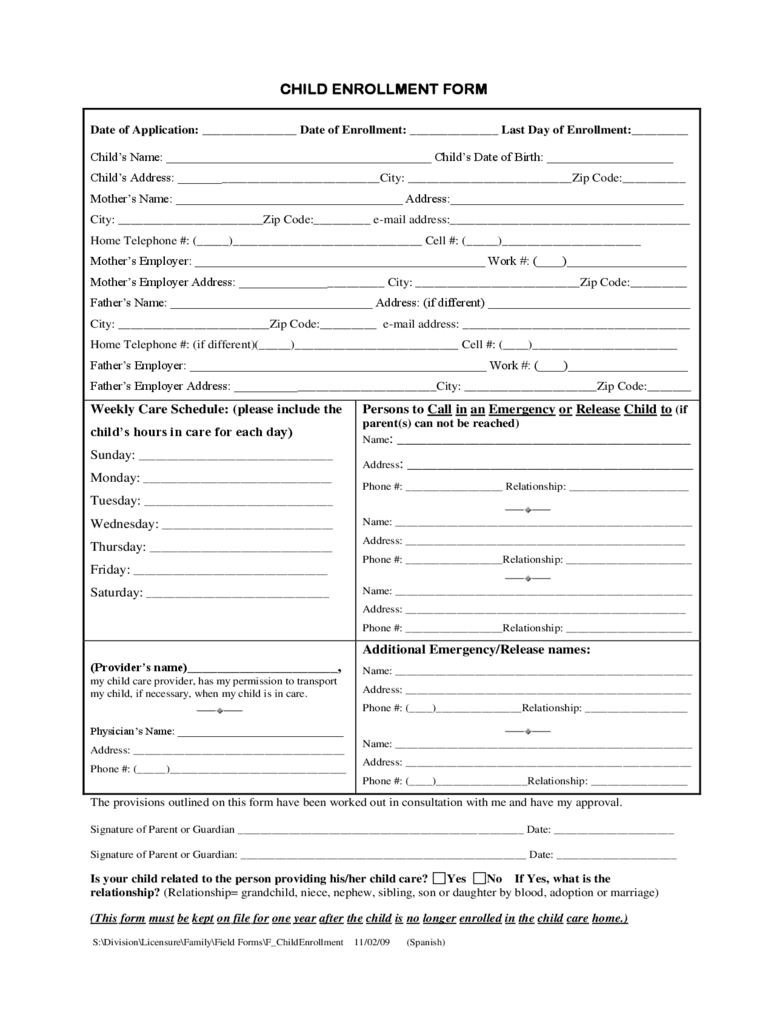
A childcare center business Template is easiest to evaluate when readers can see how real planning documents organize information. The examples below represent different practical components, including enrollment records, startup-cost worksheets, staffing schedules, financial projections, funding requirements, cash-flow forecasts, competitive analysis, and personnel responsibilities. They are useful as visual references rather than universal formats. Each center should adapt its plan to its own location, business model, services, staffing structure, and applicable rules.
These visual references also demonstrate why a strong childcare plan is usually more than a narrative document. A complete planning system may combine a written business plan with worksheets and financial schedules that make assumptions visible. Looking at several document structures can help an owner recognize which information belongs in the main narrative, which information is better handled in a spreadsheet, and which operational details should be supported by separate records or planning schedules.

Family Child Care Enrollment and Authorization Form
Source: TemplateNum

Child Care Center Start-Up Cost Form
Source: SampleForms
Child Care Enrollment Form
Source: HandyPDF

Staffing Pattern for Child Care Facilities
Source: Templateroller

Childcare Center Financial Projection Template
Source: Startup Financial Projection

ABC Daycare Funding Requirements
Source: Etsy

ABC Daycare Cash Flow Forecast
Source: Etsy
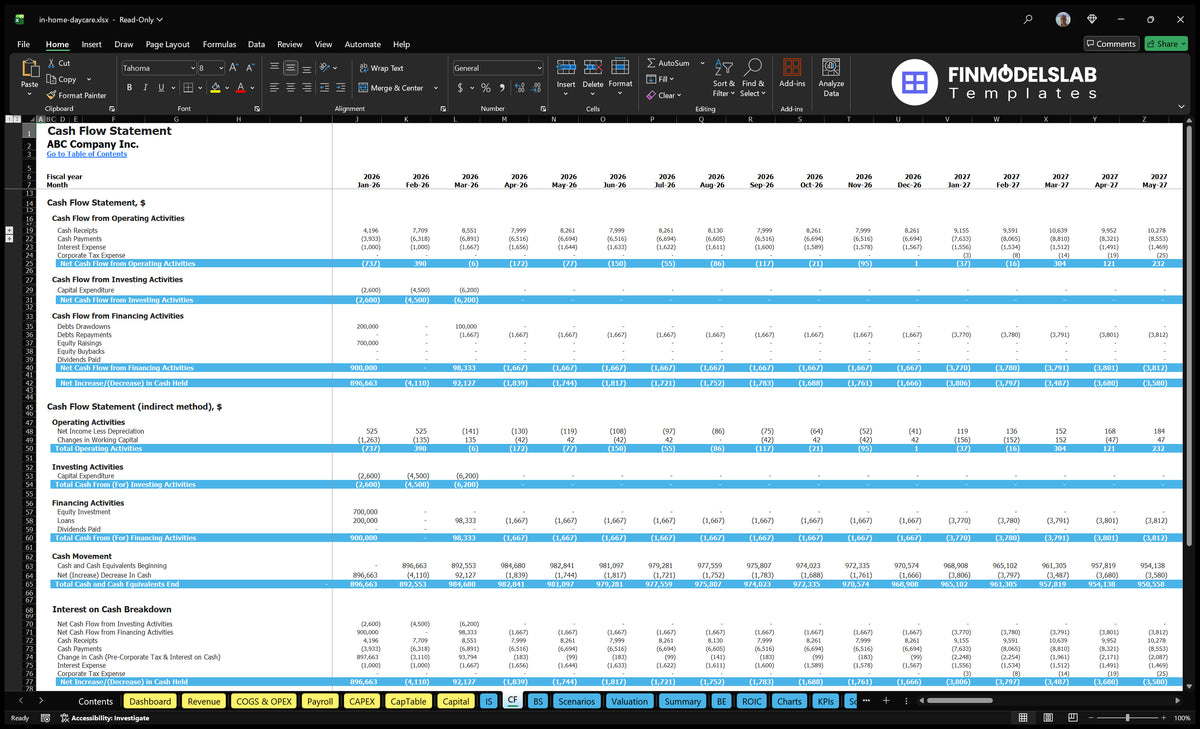
In-Home Daycare Cash Flow Statement Template
Source: Financial Models Lab
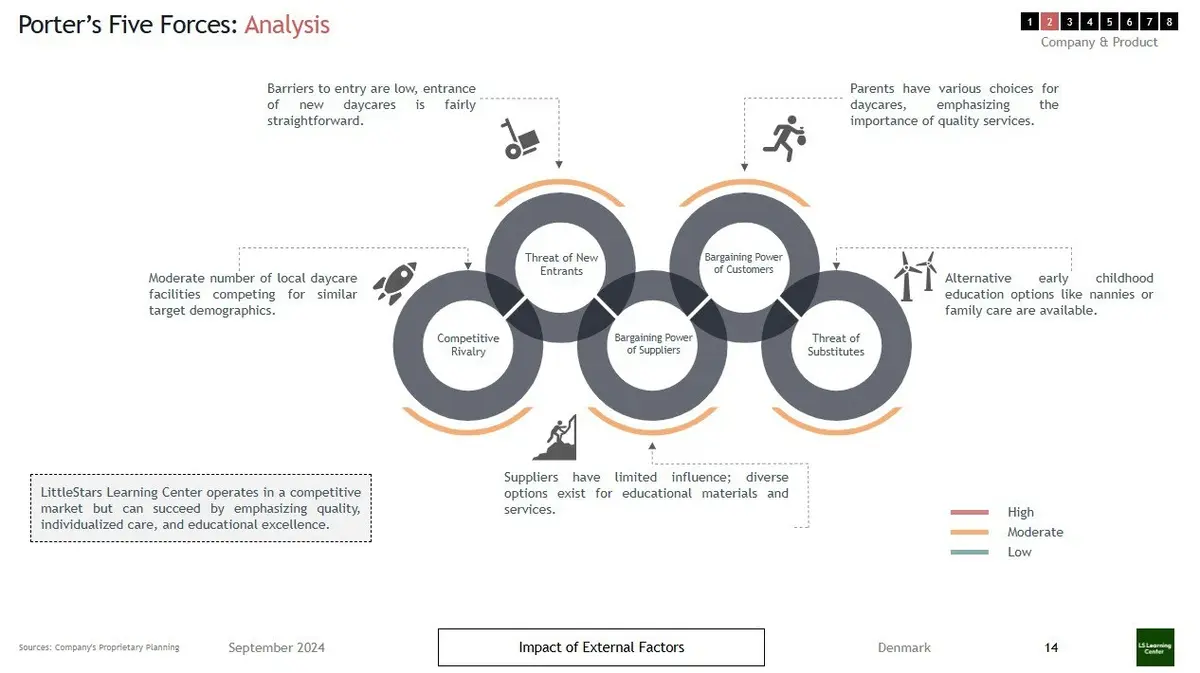
Porter’s Five Forces for Daycare Market
Source: PrometAI

Key Personnel Roles and Responsibilities
Source: SlideTeam
