An educational power of attorney form Template is generally used to document the authority given to another person to participate in educational matters on behalf of a student or minor. Depending on the situation and jurisdiction, the authority may cover school enrollment, educational records, meetings, special education decisions, permissions, communication with school officials, and other defined responsibilities. The exact scope matters because a general caregiver authorization is not necessarily the same as an educational power of attorney, and a document designed for one state may not satisfy the requirements of another.
People commonly search for an educational power of attorney when a parent will be away, a child will live temporarily with another caregiver, an adult student wants a trusted person involved in educational decisions, or a student with special education services needs a written designation concerning educational rights. Virginia, for example, recognizes written educational power-of-attorney arrangements for competent adult students in special education contexts, while Virginia law also contains a separate statutory parental-delegation form for minors.
The most important lesson is that a template should be treated as a drafting framework rather than automatic proof of legal validity. State law, the student’s age, custody arrangements, existing court orders, school district procedures, and the precise authority being delegated can all change the appropriate document. Texas, for instance, distinguishes an authorization agreement for a nonparent relative from a power of attorney and states that a public school cannot exclude an otherwise eligible student solely because the family lacks such an authorization agreement.

What an Educational Power of Attorney Does
An educational power of attorney generally creates a written record identifying the person who gives authority, the person receiving authority, the student concerned, and the decisions the agent may make. The document is especially useful when the parent, guardian, or adult student wants school personnel to know exactly who may receive notices, attend meetings, inspect records, provide consent, or participate in specified educational processes.
The authority should be written as precisely as possible. A document that merely says an agent may “handle school matters” can leave room for disagreement about whether that includes records, special education meetings, enrollment, discipline, transportation, extracurricular activities, testing, or other issues. A more carefully structured educational power of attorney separates the authority into individual categories so that the signer can grant only what is actually needed.
Educational rights can also differ depending on whether the student is a minor or an adult. For adult students, especially students receiving special education services, the student may personally control educational rights after reaching the age of majority. Virginia guidance explains that a competent adult student can designate another competent adult by power of attorney and can revoke or change that designation while competent.
Who Can Be the Principal and Who Can Be the Agent?
The principal is the person granting authority. For a minor child, that may be a parent or another legally authorized guardian, subject to the applicable state rules and any existing custody order. For an adult student, the student may be the person granting educational authority if the student has the capacity required by law.
The agent, sometimes called an attorney-in-fact, is the person who receives the specified authority. The agent might be a parent, grandparent, relative, caregiver, or another trusted adult. The important consideration is not simply familiarity with the student, but whether the person can reliably communicate with the school, protect confidential information, attend meetings when needed, and make decisions within the limits of the document.
A carefully prepared form should identify the agent with enough information to eliminate confusion. Full legal name, address, telephone number, and relationship to the student are common identifying details. Where several children are covered, each child should be identified individually rather than relying on vague language that could make the scope uncertain.
Core Sections of a Strong Template
A useful educational power of attorney template normally begins with identification. The student should be identified by full name and, where appropriate, date of birth and contact information. The principal and agent should also be clearly identified. If the document applies to more than one student, the document should state whether the authority applies equally to each child.
The next section should define the authority. Educational authority can be broad or limited. A broad clause might authorize participation in school meetings and access to educational information, while a limited clause might authorize only enrollment and routine school communication. A well-designed document can also specify whether the agent may sign educational documents or merely receive information and participate in discussions.
Duration is another essential component. The form should state when the authority begins and, when appropriate, when it ends. Some state laws impose statutory time limits on parental delegations, while other arrangements may have different rules. A document should therefore avoid assuming that a single duration works nationwide.

Educational Authority Versus General Caregiving Authority
An educational power of attorney should not automatically be treated as a substitute for guardianship, custody, or every form of parental authority. Some documents combine education with medical care, daily care, travel, and other responsibilities, while others are deliberately narrow. The distinction matters because a school may need evidence of authority for a particular transaction rather than a broad delegation covering unrelated areas.
For example, a parent who is temporarily abroad might want a caregiver to communicate with a school and attend meetings but might not intend to transfer authority over unrelated financial matters. A limited educational document can make that intention clearer. Conversely, a caregiver responsible for a child during a lengthy absence may need a broader state-specific authorization covering education and other forms of care.
Virginia provides a useful example of why terminology must be examined carefully. Its statutory parental-delegation form can include the right to enroll a child in school, inspect education records, attend school functions, and give or withhold certain consents. The same statute also places important limits on the delegation and states that it does not modify existing court orders.

Education Records and School Communication
One of the most important practical issues is access to educational records. A person may have permission to care for a child without automatically having every record-access right that a parent possesses. The document should therefore identify whether the agent may inspect, receive, discuss, or sign documents concerning educational records.
Special education can require even more precision. An educational agent may need authority to receive meeting notices, participate in evaluations, review educational documents, discuss an individualized education program, or exercise procedural rights. A Virginia educational power-of-attorney resource specifically describes authority involving meetings, evaluations, education records, educational documents, and special education dispute procedures.
The practical advantage of precise wording is that the school can more easily determine what the agent is authorized to do. It also reduces the possibility that an agent assumes powers that were never granted. If the school has its own authorization or release form, that school form may still be useful even when a separate power of attorney exists.
State Differences Matter
There is no single nationwide educational power of attorney template that should be assumed to satisfy every state. State laws can differ on execution, notarization, witnesses, duration, recording, who may delegate authority, and what authority can legally be transferred.
Florida illustrates the importance of checking execution requirements. Florida’s power-of-attorney statute provides that an agent must generally be an adult individual or qualifying financial institution and that a power of attorney must be signed by the principal, witnessed by two subscribing witnesses, and acknowledged before a notary public or executed through another statutory method.
California presents another important distinction. A California minor-child power of attorney may be used for temporary care decisions, but California also recognizes caregiver authorization mechanisms and treats custody as a separate legal issue. A form should therefore not be described as transferring custody merely because it gives a caregiver certain educational or care-related authority.

California Considerations
When researching an educational power of attorney form template california, the first step should be determining whether the intended arrangement concerns school decisions only, broader temporary care, or legal custody. Those are not necessarily interchangeable concepts. California materials concerning minors distinguish caregiver authorization from custody, making it important to match the document to the actual purpose.
A California-focused template should clearly identify the child, parent or guardian, caregiver or agent, specific educational powers, duration, and signatures. If the arrangement involves a school enrollment issue, special education rights, or an existing custody order, the school and applicable legal authority should be checked before relying on a generic form.
The safest approach is to use a California-specific structure when the situation is governed by California law and then compare its execution requirements with the current statutory rules or instructions from the relevant institution. A generic template can help organize information, but it should not be mistaken for a state-approved form unless the source actually identifies it that way.

Florida Considerations
Readers searching for an educational power of attorney form template florida should first determine whether they need a minor-child delegation, a broader power of attorney, or an educational arrangement for an adult student. Florida schools may also have their own enrollment and caregiver documentation procedures, so the document’s legal scope should be separated from the school’s administrative requirements.
A Florida minor-child form can specify whether the agent receives all parental authority or only authority described in the document. A current Florida school-related caregiver form, for example, may identify the child, parent or court-appointed guardian, attorney-in-fact, powers granted, effective date, and termination conditions.
Execution should be treated as a separate checklist item. Florida’s statutory power-of-attorney rules expressly address witnesses and acknowledgment, so a signer should not assume that merely typing names into a template creates a properly executed legal instrument.

Virginia Considerations
The phrase educational power of attorney form template virginia can refer to more than one situation. For minors, Virginia has a statutory parental or legal-custodial delegation form. For adult students, especially those receiving special education services, Virginia recognizes educational power-of-attorney arrangements through which the adult student can designate another competent adult to participate in educational matters.
The Virginia statutory form for parental delegation expressly includes school enrollment, inspection and copying of education records, school activities, and certain school-related consents among possible delegated powers. It also provides an alternative for specifying particular powers instead of using the broader delegation.
Virginia law also limits the use of parental-delegation documents for improper school-enrollment purposes and states that the delegation does not override existing court orders concerning custody, visitation, support, or related parental rights. Those limitations are important when evaluating any Virginia template.
Texas Considerations
Searchers using the phrase educational power of attorney form template texas should be especially careful with terminology. Texas provides an authorization agreement framework for a nonparent relative, and the Texas Education Agency explains that such an agreement is not required for public-school enrollment when the student otherwise qualifies for enrollment.
That means a parent should not automatically assume that a generic educational power of attorney is required merely because a child is staying with a relative. The correct document may depend on why authority is being delegated, the relationship of the caregiver, the student’s circumstances, and the particular school or district procedure involved.
Texas also has educational decision-making considerations for adult students. State materials describe power of attorney as one possible alternative to guardianship for educational decision-making in appropriate circumstances. The student’s capacity and the exact rights being delegated remain important considerations.

What a PDF or Word Version Should Contain
An educational power of attorney form template pdf is useful when the reader needs a document layout that can be printed and reviewed before signing. The visual advantage of a PDF-style form is that sections, signature blocks, dates, checkboxes, and notarial areas can be kept in a stable arrangement.
A Word-oriented structure can be useful when the document needs controlled editing before final execution. A free power of attorney form template word may appear convenient, but convenience should not replace legal review. The key question is whether the underlying wording matches the jurisdiction and intended authority, not merely whether the document can be edited.
The same principle applies to searches for a free power of attorney form template pdf or template power of attorney form free. A blank document may be visually well designed yet unsuitable for the intended state, student age, or educational purpose. A reader should inspect the source, jurisdiction, signing instructions, and scope before relying on it.

How to Draft the Authority Section
The authority section is usually the heart of an educational power of attorney. Instead of using a single broad sentence, consider separate categories such as school enrollment, educational records, meetings, evaluations, special education services, extracurricular permissions, school communication, and signing authority. This makes the document easier to interpret.
For example, a hypothetical limited clause might authorize an agent to receive school notices, attend parent-teacher meetings, communicate with teachers, inspect educational records, and sign routine school permission documents. If the principal does not intend to grant authority for special education decisions, that limitation should be stated rather than left to inference.
A broader example might authorize the agent to participate in educational planning and evaluations, review records, sign specified school documents, and communicate with the school district. Such language should still be adapted to the student’s circumstances and applicable law rather than copied blindly from another jurisdiction.

Signing, Witnesses, and Notarization
Execution requirements are among the easiest details to overlook. Depending on jurisdiction and document type, a power of attorney may require notarization, witnesses, both, or another statutory procedure. Some forms may recommend notarization even where the underlying law does not impose the same requirement.
The safest workflow is to determine the governing state first, identify the applicable statute or official guidance, and then complete the document using those requirements. The signer should not sign prematurely if the document requires witnesses or a notary to be present at the same time.
Florida provides a clear example of formal execution rules, while Virginia’s parental delegation statute also specifies execution requirements for its statutory form. These differences demonstrate why a generic signature block cannot be assumed to work everywhere.

Duration, Revocation, and Replacement
The form should clearly state its effective date and, when applicable, expiration date. A document that does not clearly identify its duration can create practical uncertainty for schools and caregivers, particularly when an institution needs to decide whether an agent’s authority remains current.
Revocation language is also valuable. The principal should know how the authority can be withdrawn and how the school or other institution will be notified. If a replacement document is created, the new document should be clearly identified as superseding the earlier designation where applicable.
Duration rules vary considerably among states. Virginia’s parental delegation statute, for example, provides different maximum periods depending on circumstances, while other jurisdictions use different statutory periods or no fixed statutory limit. A template should therefore never assume that one expiration period is universally appropriate.

Common Mistakes to Avoid
One common mistake is using a general power-of-attorney form when the actual need concerns a minor child’s education. Another is assuming that a caregiver’s physical possession of a child automatically gives that person authority to inspect records, sign educational documents, or make special education decisions.
A second mistake is copying a document from another state without checking its statutory basis. A state-specific document may contain terminology, witness provisions, time limits, or limitations that do not transfer to another jurisdiction. The appearance of a form can be nearly identical while the legal requirements are materially different.
A third mistake is giving broader authority than necessary. If the purpose is simply to let a trusted adult attend meetings and communicate with a school while the parent is traveling, a carefully limited authorization may be more appropriate than an expansive delegation covering unrelated areas.

Practical Solution
The most practical way to use an educational power of attorney template is to begin with the real-world task that needs to be handled. Write down exactly what the agent must be able to do at school. For example, the list might include receiving notices, attending meetings, reviewing records, communicating with teachers, signing routine permissions, or participating in special education procedures. Then remove every authority that is not actually necessary.
Next, identify the legal setting. Determine whether the student is a minor or an adult, where the student resides, who currently holds parental or custodial authority, whether a court order exists, and whether the student receives special education services. Then verify the current state rules for execution, duration, witnesses, notarization, and revocation. This process is more reliable than choosing a visually attractive template first and trying to make it fit afterward.
Finally, provide the completed document to the school or district before an urgent decision is needed. Ask whether the institution requires an additional internal authorization, record-release form, enrollment document, or special education designation. Keep the signed original secure and provide copies only to appropriate parties. If the authority involves substantial educational rights, disputed custody, or an adult student’s capacity, professional legal guidance can help prevent a document from being used beyond its intended scope.
Using a Template as a Drafting Framework
An educational power of attorney template is most useful when it helps the signer think through the essential components before execution. The document should identify the parties, describe the student, define authority, state limitations, specify duration, provide revocation language, and include the appropriate signature and acknowledgment provisions.
Templates are particularly helpful for comparing document structures. One state form may place educational authority inside a broader child-care delegation, while another may focus on specific educational rights. The differences can help a reader identify which issues need to be addressed in the final document.
For people searching for a power of attorney template form, the important quality test is not simply whether the form looks professional. The better test is whether it accurately reflects the legal relationship, the intended powers, the jurisdiction, and the practical requirements of the institution that will receive it.
How to Evaluate an Educational Form Before Signing
Start by reading every heading and authority clause. Look for references to education records, school enrollment, meetings, evaluations, special education, educational consent, and signatures. Then identify provisions that concern unrelated medical, financial, travel, or property matters. Those provisions may indicate that the document is broader than the educational purpose you originally intended.
Next, check the jurisdiction. A form should identify the state law under which it is intended to operate when appropriate. If the form contains another state’s statute number, agency name, or execution instructions, it should not be assumed to work merely because the wording appears sensible.
Finally, examine the signature section. Determine whether witnesses or notarization are required and whether the agent must accept the appointment. If the document will be used with a school district, confirm whether the school has an additional process for recognizing the agent.

Why Generic Forms Can Create Problems
A generic form can fail when it assumes the wrong legal relationship. For example, a document intended for a minor may not be appropriate for an adult student who is independently controlling educational rights. Likewise, a caregiver authorization may not establish the same authority as a court-appointed guardian.
Another issue is institutional acceptance. A school may understand one statutory form immediately but ask for additional evidence when presented with a custom document. This does not necessarily mean the custom document is invalid; it means the school needs enough information to determine what authority the signer or agent possesses.
There is also a privacy dimension. The form should grant only the record-access authority necessary for the educational purpose. Overly broad authorization can disclose more information than the principal intended, while overly narrow authorization may leave the agent unable to perform the task that prompted the document in the first place.

Adult Students and Transfer of Educational Rights
Adult students require special attention because educational decision-making can change when a student reaches the age of majority. In special education, the transition of rights may mean that a parent no longer automatically exercises the student’s educational rights. A power of attorney can be one possible mechanism for an adult student who wants another competent adult to participate or act on the student’s behalf.
Virginia regulations expressly recognize an adult student’s written power-of-attorney designation as one circumstance under which another competent adult may receive notices and participate in meetings and other educational procedures. The local educational agency is directed to rely on the designation until it receives notice that the authority has been revoked, terminated, or superseded by court order. :contentReference[oaicite:14]{index=14}
Texas resources similarly describe educational power of attorney as one alternative available in certain adult-student circumstances, alongside supported decision-making and educational-representative procedures. The appropriate option depends on the student’s ability to understand the arrangement and the level of decision-making authority intended.
Reference Examples
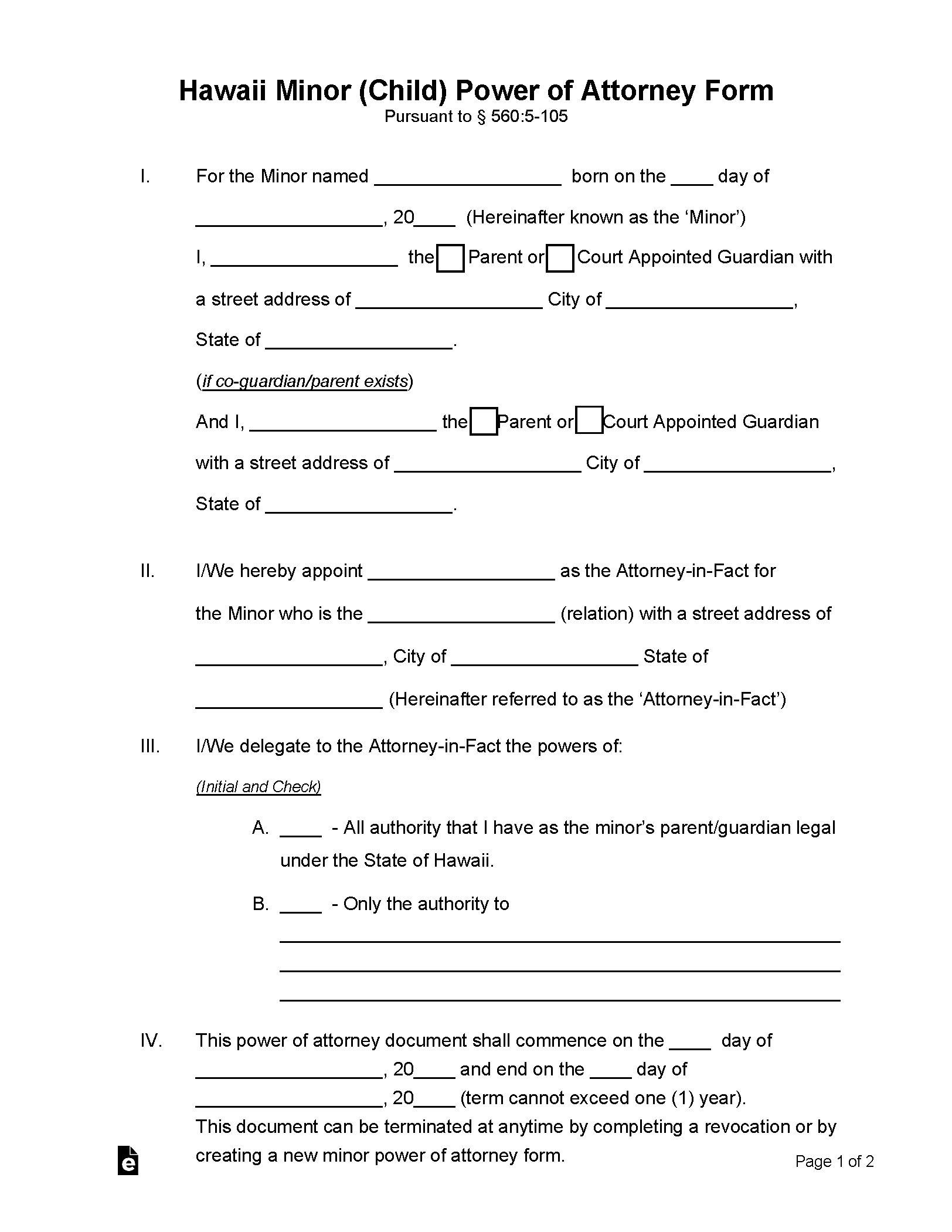
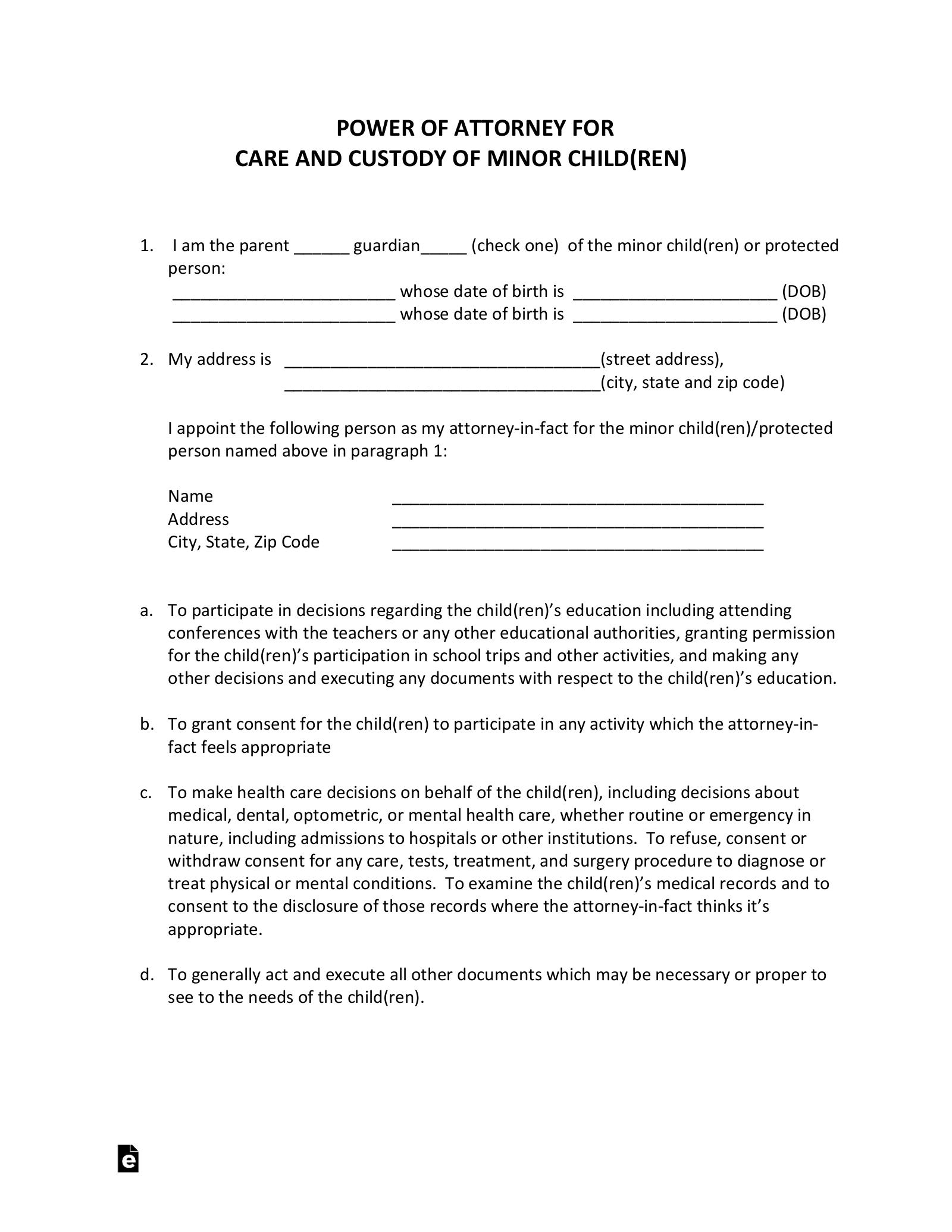
An educational power of attorney form Template is easier to evaluate when readers can compare real document structures rather than relying only on descriptions. Useful visual references show how different forms identify the principal, student, agent, delegated authority, effective period, signatures, witnesses, and notarization. They also demonstrate that terminology varies: one document may emphasize educational decisions, while another may combine education with care, health, custody, or other responsibilities. These differences are important because the best template is the one that matches the student’s circumstances and governing jurisdiction rather than the one with the most attractive appearance.
The following references illustrate common layouts and drafting patterns associated with minor-child and educational power-of-attorney documents. They can help readers recognize authority clauses, limitations, signature areas, and state-specific structures. They should be viewed as visual references rather than universal forms. Before execution, the applicable state rules and the requirements of the school or educational agency should be checked, particularly when the document concerns special education, educational records, an adult student, custody, or an existing court order.

Waco ISD Limited Power of Attorney Form
Source: Waco Independent School District

Georgia Minor Child Power of Attorney Form
Source: eForms
Virginia Minor Child Power of Attorney Form
Source: eForms
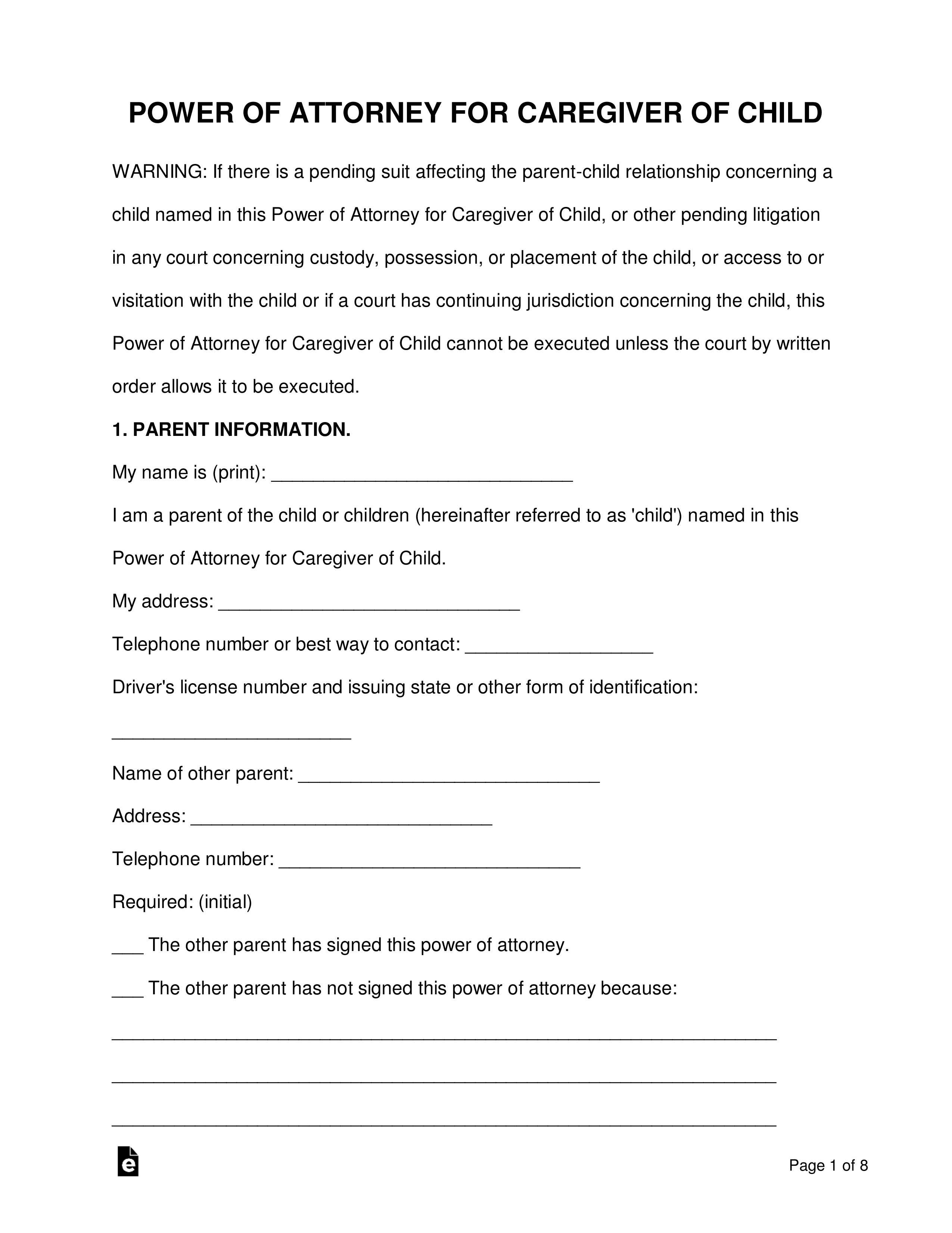
Texas Power of Attorney for Caregiver of Child
Source: eForms
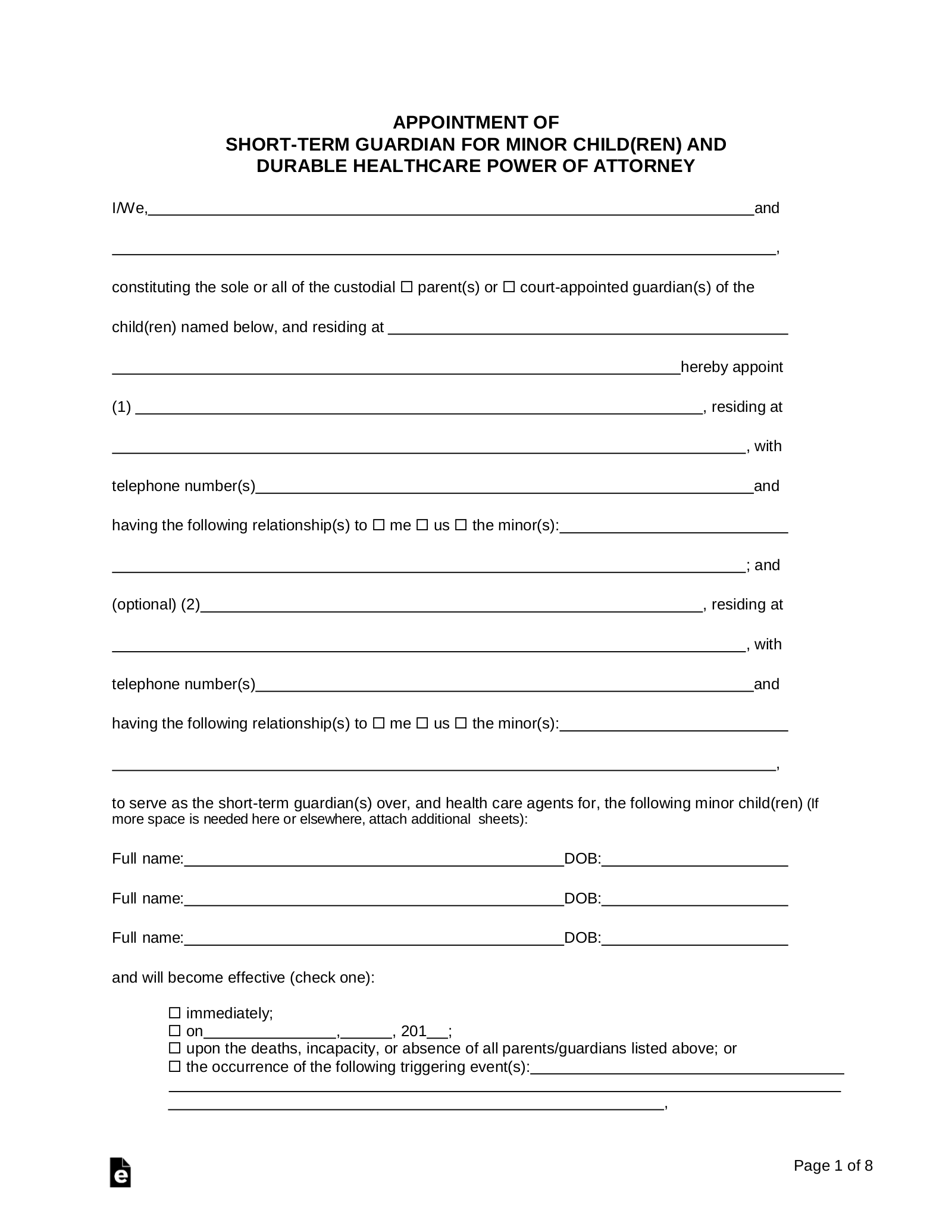
California Short-Term Guardian and Health Care Power of Attorney Form
Source: eForms
Kansas Power of Attorney for Minor Child
Source: eForms
North Dakota Power of Attorney for Care and Custody of Minor Children
Source: eForms
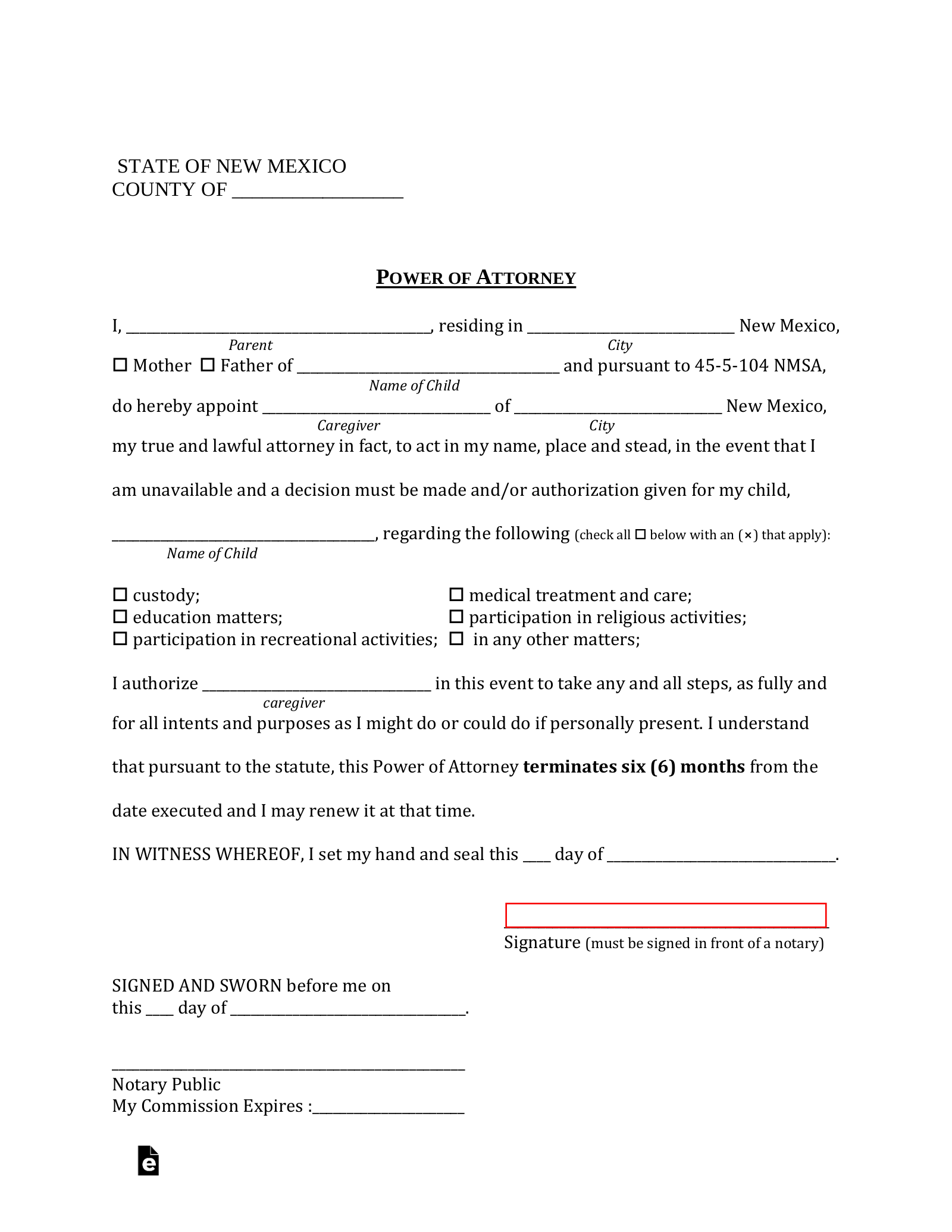
New Mexico Power of Attorney for Minor Child
Source: eForms
Montana Power of Attorney for Care, Custody or Property of Minor Child
Source: eForms
