Running a business in Arizona requires more than providing excellent products or services. Keeping invoices, bills, customer information, payment details, and transaction records organized is also an important part of professional business management. An Arizona business bill template can make this process easier by giving business owners a clear and consistent format for documenting what customers owe.
Whether you operate a small service business, retail company, consulting firm, contracting business, or freelance operation, a well-designed business bill can help you present charges professionally. It can also make it easier to track payments and maintain organized financial records.
This guide explains what an Arizona business bill should contain, how to use a business bill template, and practical ways to make your billing process more efficient.
What Is an Arizona Business Bill?
An Arizona business bill is a document used by a business to show a customer the products or services provided, the amount charged, payment information, and the total amount due. Depending on the business and transaction, the document may also include applicable tax or other charges.
A business bill can be used for many different types of transactions. For example, a contractor may use one to bill for labor and materials, while a consultant can use it to document professional services. A retailer may use an itemized bill to show individual products, quantities, prices, and applicable charges.
The exact information required can vary depending on the type of business and transaction. Businesses should also verify applicable Arizona tax and licensing requirements rather than assuming that every transaction is treated the same way.
Why Use an Arizona Business Bill Template?
Creating every bill from a blank document can take unnecessary time. A reusable template provides a consistent structure that can be customized for different customers and transactions.
A professional Arizona business bill template can help you:
- Present charges in a clear and organized format.
- Reduce the time required to prepare each bill.
- Keep customer and transaction information together.
- Separate products, services, quantities, and prices.
- Make payment terms easier for customers to understand.
- Create consistent records for your business.
- Give your business documents a more professional appearance.
Consistency is especially useful when a business sends bills regularly. Using the same basic structure helps customers quickly identify the amount due, payment instructions, invoice number, and transaction details.
What Should an Arizona Business Bill Include?
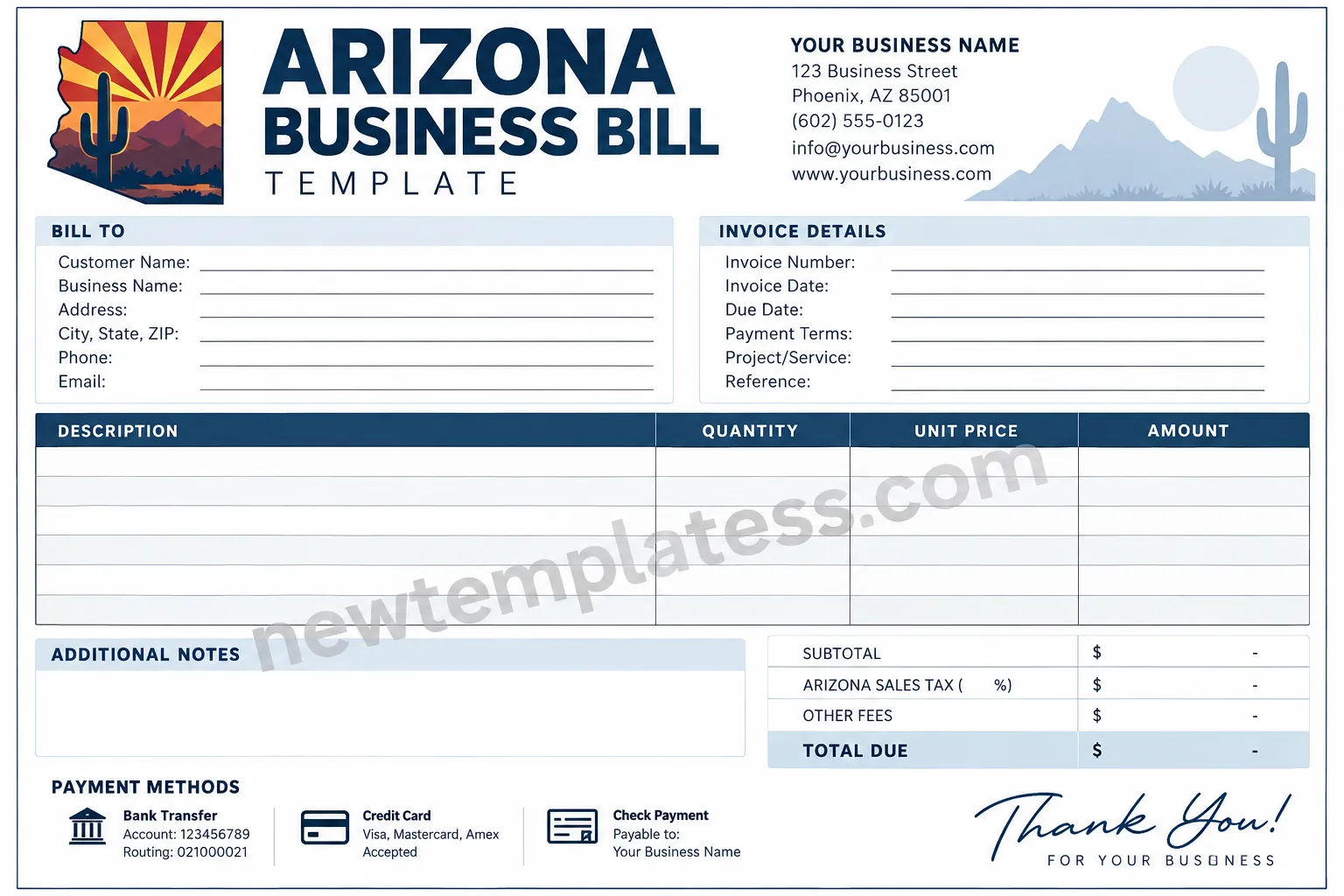
A useful business bill should contain enough information for both the business and customer to understand the transaction. A simple template can include the following sections.
Business Information
Start with your business name and contact information. Depending on your business setup, this may include your business address, phone number, email address, and website.
Keeping this information at the top of the document makes it easy for customers to identify who issued the bill and how to contact the business if they have a question.
Customer Information
The bill should provide space for the customer’s name, business name when applicable, billing address, phone number, and email address.
Accurate customer information is helpful when you need to follow up about a payment or locate a particular transaction later.
Bill or Invoice Number
Assigning a unique bill or invoice number can make recordkeeping much easier. A simple numbering system can be used, such as 1001, 1002, 1003, and so on.
For larger businesses, a more structured system can include the year or customer reference. The most important point is to use a system consistently and avoid assigning the same number to multiple transactions.
Invoice Date and Due Date
Include the date the bill was issued and, when applicable, the date payment is expected. Clearly displaying these dates helps customers understand when the transaction was recorded and when payment should be completed.
Itemized Products or Services
An itemized section is one of the most useful parts of an Arizona business bill. Instead of showing only one final amount, list the products or services individually whenever practical.
A simple itemized table can include:
- Description of the product or service
- Quantity
- Unit price
- Line-item amount
Itemization makes the bill easier to review and can reduce confusion when a customer wants to understand how the total was calculated.
Arizona Department of Revenue guidance notes that tax treatment can depend on the type of business activity, and its current rate tables are updated regularly. Businesses should therefore verify the appropriate classification and current rate rather than using a generic tax percentage for every transaction.
How to Calculate the Total on a Business Bill
A clear calculation section helps customers understand how the final amount was determined. Start with the individual line items and calculate the subtotal. If applicable, add tax or other clearly identified charges before arriving at the final total.
A basic structure may look like this:
- Subtotal: Total of products or services before additional charges.
- Applicable tax: Tax amount when required for the transaction.
- Other fees: Clearly identified additional charges, if applicable.
- Total due: Final amount the customer is expected to pay.
Arizona uses a transaction privilege tax system rather than a conventional sales tax system. The Arizona Department of Revenue explains that TPT applies to certain taxable business activities, and licensing requirements depend on the activity.
Because tax obligations can differ according to business activity and location, businesses should check the current Arizona Department of Revenue guidance before adding tax to a bill. The state’s published rate table can be used to identify applicable rates and business classifications.
Payment Information to Add to an Arizona Business Bill
Make payment instructions easy to find. Customers should not have to search through the document to determine how they can pay.
A payment section may include accepted payment methods such as:
- Bank transfer
- Credit or debit card
- Check
- Online payment
- Other payment methods offered by the business
If you accept electronic payments, provide only the information customers actually need. Sensitive banking information should be handled carefully and should not be included unnecessarily on documents that are widely shared.
How to Make Your Business Bill Look Professional
Use a Clean Layout
A professional bill does not need complicated graphics. A clean layout with clear headings, readable typography, and enough white space is usually easier to understand.
Highlight the Total Due
The final amount should stand out from the rest of the document. Using a separate total section or a lightly highlighted row can help customers identify the amount they need to pay.
Keep Descriptions Specific
Avoid vague descriptions such as “services” when a more specific explanation is possible. For example, “Website maintenance – September” gives the customer more useful information than simply writing “Services.”
Use Consistent Branding
Your business name, logo, colors, and contact information can be used consistently across your bills. This helps create a recognizable business identity without making the document difficult to read.
Tips for Using an Arizona Business Bill Template
A template is most useful when it becomes part of a consistent billing workflow. Consider these practical tips:
- Save a master copy of the blank template.
- Make a duplicate before preparing each new bill.
- Assign a unique bill or invoice number to every transaction.
- Double-check customer information before sending the document.
- Review quantities and unit prices carefully.
- Verify applicable tax treatment before adding tax.
- State payment terms clearly.
- Keep copies of completed bills with your business records.
- Record payments when they are received.
- Review unpaid bills regularly and follow up professionally.
Arizona Business Bill vs. Invoice
The words “bill” and “invoice” are often used interchangeably in everyday business communication. Both can communicate what a customer owes and provide details about a transaction.
In practice, businesses may prefer the word “invoice” for formal accounts receivable documents, while “business bill” can be a more general term for a payment request or transaction statement.
Regardless of the terminology, the important part is that the document clearly identifies the transaction, customer, charges, amount due, and payment instructions.
Who Can Use an Arizona Business Bill Template?
An Arizona business bill template can be adapted for many types of businesses, including:
- Freelancers and independent contractors
- Consultants
- Home service providers
- Contractors and tradespeople
- Small retail businesses
- Creative professionals
- Marketing and design agencies
- Professional service businesses
- Online businesses serving Arizona customers
- Small businesses that need printable billing records
The same basic template can be customized by changing the business information, customer details, line items, payment terms, and other transaction-specific information.
Important Arizona Tax and Recordkeeping Considerations
Businesses should not assume that every product or service is subject to the same Arizona tax treatment. The Arizona Department of Revenue identifies multiple taxable business classifications, and requirements can vary based on the activity and location.
For businesses that are subject to TPT, Arizona provides centralized online reporting and payment resources through AZTaxes.gov. The Department of Revenue also provides tutorials, reporting guidance, rate tables, and other resources for businesses.
For that reason, a business bill template should be treated as a document-formatting tool rather than a substitute for tax or accounting advice. When a transaction involves unusual tax circumstances, exemptions, deductions, multiple locations, or other complex issues, verify the applicable requirements with the appropriate official source or a qualified professional.
Final Thoughts on Arizona Business Bill Templates
A well-organized Arizona business bill can make everyday billing easier for both business owners and customers. By including business information, customer details, bill numbers, transaction dates, itemized charges, applicable taxes or fees, payment instructions, and a clearly displayed total, you can create a document that is practical and professional.
Using a reusable Arizona business bill template also saves time and encourages consistent recordkeeping. Before sending a bill, review every amount and confirm that any Arizona tax treatment is appropriate for the specific transaction.
With a clean template and a consistent billing process, small businesses can spend less time formatting documents and more time focusing on serving their customers.
