An advertising financial reporting schedule for your marketing campaigns can make budget management easier, clearer, and more reliable. Advertising involves many moving parts, including campaign spending, platform fees, clicks, conversions, revenue, and return on ad spend. Without a consistent reporting schedule, important financial details can become difficult to track.
A structured advertising financial reporting schedule helps businesses compare planned spending with actual costs, identify budget variances, monitor campaign performance, and make informed decisions. It can also create a simple connection between advertising teams and finance departments.
Whether you manage Google Ads, social media advertising, display campaigns, paid search, or multiple advertising channels, a well-organized reporting schedule can provide a practical framework for reviewing financial results. This guide explains what an advertising financial reporting schedule should include, how often to use one, and how to build a reporting process that supports better financial control.
What Is an Advertising Financial Reporting Schedule?
An advertising financial reporting schedule is a structured plan for recording, reviewing, and reporting advertising-related financial information over a specific period. The schedule can be organized weekly, monthly, quarterly, or annually, depending on the size and complexity of the advertising program.
The main purpose is to make advertising expenses easier to compare with approved budgets and business goals. Instead of reviewing advertising costs only after a campaign ends, teams can monitor financial performance throughout the campaign.
A useful schedule may include:
- Campaign names and advertising channels
- Budgeted advertising costs
- Actual advertising spending
- Budget variance
- Campaign dates
- Impressions, clicks, and conversions
- Cost per click and cost per acquisition
- Return on ad spend
- Revenue attributed to advertising
- Financial notes and corrective actions
Keeping these details together makes financial reporting more consistent and helps decision-makers understand where advertising money is going.
Why an Advertising Financial Reporting Schedule Matters
Advertising budgets can change quickly. A campaign may spend more than expected because of increased competition, higher bids, expanded targeting, or changes in campaign settings. At the same time, a campaign may generate stronger results and justify additional investment.
A regular reporting schedule makes these changes visible before they become larger financial problems.
Improves Budget Visibility
A reporting schedule shows the difference between planned spending and actual spending. This makes it easier to identify overspending, unused budget, or unexpected costs.
For example, if a campaign has a monthly budget of $10,000 but has already spent $8,500 halfway through the month, the financial report can highlight the issue immediately. The marketing team can then review whether the higher spending is intentional or requires adjustment.
Supports Better Financial Planning
Historical advertising data can help businesses plan future marketing budgets. When reports are maintained consistently, finance teams can compare spending patterns across months and quarters.
This information can support decisions about seasonal campaigns, product launches, promotional periods, and long-term advertising investments.
Connects Advertising Costs With Results
Advertising expenses are more useful when they are reviewed alongside performance metrics. A financial report should therefore connect spending with outcomes such as conversions, customer acquisition, and revenue.
This approach helps businesses understand not only how much they spent, but also what they received in return.
What to Include in an Advertising Financial Report
A useful advertising financial report should contain enough information to support financial and marketing decisions without becoming unnecessarily complicated.
Campaign Information
Start with basic campaign details. Include the campaign name, advertising platform, campaign objective, start date, end date, and target audience.
These details provide context for the financial figures. A campaign designed for brand awareness may have different financial goals from a campaign focused on direct sales.
Budget and Actual Spending
The financial section should clearly show the planned budget and actual advertising expenditure. A variance column can then show whether spending is above or below the approved amount.
A simple calculation is:
Budget Variance = Actual Advertising Spend − Budgeted Advertising Spend
Tracking this figure regularly can help identify financial issues early.
Advertising Performance Metrics
Financial reporting becomes more useful when it includes relevant advertising metrics. Common metrics include:
- Impressions: The number of times an advertisement was displayed.
- Clicks: The number of times users interacted with an advertisement.
- Conversions: The number of desired actions generated by a campaign.
- CPC: Average cost per click.
- CPA: Average cost per acquisition or conversion.
- ROAS: Revenue generated relative to advertising spend.
Not every business needs every metric. Choose measurements that directly relate to campaign objectives and financial goals.
How Often Should Advertising Financial Reports Be Prepared?
The ideal reporting frequency depends on advertising volume, budget size, campaign duration, and business requirements.
Weekly Advertising Reporting
Weekly reporting works well for active campaigns with significant spending or rapidly changing performance. It gives marketing teams an opportunity to identify unusual spending patterns and performance changes quickly.
A weekly review can include current spend, remaining budget, conversions, cost per acquisition, and major campaign changes.
Monthly Financial Reporting
Monthly reporting is useful for formal budget reviews. It provides enough time to identify trends while keeping financial information current.
A monthly report can compare actual spending with the approved monthly budget and previous periods. It can also include revenue, return on ad spend, and recommendations for the following month.
Quarterly Advertising Reviews
Quarterly reporting provides a broader view of advertising performance. It is particularly useful for management teams that need to review budget allocation across channels.
Quarterly reports can highlight recurring trends, changes in customer acquisition costs, and opportunities to adjust future advertising investments.
How to Create an Advertising Financial Reporting Schedule
Creating a reporting schedule does not have to be complicated. A simple process can provide a strong foundation for accurate reporting.
1. Define the Reporting Period
Decide whether the schedule will be weekly, monthly, quarterly, or a combination of reporting periods. Make sure the schedule matches the financial calendar used by your organization.
2. List Every Advertising Channel
Record the platforms used for paid advertising. Depending on your business, this could include search advertising, social media advertising, display advertising, video advertising, sponsored content, or other paid media.
3. Record Approved Budgets
Enter the approved advertising budget for each campaign or channel. If possible, separate daily, monthly, quarterly, and annual budgets.
4. Update Actual Spending
Record actual advertising expenses at the same frequency as the reporting schedule. Consistent updates reduce the risk of missing expenses or discovering budget problems too late.
5. Calculate Variances
Compare actual spending with planned spending. Investigate meaningful differences and document the reason for each major variance.
6. Add Performance Data
Include the key campaign metrics needed to interpret financial results. Avoid adding metrics simply because they are available. Focus on information that helps explain advertising efficiency and business outcomes.
7. Record Insights and Next Steps
Finish each reporting period with a short summary of what changed and what should happen next. This turns the schedule from a passive spreadsheet into a practical management tool.
Best Practices for Advertising Financial Reporting
Following a few simple practices can make financial reporting more accurate and easier to maintain.
- Use consistent reporting periods. Avoid changing the reporting dates from one report to another.
- Separate budget and actual figures. This makes financial variance easier to identify.
- Keep campaign names consistent. Consistent naming improves comparisons across reporting periods.
- Document unusual expenses. Add notes when spending changes significantly.
- Review reports regularly. A report is more useful when financial information is reviewed promptly.
- Connect spending to outcomes. Consider conversions, revenue, and acquisition costs alongside advertising expenses.
- Keep the format simple. A clear schedule is easier for marketing and finance teams to use.
Common Mistakes to Avoid
Even a well-designed advertising reporting process can become ineffective if important information is overlooked.
Only Tracking Total Advertising Spend
Total spending alone does not explain whether advertising is producing useful results. Include relevant performance and financial metrics so that spending can be evaluated in context.
Updating Reports Too Late
Delayed reporting can make it harder to control advertising budgets. If a campaign is spending faster than expected, waiting until the end of the month may limit the available options.
Ignoring Small Variances
Small differences may not always require action, but repeated small variances can reveal a larger pattern. Regular reviews help distinguish normal fluctuations from recurring problems.
Using Too Many Metrics
A report filled with unnecessary numbers can make important information harder to find. Select metrics that directly support the campaign objective and financial review.
Using a Printable Advertising Financial Reporting Template
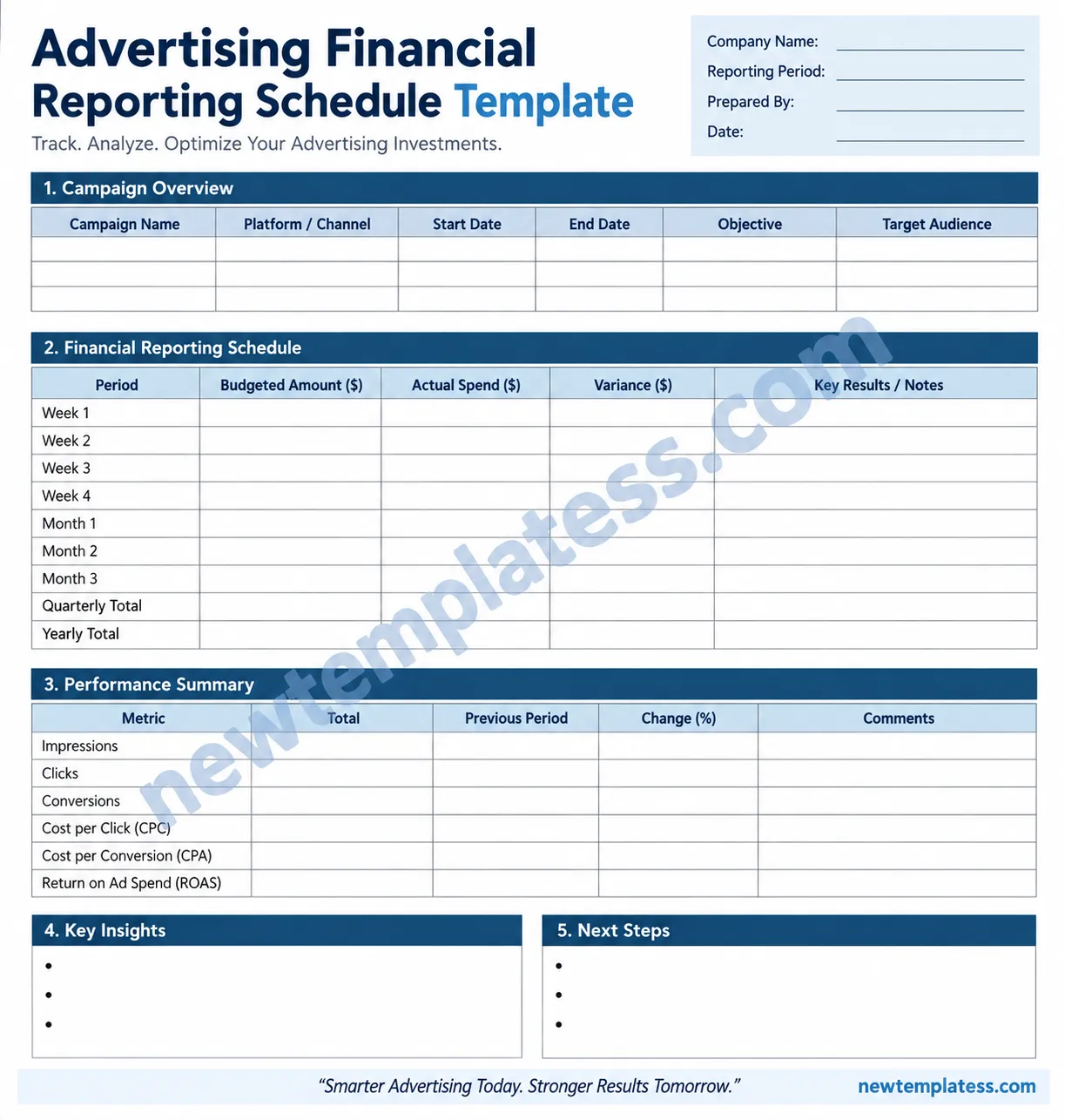
A printable template can make the reporting process easier for teams that prefer a structured document. Instead of building a new report from scratch each period, users can follow the same format and update the relevant information.
A practical template can contain sections for campaign information, financial reporting periods, budgeted amounts, actual spending, variance, performance metrics, key insights, and next steps.
Templates are especially useful when several people contribute to advertising management. A standardized format creates a shared structure for marketing managers, finance professionals, business owners, and other stakeholders.
For recurring reporting, save a master version of the template and create a new copy for each reporting period. This preserves historical records while keeping the reporting workflow consistent.
Tips for Making Financial Reporting More Actionable
The best advertising reports do more than record historical information. They help teams decide what to do next.
- Highlight campaigns that exceed their planned spending.
- Compare current performance with the previous reporting period.
- Identify campaigns with rising acquisition costs.
- Review strong-performing campaigns for potential budget increases.
- Document major changes in targeting, bids, creative, or offers.
- Set a clear action item for every significant financial issue.
- Use historical reports when preparing future advertising budgets.
It is also helpful to keep explanations short and specific. Instead of writing that spending was “higher than expected,” explain whether the increase came from higher traffic, increased bids, an extended campaign period, or another identifiable factor.
Conclusion
An advertising financial reporting schedule for ongoing campaign management can provide a simple and effective way to control advertising costs while monitoring business results. By combining budget information, actual spending, financial variance, and campaign performance metrics, businesses can create a clearer picture of their advertising investments.
The most effective reporting process is consistent, easy to understand, and connected to real decisions. Whether you prepare reports weekly, monthly, or quarterly, a structured template can reduce manual work and make important financial information easier to review.
Start with the essential figures, maintain a consistent schedule, document meaningful changes, and use each reporting period to guide the next set of advertising decisions. With the right structure, financial reporting becomes more than record keeping—it becomes a practical tool for managing advertising budgets and improving campaign accountability.
