An Agreement for Operations Management is an important document that defines how an operations manager, consultant, or service provider will manage business activities on behalf of a client. It establishes clear expectations about responsibilities, services, payment, performance, confidentiality, and other essential terms.
Whether you manage a small business, oversee a growing company, or hire an external operations professional, a written agreement can help both parties understand their roles from the beginning. It can also reduce misunderstandings and provide a practical reference throughout the working relationship.
This guide explains what an operations management agreement should contain, how to structure one, and what to consider before signing. You can also use the accompanying Agreement for Operations Management Template as a starting point for creating your own document.
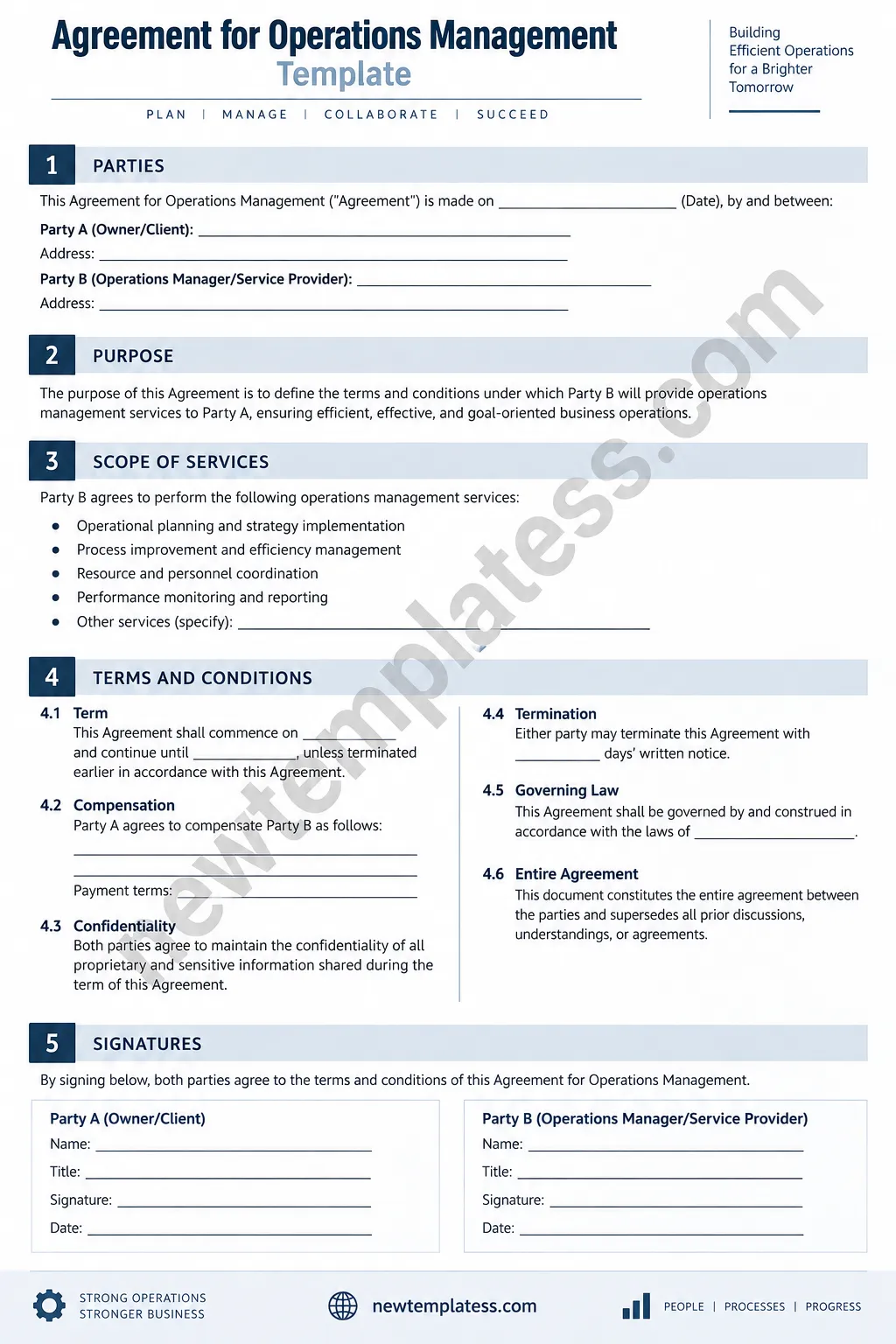
What Is an Agreement for Operations Management?
An Agreement for Operations Management is a formal document between a business owner or client and an operations manager or service provider. It describes the operational services that will be provided and the conditions under which those services will be performed.
Operations management can cover many areas. Depending on the business, the agreement may include process improvement, workforce coordination, inventory oversight, vendor management, scheduling, reporting, quality control, budgeting support, and operational planning.
The agreement provides a shared framework for the relationship. Instead of relying only on verbal discussions, both parties can refer to a written document when questions arise about responsibilities, deadlines, payment, or performance expectations.
Why Use an Operations Management Agreement?
A clear agreement can make an ongoing business relationship easier to manage. It gives both parties a practical understanding of what is expected and helps establish accountability.
1. Clarifies Responsibilities
The agreement identifies which operational duties belong to the operations manager and which remain with the client. This distinction is especially important when several employees, contractors, or departments are involved.
2. Establishes Service Expectations
A written scope of services helps prevent uncertainty. The parties can specify what the operations manager will handle, how often reports will be provided, and which activities require additional approval.
3. Defines Compensation
The agreement can explain the management fee, hourly rate, monthly retainer, performance-based compensation, or other payment structure. It can also establish payment dates and acceptable payment methods.
4. Protects Confidential Information
Operations managers may have access to financial information, employee data, supplier details, customer information, business processes, and internal strategies. Confidentiality provisions can help establish expectations for handling sensitive information.
5. Provides a Framework for Ending the Relationship
A termination section explains how either party can end the agreement. It may include notice requirements, outstanding payment obligations, the return of company property, and the handling of confidential information after termination.
Key Elements of an Agreement for Operations Management
Although every business has different requirements, a well-structured agreement usually includes several core sections.
Parties and Effective Date
Start by identifying the client and the operations manager or service provider. Include legal names, business names when applicable, addresses, and the effective date of the agreement.
This section should make it clear who is entering into the agreement and when the contractual relationship begins.
Purpose of the Agreement
Briefly explain why the agreement exists. For example, the purpose may be to establish the terms under which an operations manager will provide operational planning, process management, performance monitoring, and administrative support.
A concise purpose statement gives context to the rest of the document.
Scope of Services
The scope of services is one of the most important sections. It should describe the actual work the operations manager is expected to perform.
Possible services include:
- Operational planning and strategy implementation
- Business process improvement
- Workflow development and documentation
- Staff and resource coordination
- Vendor and supplier coordination
- Inventory and logistics oversight
- Performance monitoring
- Operational reporting
- Quality assurance and process controls
- Support for operational budgets and forecasts
Be as specific as practical. If a responsibility is outside the normal scope of work, explain how additional services will be approved and billed.
Responsibilities of Each Party
The agreement should distinguish between the responsibilities of the operations manager and those of the client. For example, the operations manager may be responsible for managing workflows, preparing reports, and coordinating staff, while the client may retain authority over hiring, major expenditures, strategic decisions, or legal matters.
Clearly defining authority can prevent operational decisions from becoming confused with ownership or executive responsibilities.
Compensation and Payment Terms
State how the operations manager will be compensated. Common arrangements include a fixed monthly fee, hourly billing, project-based pricing, or another agreed structure.
The payment section may also cover:
- Billing frequency
- Payment due dates
- Approved expenses
- Late payment procedures
- Additional service fees
- Reimbursement requirements
Clear payment terms make the financial side of the relationship easier to administer.
Important Clauses to Consider
Confidentiality
A confidentiality clause can establish how sensitive business information must be protected. It should address information that the operations manager receives while performing services and may specify obligations that continue after the agreement ends.
Performance and Reporting
Consider explaining how operational performance will be reviewed. Depending on the role, reporting may include productivity measures, service levels, cost information, inventory data, project status, or process improvement results.
Specific reporting expectations can make performance discussions more objective and useful.
Term and Renewal
Specify whether the agreement lasts for a fixed period or continues until one party terminates it. If the agreement renews automatically, explain the renewal period and any notice requirements.
Termination
A termination clause should explain how either party can end the relationship. It may include a notice period and provisions for immediate termination under certain circumstances.
It is also useful to explain what happens after termination, including final payments, document transfers, access to systems, company property, and confidential information.
Governing Law
A governing law clause identifies the jurisdiction whose laws will apply to the agreement. Because legal requirements vary by location, businesses should consider obtaining professional legal advice when preparing a contract for actual use.
How to Create an Effective Operations Management Agreement
Step 1: Identify the Business Requirements
Before writing the agreement, list the operational areas that need management. Consider current challenges, business goals, staffing needs, processes, systems, and reporting requirements.
Step 2: Define the Scope of Work
Turn the business requirements into specific services. Avoid vague language when a responsibility can be described clearly. For example, instead of simply stating “manage operations,” identify the processes, teams, reports, or activities involved.
Step 3: Establish Decision-Making Authority
Explain which decisions the operations manager can make independently and which require client approval. This can be particularly important for spending, staffing, vendor contracts, policy changes, and strategic decisions.
Step 4: Set Measurable Expectations
Where appropriate, identify performance indicators and reporting schedules. Measurable expectations can help both parties understand whether the engagement is meeting its objectives.
Step 5: Review Payment and Termination Terms
Make sure the compensation structure is easy to understand. Also confirm that both parties know how the agreement can be renewed or terminated.
Step 6: Review the Final Document
Before signing, check the agreement for missing information, inconsistent terms, unclear responsibilities, and incorrect dates. For important commercial arrangements, professional legal review may be appropriate.
Tips for Using an Operations Management Agreement Template
A template can save time by providing a practical starting structure. However, it should be customized to reflect the actual relationship between the parties.
- Replace every placeholder: Add the correct names, dates, addresses, fees, and other details.
- Customize the services: Remove services that do not apply and add responsibilities that are specific to the business.
- Define authority: Explain which operational decisions can be made without additional approval.
- Keep payment terms clear: State the amount, billing schedule, and payment deadline.
- Review confidentiality requirements: Identify the types of information that require protection.
- Include termination procedures: State the notice period and relevant obligations after termination.
- Keep a signed copy: Both parties should retain an accessible copy of the final agreement.
Common Mistakes to Avoid
Even a professional-looking agreement can cause problems if important details are missing.
Using an Overly Broad Scope
A statement such as “the manager will handle all business operations” may create uncertainty. A detailed service description provides better clarity.
Failing to Define Authority
Operations managers often coordinate multiple functions. Without clear decision-making limits, disagreements may arise over spending, staffing, suppliers, or business policies.
Ignoring Additional Work
Businesses can change quickly. The agreement should explain how additional responsibilities will be requested, approved, and compensated.
Leaving Payment Details Vague
Terms such as “paid regularly” are less useful than a specific payment schedule. State when invoices are issued, when payment is due, and how expenses are handled.
Not Updating the Agreement
If the scope of work changes significantly, the agreement should be reviewed and updated through an appropriate written amendment rather than relying on informal conversations.
When Should You Use an Operations Management Agreement?
This type of agreement can be useful whenever one party is responsible for managing operational activities for another party. It may be appropriate for an external operations consultant, fractional operations manager, management services provider, or ongoing operational support arrangement.
It can also be useful when a company is transitioning operational responsibilities to a new manager. A written agreement gives the parties a structured way to document expectations during the transition.
Final Thoughts
An Agreement for Operations Management creates a clear foundation for an ongoing management relationship. By documenting services, responsibilities, authority, compensation, confidentiality, reporting, and termination procedures, both parties can start with a shared understanding of how the engagement will work.
The best agreement is not necessarily the longest one. It is the one that accurately reflects the services being provided and addresses the practical questions that may arise during the relationship. Use a well-organized template as a starting point, customize it to your situation, and consider professional legal advice when the agreement involves significant business obligations.
