A sample security roadmap gives organizations a practical way to turn broad cybersecurity goals into an organized plan of action. Instead of treating security as a collection of disconnected tools and urgent fixes, a roadmap brings priorities, projects, responsibilities, timelines, and measurable outcomes together in one place.
Whether you are building a security program from scratch, improving an existing cybersecurity strategy, or preparing for future compliance requirements, a security roadmap can help your team understand where it is today and what needs to happen next. The key is to create a roadmap that is realistic, measurable, and flexible enough to adapt as risks and business requirements change.
In this guide, you will learn how to build a useful security roadmap, what sections to include, how to prioritize initiatives, and how to use a roadmap template to keep security improvements moving forward.
What Is a Security Roadmap?
A security roadmap is a structured plan that outlines the cybersecurity initiatives an organization intends to complete over a defined period. It connects security objectives with specific projects, priorities, owners, resources, and target dates.
A good roadmap does more than list security technologies. It can cover policies, employee awareness, identity and access management, vulnerability management, incident response, data protection, security monitoring, compliance, and third-party risk.
The roadmap should also connect security activities to business objectives. For example, a company expanding into a new market may need to strengthen access controls and data protection, while an organization preparing for an audit may prioritize documentation, policies, evidence collection, and control testing.
Why Use a Sample Security Roadmap?
Creating a cybersecurity strategy from a blank page can be difficult. A sample security roadmap provides a starting structure that can be customized to your organization.
- Clarifies priorities: Helps teams distinguish urgent risks from longer-term improvements.
- Creates accountability: Assigns owners to security initiatives and activities.
- Improves visibility: Gives leadership a clear view of security projects and progress.
- Supports budgeting: Helps identify technology, staffing, training, and service requirements.
- Tracks progress: Provides milestones and measurable targets for security improvements.
- Encourages continuous improvement: Makes it easier to review results and adjust priorities.
Key Sections of a Security Roadmap
Although security roadmaps differ between organizations, most effective examples contain several core components. These sections make the roadmap easier to understand and maintain.
1. Current Security State
Start by documenting the current state of your security program. Identify important assets, existing controls, known vulnerabilities, security processes, technology gaps, and areas where responsibilities are unclear.
Useful questions include:
- What systems and data are most important to the organization?
- Which security controls are already in place?
- Where are the largest known security gaps?
- What regulatory or contractual requirements apply?
- Which security processes require manual work or improvement?
This baseline provides the context needed to build realistic priorities.
2. Security Goals and Priorities
Next, define what the organization wants to accomplish. Security goals should be specific enough to guide projects but broad enough to support the overall business strategy.
Potential goals might include improving identity security, reducing vulnerability exposure, strengthening incident response, protecting sensitive information, increasing security awareness, or improving security monitoring.
3. Security Initiatives
Turn broad goals into individual initiatives. Each initiative should have a clear purpose and an expected outcome.
Examples include:
- Implement multi-factor authentication across critical applications.
- Establish a formal vulnerability management process.
- Review privileged accounts and access permissions.
- Develop and test an incident response plan.
- Improve endpoint detection and monitoring.
- Conduct employee security awareness training.
- Review third-party and vendor security requirements.
- Establish a recurring security metrics program.
4. Owners and Responsibilities
Every major initiative should have an accountable owner. Without clear ownership, security projects can remain on a roadmap without meaningful progress.
Depending on the organization, owners may include security leaders, IT administrators, application owners, compliance personnel, human resources, legal teams, or external security providers.
5. Timeline and Milestones
A roadmap becomes much more useful when initiatives have target dates and milestones. Instead of putting every project into one annual bucket, divide work into manageable time periods such as monthly, quarterly, or half-year phases.
For example, an organization could begin with a security assessment, move into priority remediation, implement new controls, measure results, and then establish an ongoing improvement cycle.
How to Prioritize Security Initiatives
Not every security project can be completed at the same time. Prioritization helps organizations direct limited resources toward the areas that require attention first.
Consider evaluating each initiative according to:
- Risk reduction: How much security exposure could the initiative address?
- Business impact: Which systems, operations, customers, or data could be affected?
- Compliance requirements: Is the initiative connected to an applicable obligation?
- Effort: How much time, money, staffing, and technical work are required?
- Dependencies: Does another project need to be completed first?
- Time sensitivity: Is there a known deadline or changing threat that affects timing?
A practical approach is to identify a small number of high-priority initiatives for the next planning period while keeping longer-term projects visible on the roadmap.
Sample Security Roadmap Structure
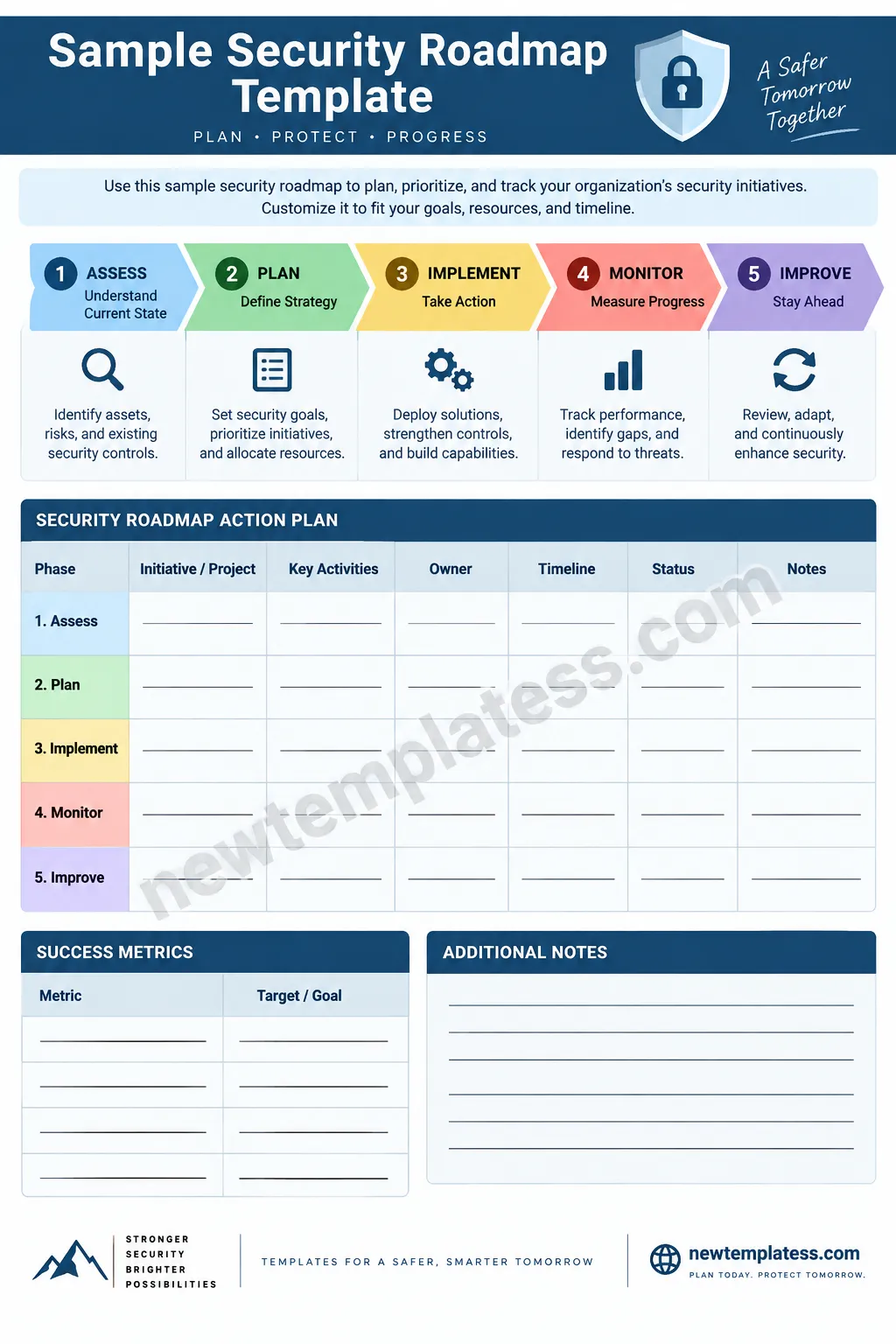
A simple roadmap can follow five recurring stages: assess, plan, implement, monitor, and improve. This structure works well because security is not a one-time project. It is an ongoing process.
Assess
Review assets, threats, vulnerabilities, existing controls, policies, and business requirements. Establish a clear baseline before selecting major improvements.
Plan
Define objectives, prioritize initiatives, assign owners, estimate resources, and establish target dates. Make sure the planned work is realistic for available capacity.
Implement
Execute the selected projects. This may include deploying security technologies, updating policies, improving processes, training employees, or strengthening technical controls.
Monitor
Track implementation status and security performance. Use meaningful metrics to identify gaps, delays, recurring problems, and areas that require additional attention.
Improve
Review what has changed and update the roadmap. New systems, business priorities, vulnerabilities, regulations, and lessons from security incidents may require the plan to evolve.
Security Roadmap Metrics to Track
Metrics help turn a roadmap from a project list into a management tool. Choose measurements that demonstrate progress and support decision-making.
Potential security roadmap metrics include:
- Percentage of critical systems covered by security controls.
- Percentage of users protected by multi-factor authentication.
- Number of unresolved critical vulnerabilities.
- Average time to remediate high-priority vulnerabilities.
- Security awareness training completion rate.
- Incident response testing frequency.
- Percentage of critical vendors reviewed for security risk.
- Progress against planned security initiatives.
Avoid collecting metrics simply because they are easy to measure. The best indicators help answer whether the security program is reducing meaningful risk or improving operational resilience.
Practical Tips for Building a Better Security Roadmap
Keep the roadmap understandable
A roadmap should be useful to both technical teams and business leaders. Use straightforward language and explain technical initiatives in terms of their purpose, risk, cost, and expected outcome.
Separate strategic and operational work
Strategic initiatives describe larger improvements, while operational tasks cover recurring activities such as patching, access reviews, monitoring, and incident exercises. Keeping both visible prevents routine security work from disappearing behind major projects.
Review the roadmap regularly
A security roadmap should not be treated as a static annual document. Review it regularly and adjust priorities when circumstances change.
Include realistic capacity
A long list of ambitious initiatives does not necessarily represent an effective security strategy. Consider available staff, budget, technical dependencies, and competing business priorities before committing to dates.
Document assumptions and dependencies
If a project depends on a new identity platform, infrastructure migration, procurement process, or staffing change, document that dependency. Doing so makes delays easier to understand and manage.
Using a Printable Security Roadmap Template
A printable security roadmap template can make planning sessions easier because teams can immediately see phases, initiatives, owners, timelines, statuses, and notes in one view.
When customizing a template, start by replacing generic initiatives with your organization’s actual security priorities. Add realistic dates, assign accountable owners, and define measurable success criteria. You can then use the same document during security reviews to record progress and identify changes.
For larger teams, the roadmap can also serve as a high-level summary while detailed project plans are maintained separately. This keeps leadership reporting concise without losing operational detail.
Common Security Roadmap Mistakes to Avoid
- Listing too many projects: An overloaded roadmap can make priorities unclear.
- Ignoring business context: Security initiatives should connect to actual organizational needs.
- Leaving owners undefined: Every significant initiative needs clear accountability.
- Using vague goals: Define outcomes that can be measured or demonstrated.
- Failing to review progress: A roadmap loses value when it is created once and never updated.
- Focusing only on technology: Effective security also depends on people, processes, policies, and governance.
Conclusion
A well-designed sample security roadmap can provide a clear framework for organizing cybersecurity priorities, assigning responsibility, managing timelines, and measuring progress. The most useful roadmap is not necessarily the longest one; it is the one that clearly connects security needs with practical actions.
Start by assessing your current environment, define realistic goals, prioritize initiatives, assign owners, establish milestones, and track meaningful metrics. Then review and improve the roadmap regularly as your organization, technology environment, and security requirements evolve.
With a structured approach and a customizable security roadmap template, teams can turn cybersecurity planning into an ongoing, measurable process rather than a collection of disconnected tasks.
