Understanding social media marketing user behavior is essential for businesses that want to create content people actually notice, engage with, and remember. Social media users do not interact with every post in the same way. Their actions are influenced by their interests, habits, preferred platforms, content formats, timing, personal needs, and relationships with brands.
When marketers understand these behavioral patterns, they can create more relevant content, improve engagement, build stronger customer relationships, and make better decisions about their social media strategy. Instead of simply publishing more content, businesses can focus on publishing the right content for the right audience at the right time.
This guide explains the key factors behind social media behavior and provides practical ways to use those insights in a social media marketing strategy.
What Is Social Media Marketing User Behavior?
Social media marketing user behavior refers to the ways people interact with social platforms, content, creators, communities, and brands. It includes everything from viewing and liking a post to commenting, sharing, saving, clicking a link, following an account, or purchasing a product.
Behavior can also include passive actions. A user may repeatedly watch videos, read captions, visit a profile, or see branded content without immediately clicking a button. These interactions can still provide useful signals about audience interests and content preferences.
Common examples of social media user behavior include:
- Scrolling through feeds and discovering new content.
- Watching short-form videos and longer educational content.
- Liking, commenting on, saving, and sharing posts.
- Following creators, brands, communities, and influencers.
- Clicking links to websites, products, or landing pages.
- Responding to polls, questions, quizzes, and interactive content.
- Reading reviews and recommendations before making purchasing decisions.
- Creating and sharing user-generated content.
Why User Behavior Matters in Social Media Marketing
Social media marketing becomes more effective when decisions are based on audience behavior rather than assumptions. Behavioral insights help marketers understand what their audience wants, what motivates interaction, and what prevents people from taking action.
For example, if analytics show that educational carousel posts receive more saves than promotional posts, a business can increase the amount of educational content it produces. If short videos generate more profile visits, video can become a stronger part of the content strategy.
Understanding behavior can help businesses:
- Create more relevant and useful content.
- Improve audience engagement.
- Choose appropriate content formats.
- Identify the best opportunities for calls to action.
- Develop stronger customer relationships.
- Improve social media advertising performance.
- Increase website traffic and conversions.
- Make content planning more data-driven.
Key Factors That Influence Social Media User Behavior
Audience Demographics and Interests
Age, location, occupation, interests, lifestyle, and purchasing needs can influence how people use social platforms. However, demographics alone do not explain everything. Two users in the same age group may have completely different motivations and content preferences.
Combine demographic information with behavioral data to build a more complete picture of your audience. Look at which topics users engage with, which formats they prefer, and what actions they take after interacting with your content.
Content Format
Different users respond differently to videos, images, carousels, articles, stories, live streams, and text-based posts. Content format can affect how quickly someone understands a message and whether they decide to engage.
Test several formats instead of assuming that one format will always perform best. Track meaningful outcomes such as watch time, saves, shares, profile visits, clicks, and conversions.
Timing and Online Habits
When users are active can influence content visibility and engagement. However, the best posting time varies by audience and platform. Rather than relying entirely on generic posting-time recommendations, review your own audience analytics.
Look for recurring patterns in engagement and reach. Then test different publishing times and compare the results over several weeks.
Emotions and Motivation
People often engage with content because it makes them feel curious, informed, entertained, inspired, understood, or motivated. Content that addresses a real problem or provides a useful solution can be particularly valuable.
Ask yourself what the audience should think, feel, or do after seeing a post. This simple question can make content more purposeful.
How Users Interact With Social Media Content
Social media engagement exists on a spectrum. A user may first notice a post, consume the content, interact with it, visit the brand profile, and eventually become a customer.
A typical journey can look like this:
- Discovery: The user encounters a post through a feed, search, recommendation, or shared content.
- Attention: The headline, visual, opening sentence, or video hook encourages further viewing.
- Consumption: The user reads, watches, or explores the content.
- Engagement: The user likes, comments, saves, shares, or responds.
- Consideration: The user visits a profile, website, product page, or review.
- Conversion: The user completes a desired action such as subscribing, contacting the business, or purchasing.
Not every user follows this journey in the same order. The important point is to create useful touchpoints throughout the customer journey.
Using Behavioral Data to Improve Your Content Strategy
Behavioral data can transform content planning from guesswork into a structured process. Start by reviewing your existing social media analytics and identify patterns across your strongest and weakest posts.
Analyze High-Performing Content
Do not look only at likes. Examine several metrics to understand why a post performed well.
- Reach: How many people saw the content?
- Impressions: How often was the content displayed?
- Engagement rate: How actively did users interact?
- Saves: Did users consider the content useful enough to return to?
- Shares: Did people find the content valuable enough to recommend?
- Click-through rate: Did the content encourage users to visit another destination?
- Conversions: Did social traffic contribute to a desired business outcome?
Look for patterns rather than isolated results. One viral post may be interesting, but repeated performance across multiple posts provides stronger evidence for strategic decisions.
Identify Audience Pain Points
Comments, direct messages, reviews, search queries, and frequently asked questions can reveal what your audience needs. These insights can become the foundation for educational posts, tutorials, product demonstrations, FAQs, and problem-solving content.
For example, if customers repeatedly ask how to use a product, create a short tutorial series. If people frequently compare two options, create a clear comparison guide. Behavioral insights can therefore become a direct source of content ideas.
Practical Ways to Increase Social Media Engagement
Once you understand your audience’s behavior, use that knowledge to make interaction easier and more valuable.
- Ask specific questions that are easy to answer.
- Use polls and interactive features when they fit the topic.
- Create content that solves common audience problems.
- Use clear and relevant calls to action.
- Respond to meaningful comments and questions.
- Encourage customers to share their experiences.
- Experiment with educational, entertaining, inspirational, and promotional content.
- Repurpose successful ideas into different formats.
- Review performance data regularly and adjust your strategy.
Engagement should not be treated as a numbers game alone. Meaningful comments, useful conversations, qualified clicks, and customer relationships can be more valuable than a large volume of low-intent interactions.
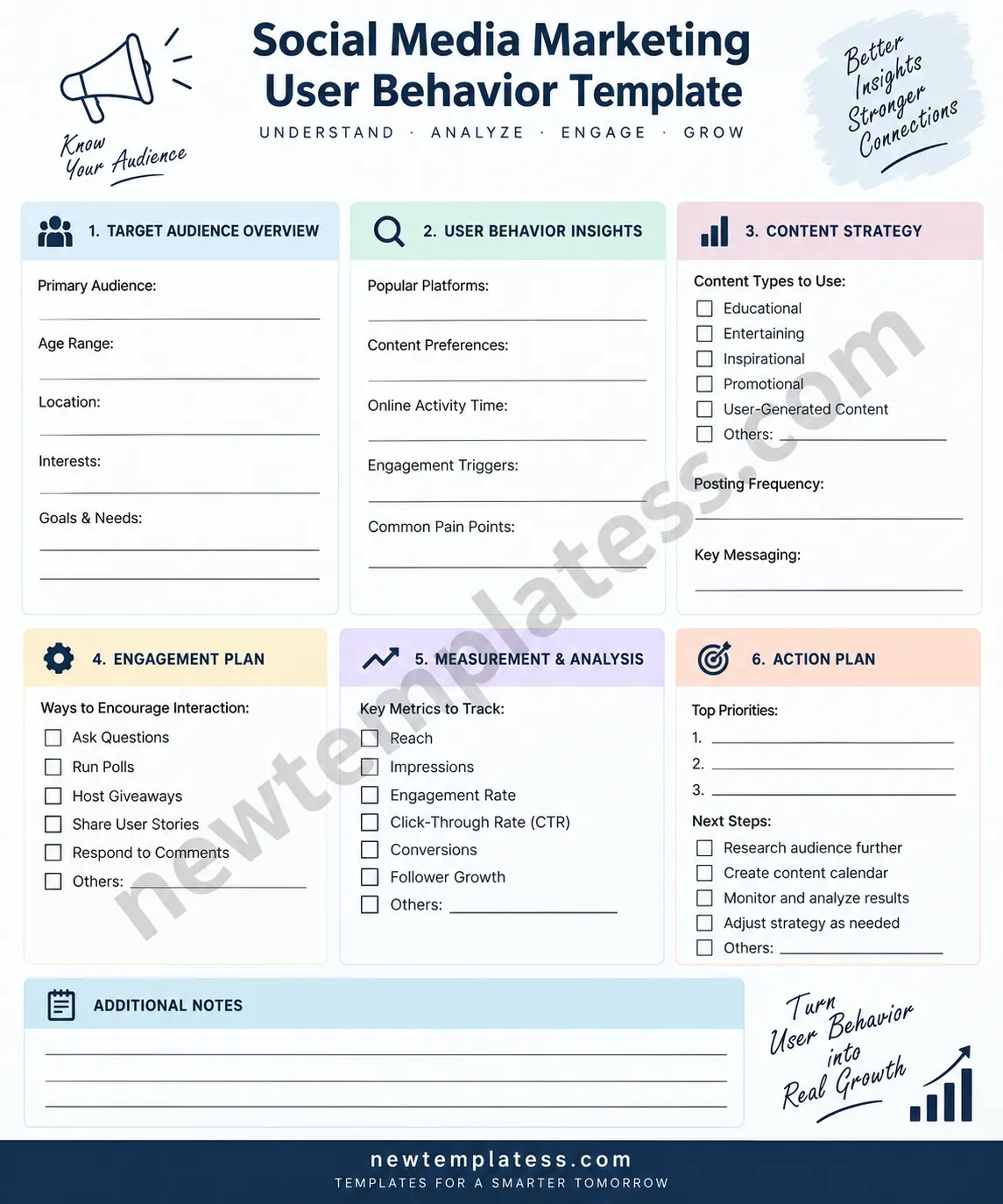
Use the template below to organize audience characteristics, behavioral insights, content preferences, engagement tactics, metrics, and next steps.
Common Mistakes in Social Media User Behavior Analysis
Focusing Only on Follower Counts
A growing follower count does not automatically mean that an audience is engaged or likely to become customers. Analyze the quality of interactions and the actions users take after discovering your content.
Copying Competitors Without Understanding Your Audience
Competitor research can provide ideas, but another brand’s audience may behave differently. Use competitor observations as inspiration while relying on your own audience data for strategic decisions.
Changing Strategy Too Quickly
Social media performance can fluctuate. Avoid abandoning a strategy because of one poor-performing post. Give content experiments enough time and volume to produce useful evidence.
Ignoring Qualitative Feedback
Analytics provide valuable numbers, but comments and conversations can explain why users behave in particular ways. Combine quantitative metrics with qualitative feedback for a fuller understanding.
A Simple Process for Analyzing User Behavior
You can create a repeatable workflow by following these steps:
- Step 1: Define your target audience and business objectives.
- Step 2: Identify the platforms where your audience is active.
- Step 3: Review engagement, traffic, and conversion data.
- Step 4: Identify patterns in topics, formats, and posting times.
- Step 5: Collect audience feedback from comments, messages, reviews, and surveys.
- Step 6: Create content experiments based on your findings.
- Step 7: Measure results using consistent metrics.
- Step 8: Refine your social media strategy based on the evidence.
This process creates a continuous feedback loop. Audience behavior informs content, content generates new data, and that data helps improve future decisions.
The Future of Social Media Marketing User Behavior
Social media behavior continues to evolve as platforms, content formats, algorithms, and consumer expectations change. Users increasingly encounter personalized recommendations, short-form video, creator content, social commerce, communities, and interactive experiences.
For marketers, the most important principle is adaptability. A strategy that works today should still be tested and refined as audience expectations change.
Businesses should pay attention to emerging content formats while maintaining a clear focus on customer needs. Technology can help marketers analyze behavioral signals, but useful strategy still depends on understanding the people behind the data.
Conclusion
Social media marketing user behavior provides valuable insight into how audiences discover, consume, interact with, and respond to content. By studying engagement patterns, content preferences, audience needs, and conversion behavior, marketers can create more relevant experiences and make more informed decisions.
The goal is not simply to collect more social media metrics. The goal is to understand what those metrics reveal about real people. Use behavioral data alongside audience feedback, test different content approaches, and continually refine your strategy. When businesses understand their audience and respond to genuine needs, social media can become a stronger channel for engagement, trust, traffic, and long-term growth.
