A well-structured legal employment labor meeting minute Template can help an employer, HR team, employee representative, union committee, or legal department create a consistent record of what was discussed, what evidence was considered, what decisions were made, and what follow-up was assigned. The key is not to treat minutes as a verbatim transcript. A useful record should be factual, organized, understandable to someone who was not present, and carefully separated from personal opinions or unsupported conclusions.
Meeting records can become particularly important when a discussion involves employee relations, workplace conduct, grievances, performance concerns, disciplinary matters, labor negotiations, policy changes, safety issues, or other employment-related disputes. In the United Kingdom, Acas advises employers to keep a confidential record of what is said, evidence gathered, and decisions or actions arising from a grievance meeting. :contentReference[oaicite:0]{index=0} In Australia, the Fair Work Ombudsman similarly recommends keeping written records throughout performance or conduct processes and emphasizes factual, impartial recording.
The format itself does not automatically make a meeting record legally sufficient. Employment and labor obligations vary by jurisdiction, industry, collective agreement, company policy, and the nature of the dispute. A template is therefore best treated as a documentation framework rather than legal advice. The sections below explain how to design a record that is practical for everyday HR work while allowing enough structure for more sensitive employment and labor discussions.

What a legal employment labor meeting minute Template should accomplish
The central purpose of meeting minutes is to preserve a reliable account of a workplace discussion. That means the document should identify the meeting, establish who attended, summarize the agenda, record material points raised, identify decisions or unresolved questions, and assign follow-up actions. A good structure makes it easier for a later reader to understand the sequence without having to reconstruct the meeting from scattered emails, notes, or memory.
Employment records often involve sensitive information, so clarity must be balanced with restraint. A minute-taker should distinguish between an allegation, a response, an established fact, a document presented as evidence, and a decision. For example, instead of writing that an employee “was dishonest,” the record can state that a concern about an inconsistency was raised, identify the information discussed, record the employee’s response, and note what action was agreed. This approach creates a more neutral documentary trail.
Consistency is another important objective. If one meeting records dates, participants, evidence, decisions, and action owners while another records only a few informal comments, the organization may later have difficulty comparing what occurred. A standardized structure can reduce that inconsistency. Template examples commonly organize meeting details, attendees, agenda items, discussion points, decisions, and action items into distinct sections, which is a useful design principle for employment-related records.
A practical document should also make clear whether it is a formal meeting record, an internal working note, an investigation record, or a summary intended for circulation. Those documents can serve different purposes and may need different access controls. Texas Workforce Commission guidance, for example, recommends separating grievance and investigation records from general personnel records because they may contain confidential or highly private information. :contentReference[oaicite:2]{index=2}
Core sections to include in the meeting record
The opening section should establish the identity of the meeting. Include the organization or department, meeting subject, date, start and end time, location or meeting platform, chair or facilitator, and note-taker. If the meeting is part of a larger process, such as a grievance, investigation, negotiation, or disciplinary procedure, identify that process without prejudging its outcome.
The attendance section should identify participants by name and role where appropriate. Distinguish attendees from people who were invited but absent. For sensitive matters, it can also be useful to identify the capacity in which each participant attended, such as employee, manager, HR representative, union representative, investigator, adviser, or witness. This makes the later discussion easier to understand without requiring unnecessary personal information.
The agenda should provide an organized roadmap for the discussion. In employment and labor matters, agenda headings might cover the reason for the meeting, previous actions, employee concerns, management response, evidence review, policy or agreement provisions, proposed actions, unresolved issues, and next steps. A clear agenda also helps the note-taker distinguish substantive discussion from side conversations that do not belong in the formal record.

The discussion section should summarize material points rather than reproduce every sentence. Focus on statements that affect the issue being considered, evidence that was introduced, questions that were asked, explanations provided, and matters that require follow-up. If a participant disputes a factual point, record the disagreement accurately rather than silently choosing one version.
The decision section should state what was actually decided and what remains unresolved. Avoid transforming a discussion into a decision when participants merely explored an option. Similarly, do not describe a proposal as an agreement unless the participants actually reached agreement. If no decision was made, a useful entry might state that further information was requested and that the matter will return to the agenda at a later meeting.
Action items should identify the task, responsible person or function, target date, and any dependency that must be resolved first. This makes the minutes operational rather than merely archival. An action such as “HR to review the attendance records and report back at the next meeting” is substantially more useful than “attendance discussed.”

How to record sensitive employment discussions
Employment meetings can involve allegations of misconduct, discrimination concerns, workplace conflict, performance issues, compensation questions, accommodation matters, or grievances. The minute-taker should therefore avoid language that sounds argumentative, emotional, sarcastic, speculative, or conclusory. The document should identify what was said and what was considered without turning the writer’s interpretation into an established fact.
A useful technique is to attribute important statements. Phrases such as “the employee stated,” “the manager explained,” “the representative requested,” and “the investigator noted” clarify who made a particular assertion. When documentary evidence is discussed, identify the document by a neutral description and note the relevant issue. This is particularly valuable where different participants remember an event differently.
Confidentiality should also be considered before circulation. Not everyone who needs the meeting outcome needs access to every underlying detail. Texas Workforce Commission guidance emphasizes limiting access to employee information to people with a job-related need to know and recommends secure procedures for personnel information.

For an investigation, the record should distinguish the meeting summary from evidence itself. A minute may state that an email, attendance record, policy document, witness statement, or other material was considered, but the underlying evidence should generally be retained in the appropriate case or personnel record rather than reproduced unnecessarily in the minutes.
When the meeting concerns a grievance, a balanced structure is especially important. Acas guidance for formal grievance meetings says employers should consider information or evidence from all sides and keep a confidential record of what was said, evidence gathered, and decisions or actions taken. Acas also recommends giving the employee copies of the meeting record and allowing them to confirm whether the notes are accurate. :contentReference[oaicite:4]{index=4}
For witness meetings, the note-taking approach can be slightly different. Acas explains that where a witness meeting is used to gather relevant information, someone should take notes and the witness should have an opportunity to review and sign the notes as a confirmation of accuracy. :contentReference[oaicite:5]{index=5} This illustrates why a meeting record should be designed around the actual process rather than copied mechanically from an ordinary staff meeting format.
Employment and labor meeting minutes versus ordinary staff minutes
Ordinary staff minutes may focus primarily on projects, schedules, operational updates, and routine decisions. Employment and labor minutes require additional care because the subject matter can affect individual rights, workplace obligations, collective bargaining relationships, internal investigations, or later disputes. The more sensitive the subject, the more important it becomes to identify facts, sources, decisions, and unresolved issues precisely.
Labor relations meetings can also involve multiple parties with distinct roles. A negotiation meeting might include management representatives, HR personnel, finance representatives, legal advisers, and employee or union representatives. The minutes should make those roles clear while avoiding language that implies agreement where the participants only exchanged proposals.
For union-related meetings, the document can include the opening of the meeting, approval of prior minutes where relevant, bargaining subjects, proposals exchanged, responses, tentative agreements if actually reached, open issues, caucus periods where appropriate, action items, and the next meeting date. A union negotiation example published by Template.net demonstrates a structure built around participants, agenda items, current issues, proposals, next steps, and closing remarks.

A labor meeting record should not be confused with a collective bargaining agreement, settlement agreement, disciplinary decision, or formal policy. Minutes document the meeting; they do not automatically replace the separate document that creates or records a legal obligation. If participants approve a written agreement, the minutes can identify that an agreement was approved and indicate where the executed document is maintained.
For labor organizations subject to the federal Labor-Management Reporting and Disclosure Act, the U.S. Department of Labor’s Office of Labor-Management Standards states that certain records supporting required reports must be retained for at least five years after filing, and it specifically notes that meeting minutes can document matters such as officer compensation approvals. That requirement applies to covered records and organizations; it should not be generalized into a universal five-year retention rule for every employment meeting minute.
Retention should therefore be based on the nature of the record, the jurisdiction, applicable law, the company’s retention schedule, any collective agreement, and whether litigation or an investigation is pending. A general meeting-minutes template should not promise a single retention period for every workplace.

Jurisdiction-specific considerations
California
A California employer should distinguish ordinary meeting notes from personnel records and other records governed by specific state or federal requirements. California’s Division of Labor Standards Enforcement explains that current and former employees, or their representatives, generally have rights to inspect and receive copies of personnel files and records relating to performance or grievances, subject to the statutory conditions. The agency also states that employers must maintain a copy of each employee’s personnel records for at least three years after termination.
That does not mean every labor meeting minute automatically belongs in the personnel file. The better practice is to determine what the record is documenting and whether it forms part of the employee’s personnel records, an investigation file, a safety record, or another category. California also has separate recordkeeping provisions for particular employment arrangements; for example, the state’s labor-contractor rules contain specific record requirements and retention periods.
A legal employment labor meeting minute template california workflow should therefore include a document-classification step before the final record is stored. The template can contain a field for “Record category” or “Confidentiality level,” but the organization’s HR or legal team should determine the actual classification based on the circumstances.

Texas
Texas presents a different recordkeeping landscape. Texas Workforce Commission guidance explains that most Texas and federal employment laws impose recordkeeping duties for particular categories of records, including requirements concerning the form and retention of records.
Texas guidance also explains that employers are not generally required by Texas law to allow employees to inspect their personnel files, while noting that many employers maintain personnel records because documentation can be important in employment disputes. It recommends keeping grievance and investigation records separately and controlling access to confidential information.
For readers searching for a legal employment labor meeting minute template texas format, the practical design implication is to make the record factual, clearly categorized, and securely stored. A template should not state that Texas law requires a particular meeting-minute form unless a specific legal provision actually does so.
Oregon
Oregon employers should pay attention to the distinction between personnel records and other employment information. The Oregon Bureau of Labor and Industries explains that personnel records include records used to determine an employee’s qualifications, promotion, additional compensation, termination, or disciplinary action. The agency also identifies performance reviews, promotion records, disciplinary actions, and termination notices as examples. :contentReference[oaicite:12]{index=12}
BOLI states that covered personnel records generally must be produced within 45 days of an employee’s request and identifies separate retention periods for personnel, time, and payroll records. It also says medical records, tax records, and immigration documents should not be included in a response to a personnel-record request.
For a legal employment labor meeting minute template oregon process, classification and controlled storage are therefore important. If meeting notes contain information that formed part of a personnel action, the organization should determine whether the record falls within the relevant personnel-record category rather than assuming that all meeting notes are treated identically.

United Kingdom
UK workplace processes often place significant emphasis on fair procedure and accurate records. Acas guidance states that employers should keep a confidential record of grievance meetings, including what was said, evidence gathered, and decisions or actions taken. It also recommends giving the employee copies of the meeting record and asking the employee to confirm whether the notes are accurate.
For disciplinary processes, Acas guidance describes a formal meeting in which the employer explains the concern and evidence, while the worker has an opportunity to respond, ask questions, present evidence, and call relevant witnesses. A record should therefore capture the procedural steps that actually occurred without claiming that an opportunity was provided if it was not.
A legal employment labor meeting minute template uk can be structured around meeting purpose, participants, evidence considered, employee response, representative or companion attendance, questions, outcome, and follow-up. The organization should still check its own disciplinary or grievance procedure and current Acas guidance before relying on the template for a live case.

Australia
Australian employers can use formal meeting records as part of performance or conduct processes. The Fair Work Ombudsman provides a specific meeting-record template and advises employers to keep written records throughout performance or conduct management. Its guidance emphasizes writing down meeting details promptly and keeping the record impartial and factual.
Fair Work also notes that people present at the meeting may be asked to sign the record if they agree with it, but they are not required by law to sign. The guidance recommends providing a copy of the formal record to the employee, which can improve transparency and reliability if the record is later relied upon.
For a legal employment labor meeting minute template australia workflow, the document can therefore include a factual meeting summary, evidence considered, employee response, agreed actions, and confirmation or acknowledgment fields. Those fields should not be presented as a universal statutory requirement because the appropriate process depends on the circumstances.

Choosing Word, PDF, spreadsheet, or another format
People searching for a legal employment labor meeting minute template word format are usually looking for a document that can be edited easily, circulated for review, and stored with other employment records. A word-processing document works well when the minutes contain narrative summaries, statements, evidence references, and action descriptions.
A legal employment labor meeting minute template pdf can be useful when a finalized version needs to be preserved in a consistent visual format. The important distinction is between a working record and the finalized record. During drafting, changes may be necessary after participants review the notes. Once the organization has completed its review, a stable final version can be stored according to its records policy.
A legal employment labor meeting minute template excel structure can be useful when the main purpose is tracking multiple meetings, action owners, deadlines, or recurring labor-relations matters. A spreadsheet is less suitable when the record requires extensive narrative detail. In that situation, a document format may be easier to read and review.

Some organizations may search for a legal employment labor meeting minute template word free format because they want a familiar document structure without committing to specialized software. The important consideration is whether the format supports the organization’s actual workflow: editing, review, version control, confidentiality, storage, retrieval, and controlled access.
Others may search for a legal employment labor meeting minute template free resource because they want a straightforward starting point. A no-cost template can still require substantial customization. The headings should be reviewed against the organization’s policies, collective agreements, privacy requirements, disciplinary procedures, and record-retention schedule before being used for an actual employment matter.
Similarly, the phrase legal employment labor meeting minute template free download reflects a search for an immediately usable resource, but the presence of a downloadable document does not establish that the format satisfies the law of a particular jurisdiction. The value of the template is its structure; legal sufficiency depends on how the record is completed, stored, reviewed, and used.

A reader looking specifically for a legal employment labor meeting minute template download should verify the origin of the resource, inspect the fields before use, and avoid treating a generic meeting document as a substitute for a formal legal instrument. If the matter concerns litigation, a statutory investigation, a collective bargaining dispute, or a serious disciplinary action, professional legal or workplace-relations advice may be appropriate.
How to write the discussion section accurately
The strongest discussion notes answer five questions: what issue was raised, what information was presented, what responses were given, what remained uncertain, and what happened next. This creates a logical record without requiring a transcript. It also makes later review easier because the reader can distinguish facts, statements, evidence, and decisions.
For example, a hypothetical attendance meeting might record that the manager presented attendance records for a specified period, the employee explained that several entries were disputed, the parties agreed to verify two dates, and HR would review the relevant policy before the next meeting. That is more useful than writing “attendance problem discussed.” The example is illustrative rather than a statement about any particular employer’s policy.
For a grievance, the same principle can be applied to each issue. Identify the complaint, summarize the employee’s position, record management’s response, note evidence discussed, and state what further investigation is required. If the parties reach a resolution, record the actual resolution. If they do not, clearly identify the outstanding issue instead of creating the appearance of consensus.

Common mistakes that weaken employment meeting minutes
One common mistake is writing conclusions instead of observations. Statements such as “the employee clearly violated the rules” may go beyond what the meeting established. A more precise record identifies the rule or concern discussed, the evidence presented, the employee’s response, and the decision made by the appropriate decision-maker.
Another mistake is recording too much irrelevant information. A minute does not become more reliable simply because it is longer. Personal conversations, unrelated workplace complaints, speculation about motives, and unnecessary personal details can make the record harder to use and may create additional confidentiality concerns.
A third mistake is changing the record silently after the meeting. If a participant identifies an error, the organization should follow a consistent correction process. The Fair Work Ombudsman specifically recommends preparing meeting records promptly, allowing participants to review them, and making amendments when appropriate before final confirmation.

Another problem is failing to identify the status of an item. A proposal, discussion point, recommendation, decision, and action item are not interchangeable. Adding a simple status field such as “discussion,” “decision,” “pending evidence,” or “action assigned” can significantly improve clarity.
Finally, avoid treating signatures as a universal legal requirement. Some processes may use acknowledgment or confirmation, while others may not require a signature at all. The appropriate approach depends on the jurisdiction, policy, agreement, and nature of the record.
Practical Solution
Start with a master meeting record containing the following fields: meeting title, case or matter reference, date, time, location, chair, note-taker, participants, representatives, purpose, agenda, discussion, evidence considered, decisions, unresolved matters, action items, deadlines, next meeting, and distribution list. Add a confidentiality classification if the organization uses one. This creates a consistent foundation while allowing the same structure to support routine HR meetings and more sensitive employment matters.
Before the meeting, prepare the header and agenda rather than attempting to create the entire record during the discussion. During the meeting, capture concise factual notes and identify who made material statements. Record documents or evidence by neutral descriptions. When a disagreement occurs, capture the competing positions without deciding which account is correct unless the meeting itself formally makes that determination.
Immediately after the meeting, review the notes for accuracy, completeness, neutral wording, and consistency with the actual discussion. Separate confirmed decisions from pending matters. Identify each action owner and deadline. Then follow the organization’s review, circulation, confidentiality, and retention procedures. For a grievance or disciplinary matter, check the relevant workplace procedure and current jurisdiction-specific guidance before treating the record as complete.

A practical record should also have a version-control method. If the document is revised after review, identify the revision date and preserve the organization’s approved record according to its records policy. Avoid having several uncontrolled copies with different wording circulating among managers, employees, representatives, and advisers.
Access control is equally important. Store sensitive grievance, investigation, disciplinary, or employee-relations records where only authorized personnel can retrieve them. Texas Workforce Commission guidance specifically recommends secure procedures and separation of certain sensitive records, while Oregon and California rules demonstrate why the classification of personnel records can affect employee access rights.
Finally, review the template periodically. Laws, workplace policies, collective agreements, and organizational processes can change. A template should therefore be treated as a controlled document that is reviewed when the relevant legal or procedural environment changes rather than as a permanent statement of legal requirements.

Practical example of a completed meeting structure
Consider a hypothetical employee-relations meeting concerning a disputed workplace policy. The header identifies the date, participants, purpose, and note-taker. The agenda lists review of the previous meeting, the employee’s concern, management’s response, relevant policy language, evidence, proposed actions, and next steps. The discussion section then summarizes each topic in the order addressed.
The decision section might state that the parties agreed to verify a particular record and that HR would review the policy wording. It would not say that the employee’s complaint was “resolved” if the evidence review remains outstanding. The action section would assign each task to a responsible role and provide the agreed target date.
If the next meeting changes the outcome, the later record should refer back to the earlier action and state what new information was considered. This creates a chronological documentary trail. The approach is useful because it lets a later reviewer understand how the matter developed without relying entirely on memory.

What should not be included
A meeting record should normally avoid unnecessary medical information, private family details, personal opinions about participants, unsupported allegations presented as facts, unrelated workplace gossip, and speculative comments about future conduct. When sensitive information is genuinely necessary for the employment process, the organization should determine the appropriate record category and access restrictions rather than automatically placing every detail in ordinary meeting minutes.
Do not use minutes as a substitute for a legal agreement. If the meeting produces a settlement, policy amendment, collective agreement, disciplinary decision, or other formal instrument, that document should be maintained separately where appropriate. The minutes can record the fact that the document was discussed or approved without reproducing the entire instrument.
Do not promise a particular legal outcome simply because the organization used a standardized format. A well-designed template supports consistent documentation, but it does not determine whether an employer complied with a statute, collective agreement, procedural requirement, privacy rule, or contractual obligation.

How to evaluate a template before using it
First, check whether the template captures the information needed for the specific meeting. A routine HR planning meeting may need only basic details, agenda items, decisions, and actions. A grievance or disciplinary meeting may need additional fields for evidence, employee responses, representatives, procedural steps, and outcome status.
Second, examine whether the wording encourages neutral documentation. Labels such as “allegation,” “response,” “evidence considered,” “decision,” and “action required” are generally clearer than labels that presume fault or agreement. A template should guide the note-taker toward facts rather than conclusions.
Third, review storage and access requirements before using the document. A meeting record may become part of a larger employment file or investigation record. Its location, naming convention, permissions, retention period, and circulation should be consistent with the organization’s established records process and relevant law.

For users searching for a legal employment labor meeting minute template word, legal employment labor meeting minute template pdf, or legal employment labor meeting minute template excel resource, the file format should be considered secondary to the quality of the underlying structure. A visually attractive document that lacks evidence, decision, action, and confidentiality fields may be less useful than a simple document that captures the right information.
Records, retention, and later review
Retention should be determined by the type of record rather than by the title printed at the top of the document. Different laws can prescribe different periods for payroll, personnel, safety, discrimination, tax, immigration, and other records. Texas Workforce Commission guidance, for example, describes different retention periods for several categories rather than one universal period for all employment records.
Australia’s Fair Work Ombudsman likewise distinguishes statutory time and wage records from other workplace documentation and states that time and wages records generally must be kept for seven years. That requirement concerns specified employment records and should not be interpreted as a universal seven-year rule for every meeting minute.
In the United States, labor organizations covered by the LMRDA can have separate recordkeeping duties. The Department of Labor states that covered records supporting reports must generally be maintained for at least five years after filing, with records retained longer when necessary to verify certain reports. This illustrates why a retention schedule should identify the governing record category instead of relying on a generic meeting-minutes rule.

Final checklist for a reliable employment labor meeting record
Before closing the record, confirm that the meeting identity is complete, all relevant participants are identified, the purpose is clear, and the agenda matches the subject actually discussed. Check that important statements are attributed accurately and that allegations are not presented as established facts.
Next, verify that evidence is described clearly, decisions are separated from proposals, unresolved issues remain visible, and every action has an owner and target date where appropriate. If participants disagreed about the notes, preserve the disagreement through the organization’s established correction or review process rather than silently changing substantive content.
Finally, confirm the record’s classification, confidentiality, storage location, access permissions, retention requirement, and distribution. This final review turns a basic meeting note into a controlled workplace record that can be understood later by someone who did not attend the meeting.

Reference Examples
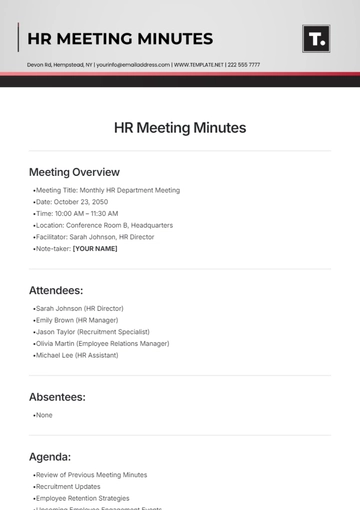
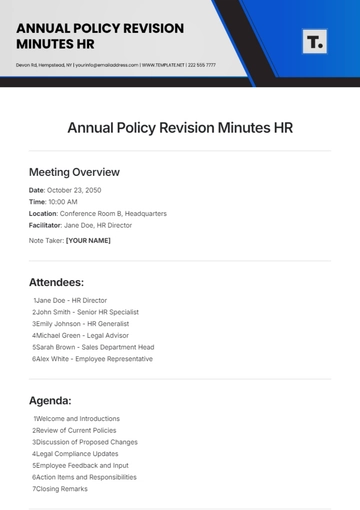
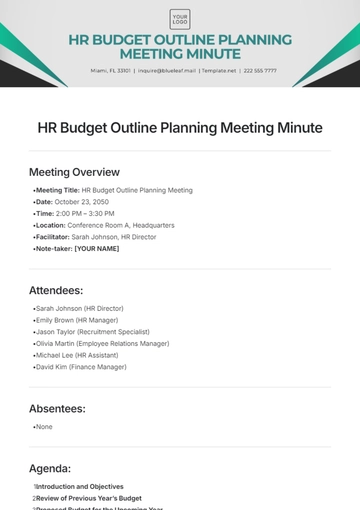
A legal employment labor meeting minute Template is easiest to understand when viewed as a structured record rather than merely a blank form. Useful examples typically show a recognizable hierarchy: meeting information first, participants next, then agenda and discussion, followed by decisions and actions. The visual examples below demonstrate different ways those elements can be arranged, including HR committee records, disciplinary records, legal meeting records, safety discussions, and employee-relations formats. They are visual references rather than statements that any particular layout is legally required. The appropriate structure depends on the purpose of the meeting and the jurisdiction involved.
These references also illustrate why one template should not be treated as suitable for every employment situation. A routine HR meeting can use a relatively simple agenda-and-actions structure, while a grievance, disciplinary meeting, investigation, or labor negotiation may require more precise treatment of evidence, responses, representatives, decisions, and confidentiality. Comparing the layouts can help readers identify which fields are useful for their own legal employment labor meeting minute Template workflow while keeping the final record aligned with applicable workplace procedures and recordkeeping rules.

Law Firm Quarterly Meeting Minutes
Source: Template.net

Law Firm Disciplinary Meeting Minutes
Source: Template.net

Law Firm Court Preparation Meeting Minutes
Source: Template.net

Law Firm Virtual Meeting Minutes
Source: Template.net

Spa Legal Meeting Minutes
Source: Template.net

Law Firm Review Meeting Minutes
Source: Template.net

Law Firm Safety Meeting Minutes
Source: Template.net

Law Firm Case Review Meeting Minutes
Source: Template.net

Law Firm Leadership Meeting Minutes
Source: Template.net
Car Rental Legal Meeting Minutes
Source: Template.net
