A strong health safety legal compliance plan Template should connect three functions that are often managed separately: protecting people from workplace hazards, meeting legal duties, and preserving evidence that controls are actually working. The best plan is not simply a polished form. It is a management system that identifies obligations, assigns ownership, records risks, sets controls, establishes training, and creates a review cycle.
For organizations searching for a reusable structure, the main challenge is deciding what belongs in the central document and what should remain in supporting records. A practical plan can serve as the organizing document, while detailed risk assessments, inspection records, training logs, incident reports, emergency procedures, and corrective actions sit behind it. This keeps the main plan readable without sacrificing operational detail.
The regulatory context matters because there is no universal document that automatically satisfies every employer. OSHA provides recommended practices and topic-specific standards, while states may operate their own OSHA-approved plans. California, for example, has its own Cal/OSHA requirements and requires employers to establish, implement, and maintain a written Injury and Illness Prevention Program. Florida is under federal OSHA jurisdiction for most private-sector workers. A useful template therefore needs a jurisdiction field and a process for checking current requirements rather than assuming one format works everywhere.

What a Health, Safety, and Legal Compliance Plan Should Accomplish
The central purpose of a compliance plan is to translate obligations into controlled actions. Instead of keeping regulations, policies, inspections, and training in unrelated folders, the plan establishes a logical connection between the requirement, the responsible person, the control, the evidence, and the review date. That structure makes it easier for managers to see whether an important obligation has an owner and whether evidence exists to demonstrate that the organization is acting on it.
A good plan also separates legal requirements from internal standards. A law or regulation may establish a minimum obligation, while an organization may choose a stronger internal rule because of its risk profile, client requirements, insurance expectations, or operational experience. The document should identify the source of each obligation and label internal controls clearly so that employees do not mistake an internal policy for a government requirement.
The plan should also be designed for change. Workplace equipment, chemicals, staffing, processes, facilities, vendors, and legal requirements can change during the year. A static document can quickly become misleading. A controlled revision process, document owner, approval record, review frequency, and change log make the plan a living management tool rather than a document prepared once and then forgotten.
Core Sections to Include in the Template
The opening section should identify the organization, locations, business activities, document owner, responsible manager, effective date, revision number, and jurisdictions covered. If several facilities are included, list each location and explain whether the same controls apply to all sites. A central plan can work across multiple locations, but site-specific risks and legal duties should be linked to separate records when they differ materially.
The next section should define roles and responsibilities. Assign responsibility for compliance oversight, hazard identification, incident reporting, training, inspections, corrective actions, emergency planning, document control, and management review. Responsibility should be specific enough that an employee can identify who receives a report or approves a corrective action. Avoid vague statements such as “management is responsible” when a named role or department can be identified.
The compliance register is another essential component. It can contain the requirement, source, topic, location, responsible role, evidence required, review frequency, current status, and action needed. The register should not attempt to reproduce entire regulations. Its purpose is to create a practical map between the organization’s activities and the obligations that need to be monitored.
Risk Identification and Assessment
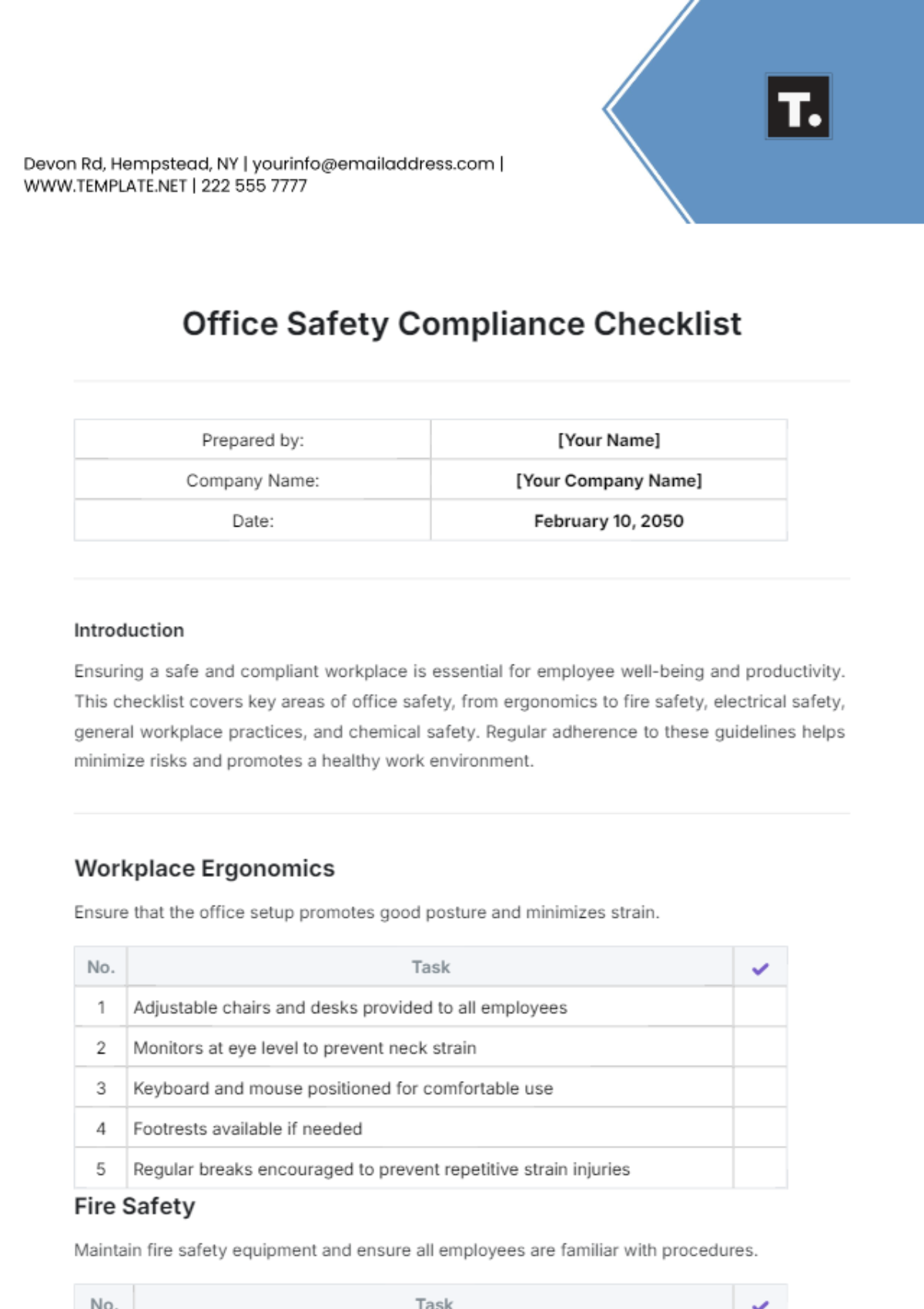
Risk assessment should begin with the work rather than with a generic checklist. Identify tasks, equipment, materials, environmental conditions, vulnerable activities, non-routine work, emergency situations, and foreseeable changes. OSHA guidance emphasizes worker participation, workplace inspection, incident investigation, emergency identification, and prioritization of hazards as important parts of a safety and health program.
Each significant hazard should be described in practical terms. Record the hazard, affected activity, potential consequence, existing controls, additional controls, responsible person, target date, and verification method. A risk matrix can help prioritize issues, but the scoring method should be explained. A numerical score should support decision-making rather than create the illusion of mathematical precision where the underlying information is uncertain.
Controls should follow a logical hierarchy. Where possible, eliminate the hazard or substitute a safer process before relying heavily on administrative controls or personal protective equipment. If PPE is required under OSHA rules, the employer must assess the workplace and maintain written certification of the hazard assessment under the relevant standard. The compliance plan should therefore link the risk assessment to PPE selection, training, inspection, and replacement records.
Building a Safety Plan Compliance Document
A safety plan compliance document should explain how hazards are identified, evaluated, controlled, monitored, and corrected. It should also explain how workers report concerns and how management responds. OSHA’s recommended safety and health practices emphasize management leadership, worker participation, hazard identification and assessment, hazard prevention and control, education and training, program evaluation, and improvement.
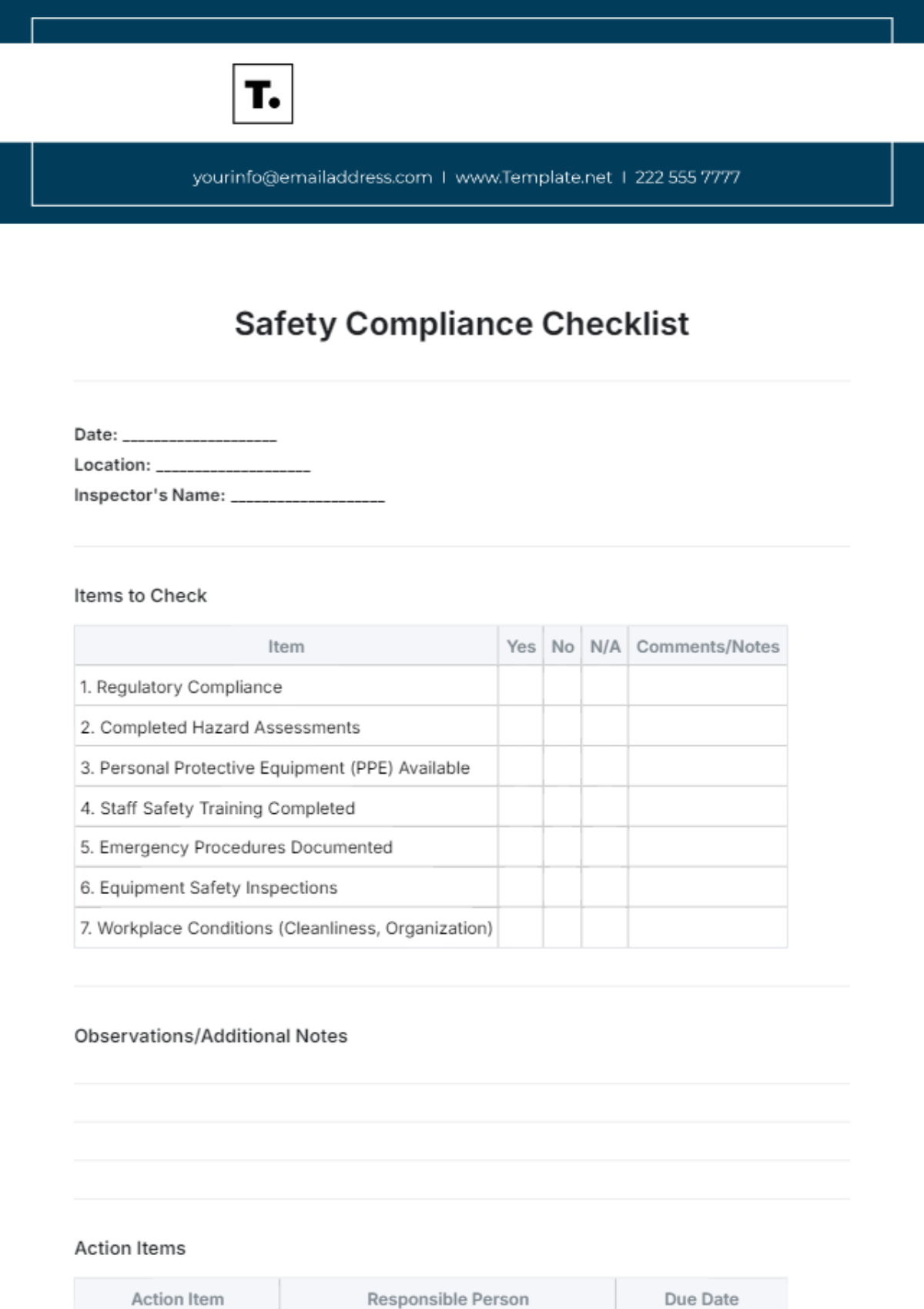
The document should define inspection intervals without assuming that every area needs the same frequency. A high-risk production area may require more frequent inspections than a low-risk administrative area. Inspection records should capture observations, status, corrective action, owner, deadline, and verification. The objective is not merely to collect completed checklists but to demonstrate that identified problems are actually addressed.
Incident and near-miss processes should also be connected to the plan. A useful workflow records what happened, where it occurred, immediate controls, contributing factors, root causes where appropriate, corrective actions, responsible persons, and verification. Near misses can be valuable because they may reveal weaknesses before an injury occurs. The plan should explain when an issue is escalated and who has authority to stop or modify unsafe work.
OSHA Considerations and Recordkeeping
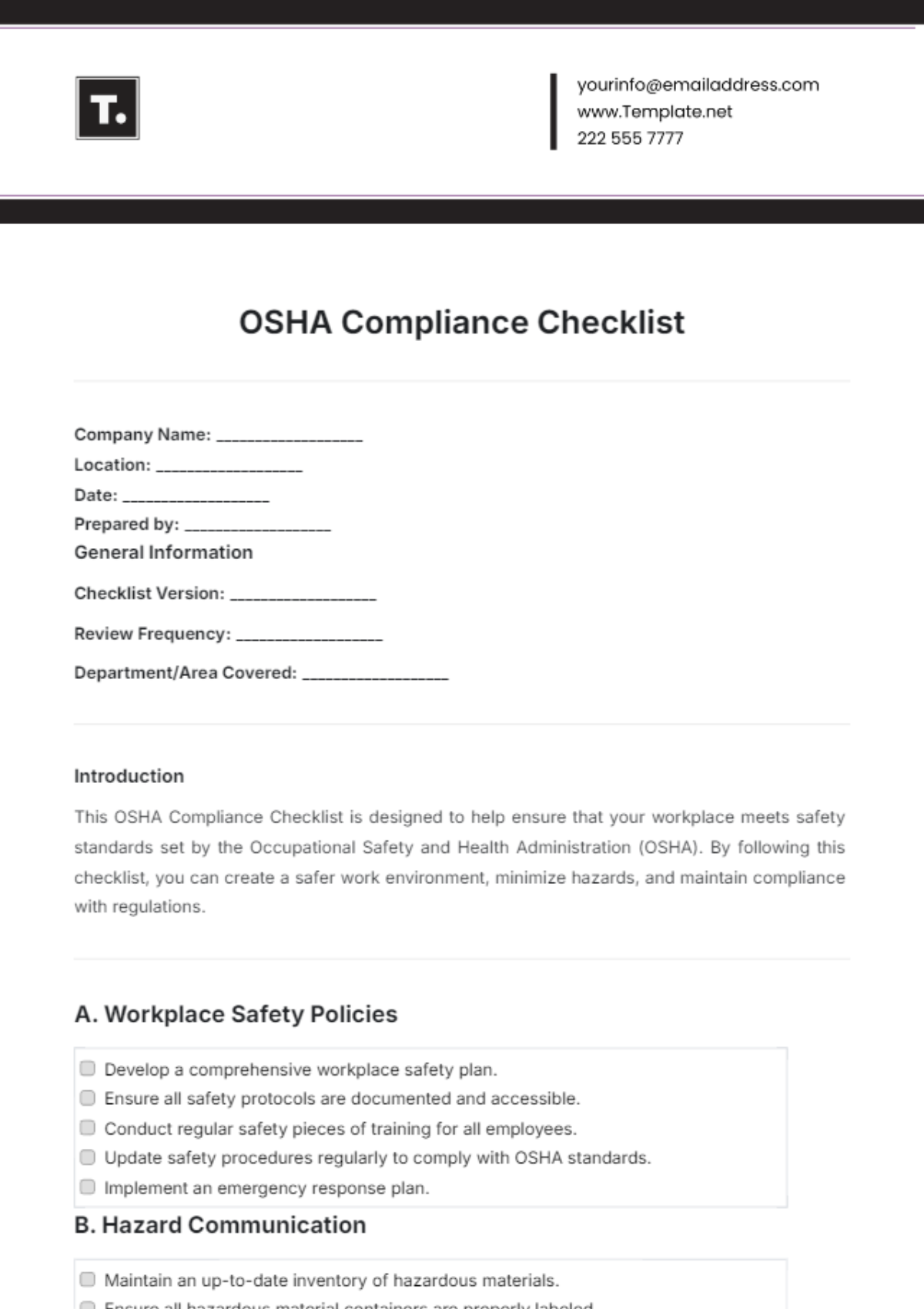
Organizations looking for a health safety legal compliance plan template osha should avoid treating an OSHA reference as a substitute for reviewing the standards that actually apply to the workplace. OSHA’s sample safety and health programs are examples that employers can adapt; they are not intended to replace the requirements of individual standards. The plan should therefore contain a standards-review process rather than simply displaying an OSHA label.
Recordkeeping deserves its own section because records demonstrate what was assessed, what was communicated, and what was corrected. Depending on coverage and industry, OSHA recordkeeping requirements can involve Forms 300, 300A, and 301 or equivalent records. The plan should identify who determines recordability, who maintains records, who handles required reporting, and how retention is controlled.
Emergency action planning is another area where precision matters. OSHA 1910.38 specifies minimum elements for covered emergency action plans, including emergency reporting procedures, evacuation procedures, procedures for employees who remain for critical operations, employee accountability after evacuation, rescue or medical duties, and contact information for people who can provide plan information. The plan should connect these requirements to drills, training, communications, and review.
California and Florida Considerations
Organizations searching for a health safety legal compliance plan template california should recognize that California operates an OSHA-approved State Plan administered through Cal/OSHA. California’s Injury and Illness Prevention Program requirements are particularly important for employers because the regulation requires a written program containing elements such as responsibility, employee compliance, communication, hazard assessment, accident and exposure investigation, hazard correction, training, and recordkeeping.
The California portion of a template should therefore contain fields for the person with authority and responsibility, methods for employee communication, hazard assessment procedures, investigation procedures, corrective action, training, and records. A generic federal OSHA checklist can be a useful starting point, but it should not be presented as automatically satisfying California requirements. The organization should compare its actual operations with the current California regulations and any industry-specific rules that apply.
For an organization searching for a health safety legal compliance plan template florida, the jurisdictional approach is different. Florida is not an OSHA-approved State Plan for most private-sector employment, so federal OSHA generally has jurisdiction over those workplaces. That does not mean a Florida employer has no state or local obligations. The plan should include a legal-review field covering federal requirements plus other laws, codes, licensing obligations, workers’ compensation requirements, and local rules relevant to the organization.
Choosing PDF, Word, or Excel Structure
A health safety legal compliance plan template pdf is useful when the organization needs a controlled, stable version for review, approval, distribution, or formal records. PDF is generally best treated as the finalized representation of a controlled document rather than the primary working environment. The editable master should remain under document control so that changes can be reviewed before a new controlled version is issued.
A health safety legal compliance plan template word structure is practical for narrative policies, procedures, roles, responsibilities, and explanatory sections. Word-style documents are particularly useful when the plan requires substantial prose and controlled headings. The important issue is not the software format itself but version control, approval, accessibility, revision history, and consistency between the master document and the records used in daily operations.
A health safety legal compliance plan template excel structure can be valuable for registers, action trackers, inspection schedules, training matrices, risk registers, and recurring review dates. Spreadsheet-based records should have clearly defined fields and ownership. Avoid creating a single enormous worksheet that mixes regulations, risks, incidents, training, and corrective actions. Separate logical datasets make filtering and review easier and reduce the risk of overwriting important information.

Healthcare Compliance and Health Plans
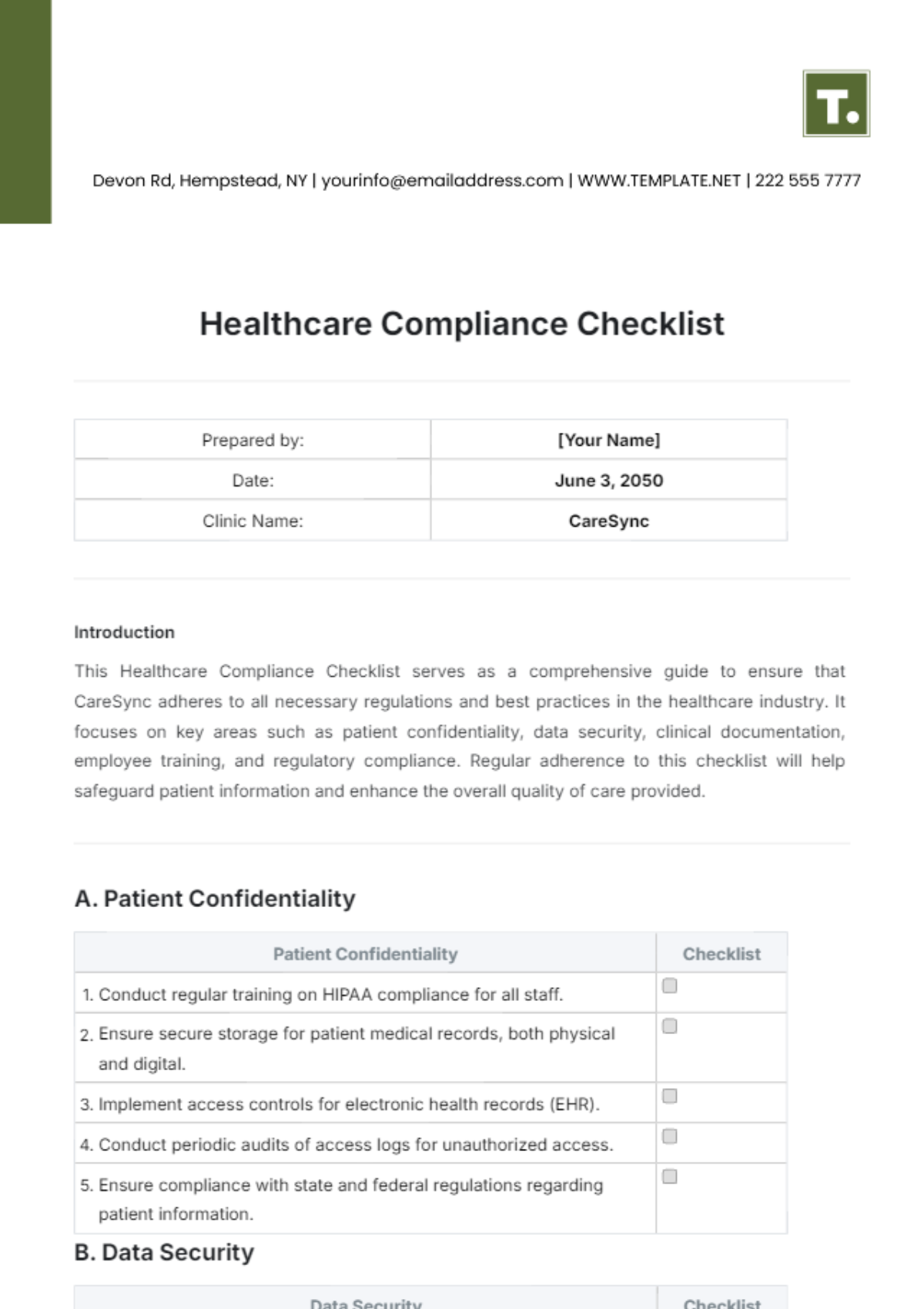
A healthcare compliance plan requires additional care because health organizations can face overlapping operational, privacy, billing, quality, fraud-and-abuse, credentialing, documentation, and patient-safety risks. A healthcare compliance plan template should therefore begin with a risk assessment tailored to the organization’s services, payer relationships, clinical activities, workforce, contractors, and data environment.
The U.S. Department of Health and Human Services Office of Inspector General describes seven fundamental elements as a useful starting point for healthcare compliance programs: written policies and procedures, a compliance professional or responsible function, training and education, communication, internal monitoring, enforcement of standards, and prompt response to detected problems. OIG also emphasizes that compliance programs should be adapted to the organization’s circumstances rather than treated as one universal model.
A health plan compliance plan should similarly identify the organization’s specific regulatory and contractual environment. The document can track policy ownership, training obligations, monitoring activities, audit findings, corrective actions, reporting channels, and management oversight. For healthcare organizations, the central plan should not attempt to replace specialized clinical policies or privacy procedures; instead, it should provide a framework that shows how those controls are governed and reviewed.
Training, Communication, and Employee Participation
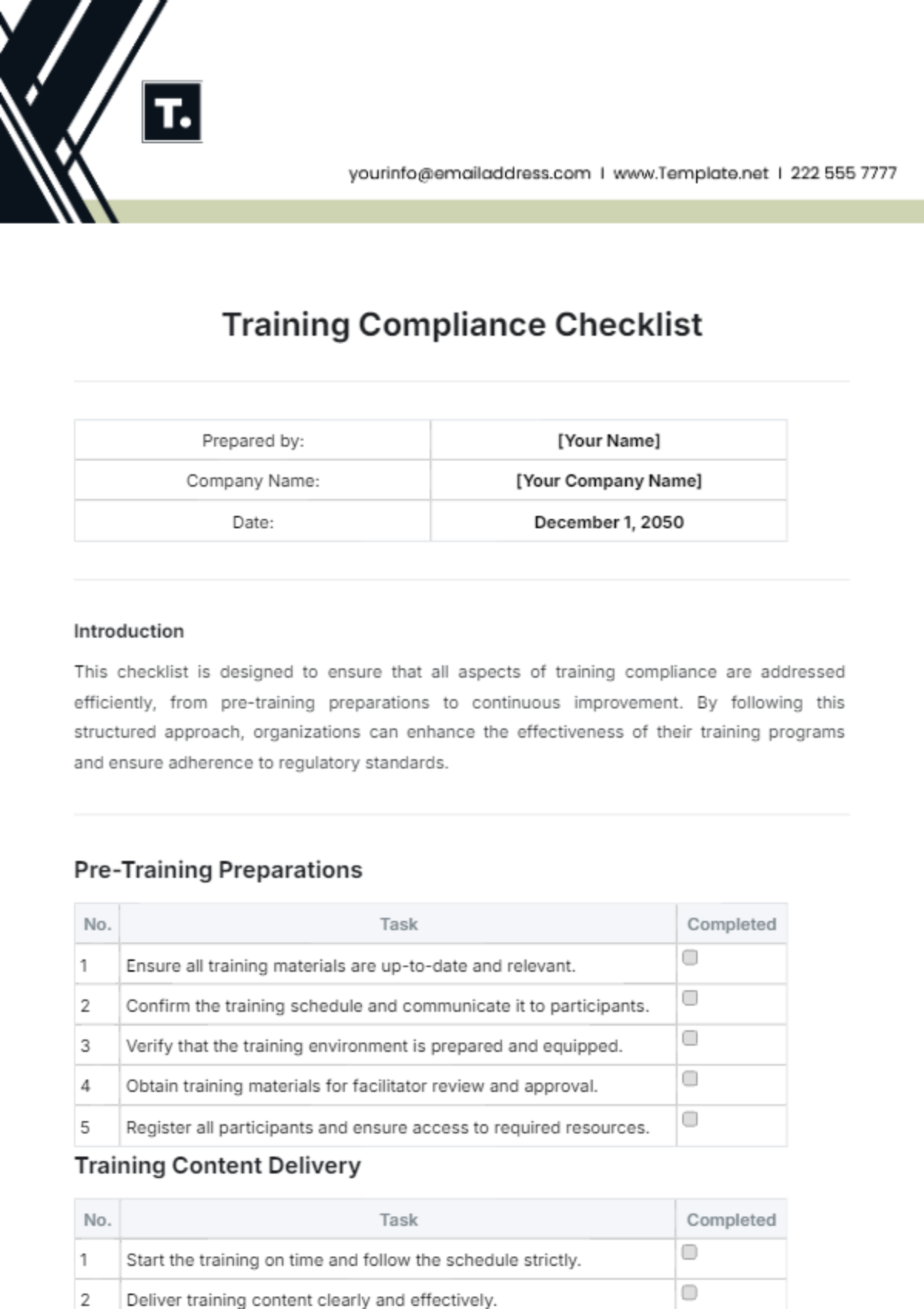
Training should be connected directly to identified risks and responsibilities. A training matrix can show which roles require orientation, task-specific instruction, emergency training, hazard communication training, PPE instruction, refresher training, or specialized compliance education. The matrix should record the subject, target role, training date, trainer, completion status, and next review where relevant.
Communication should work in both directions. Employees need access to relevant policies and a practical way to report hazards, suspected violations, near misses, or compliance concerns. The plan should identify escalation channels and explain how concerns are investigated. A procedure that exists only on paper but is difficult for workers to understand or use will not provide the same value as a process that is visible, accessible, and routinely reinforced.
Management review should examine more than training completion percentages. Leaders should review recurring hazards, overdue corrective actions, inspection trends, incident patterns, audit findings, employee concerns, changes in operations, and regulatory developments. This allows the organization to identify whether the compliance system is improving or merely generating paperwork.
Documentation, Audits, and Corrective Actions
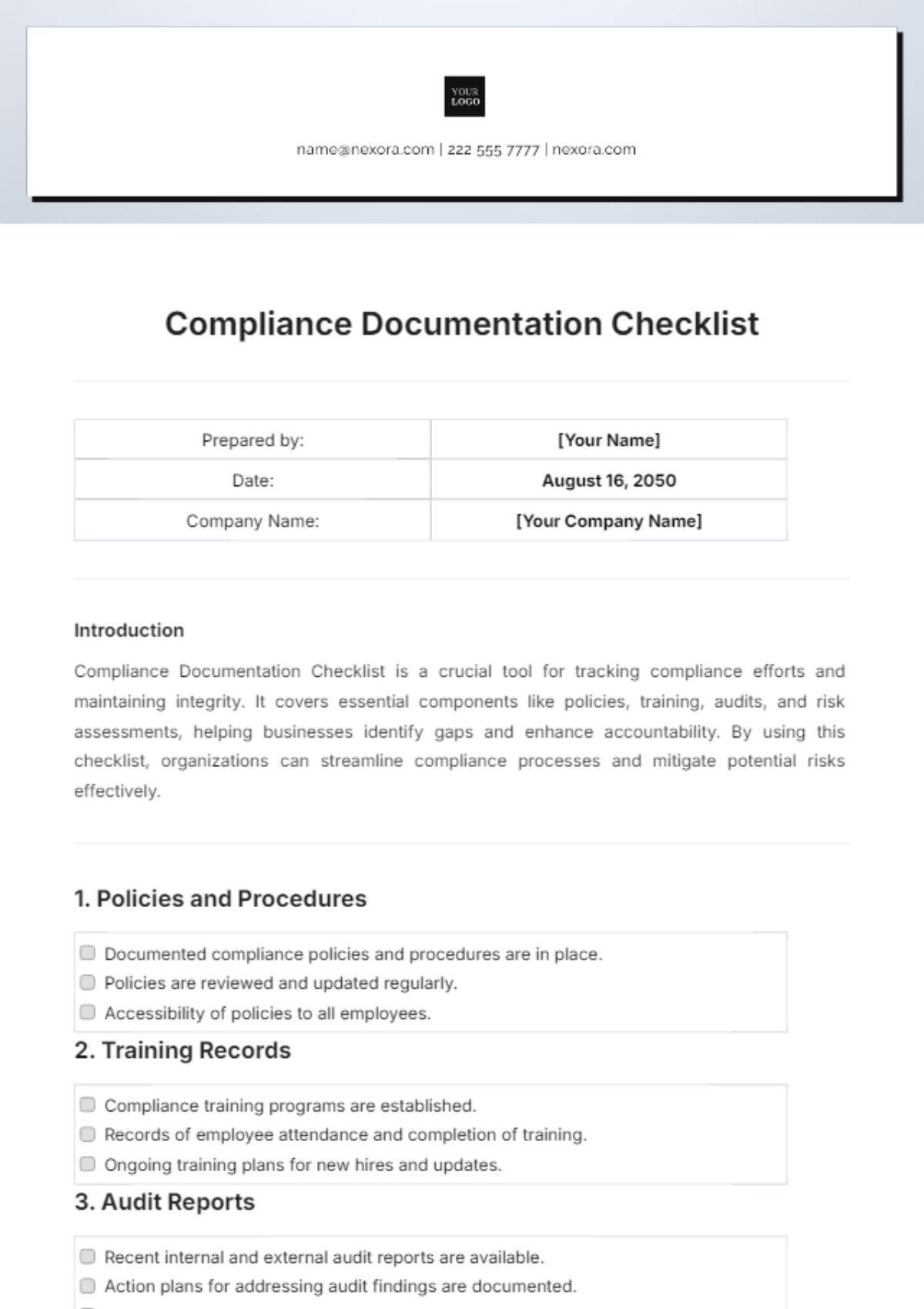
Documentation should make it possible to reconstruct the history of a compliance issue. A reviewer should be able to determine what requirement was considered, what risk was identified, what control was selected, who was responsible, when the control was implemented, and how effectiveness was checked. This is why a safety plan compliance document should link to evidence rather than simply state that a control exists.
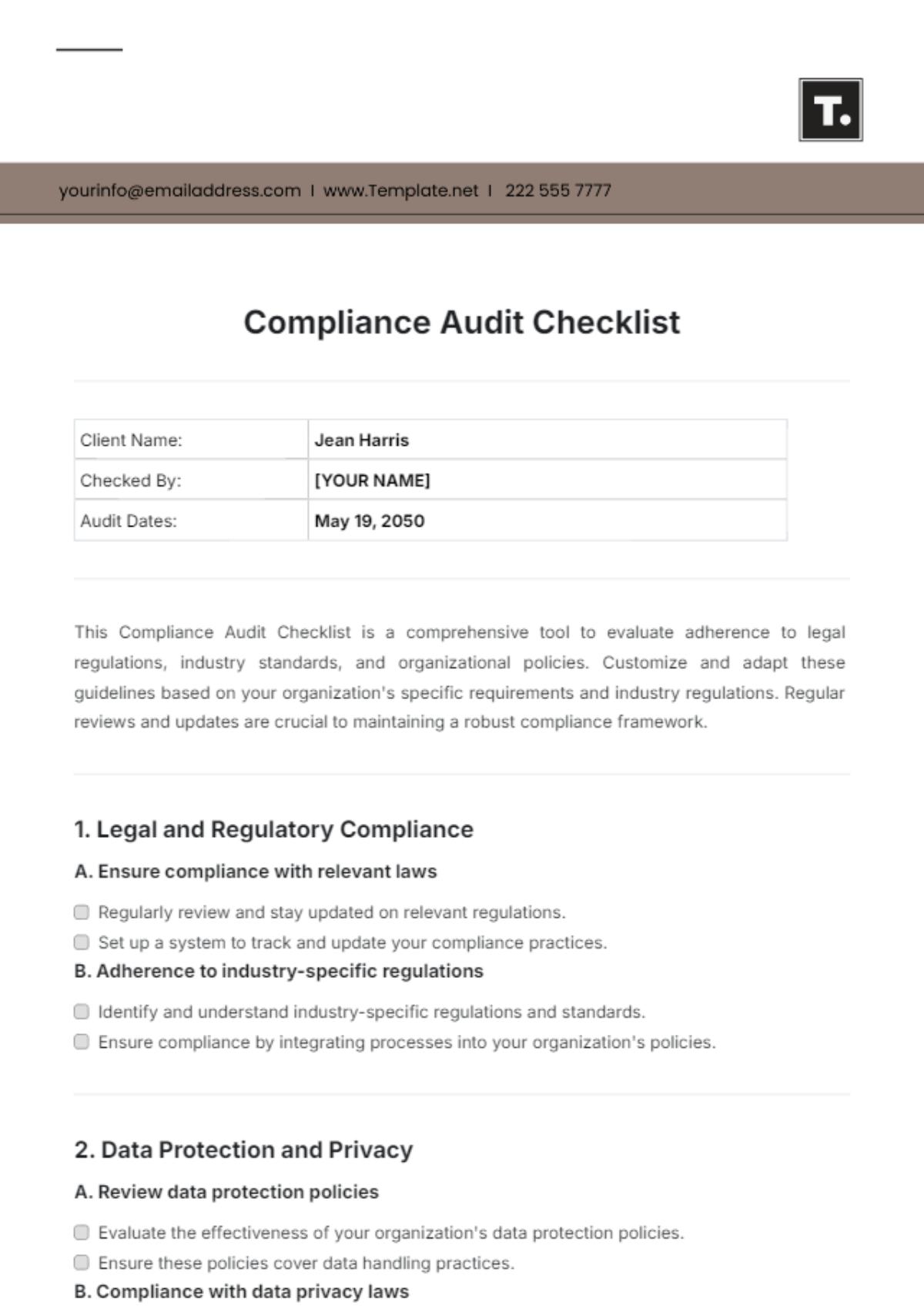
Internal audits should be risk-based and proportionate. The audit scope can cover legal registers, inspections, training, emergency planning, PPE assessments, incident investigations, recordkeeping, contractor controls, and management review. Findings should distinguish between observations, minor deficiencies, significant gaps, and urgent risks where the organization’s methodology uses those categories.
Corrective actions should contain enough information to prevent vague assignments. A useful record identifies the issue, immediate containment, root or contributing cause, corrective action, responsible owner, target date, completion evidence, and effectiveness review. Closing an action because someone marked a box is not the same as verifying that the underlying risk has been reduced.

How to Organize a Reusable Plan
A practical structure can begin with document control, followed by scope and jurisdiction, roles and responsibilities, legal and regulatory register, risk assessment methodology, hazard controls, training, emergency planning, incident management, inspection procedures, recordkeeping, auditing, corrective action, contractor oversight, management review, and revision control. Supporting forms can then be referenced rather than reproduced in full.
The document should use consistent terminology. If the plan calls something a corrective action in one section, it should not call the same process a remediation task elsewhere without defining the distinction. Consistency is particularly important when multiple managers maintain records. Clear field names and status definitions reduce interpretation differences and improve reporting.
Every section should also identify evidence. For example, a training requirement should point to a training record; a hazard assessment should point to the assessment record; an emergency procedure should point to drill or review records; and a corrective action should point to completion evidence. This creates an audit trail and turns the template into an operating framework rather than a collection of statements.
Common Mistakes to Avoid
One common mistake is copying a generic safety plan and changing only the company name. A document can look professional while failing to address actual workplace hazards. The solution is to begin with activities, locations, people, equipment, materials, contractors, emergencies, and regulatory obligations, then shape the template around those facts.
Another mistake is treating the plan as evidence by itself. A policy saying that inspections occur does not prove that inspections occurred. A training policy does not prove that employees were trained. A corrective-action procedure does not prove that hazards were corrected. The plan should identify the records that demonstrate implementation and establish who maintains them.
A third mistake is failing to control revisions. Old versions can remain in circulation, especially when documents are printed or stored in multiple locations. Every controlled version should have an identifier, approval date, effective date, owner, and revision history. Obsolete versions should be clearly controlled so employees do not unknowingly rely on outdated instructions.
Practical Solution
The most practical way to build the plan is to start with a compliance register rather than with formatting. List the organization’s locations, activities, major hazards, relevant legal sources, internal policies, required records, responsible roles, and review dates. Then identify which obligations require a written procedure, training, inspection, monitoring, reporting, or documented corrective action. This creates the backbone of the plan before visual design decisions are made.
Next, create a small set of linked records: a risk register, inspection record, training matrix, incident record, corrective-action tracker, emergency-plan review record, and compliance audit record. Each record should use consistent identifiers so that a finding can be traced back to a requirement and forward to its corrective action. For a small organization, these records can remain simple. For a larger organization, they can be maintained in controlled business systems with appropriate permissions and retention rules.
Finally, establish a review cycle. Review high-risk controls more frequently than low-risk administrative content, and trigger additional review when there is a significant incident, new equipment, new chemical, process change, facility change, regulatory development, or organizational restructuring. Management should periodically examine overdue actions and recurring findings. The goal is continuous control improvement, not simply completion of a document.
Practical Template Fields to Include
The following fields provide a useful starting structure for a health safety legal compliance plan Template. They can be adapted to the organization’s size and risk profile without presenting the format as an official government form.
- Document control: document owner, revision number, effective date, approval authority, review date, and change history.
- Organization profile: legal entity, locations, business activities, workforce categories, contractors, and operational scope.
- Jurisdiction register: federal, state, local, contractual, licensing, and industry-specific requirements relevant to each location.
- Responsibilities: management, supervisors, safety personnel, compliance personnel, workers, contractors, and emergency roles.
- Risk register: hazard, activity, affected group, risk level, existing controls, additional controls, owner, deadline, and verification.
- Training register: subject, role, required frequency, completion status, trainer, evidence, and review trigger.
- Inspection register: location, inspection type, frequency, findings, corrective action, owner, due date, and verification.
- Incident management: incident type, immediate response, investigation, contributing factors, corrective action, and follow-up.
- Emergency planning: foreseeable emergencies, reporting, evacuation, accountability, emergency contacts, drills, and plan review.
- Audit and review: audit scope, evidence reviewed, findings, action plans, management review, and effectiveness checks.
Using the Plan as an Ongoing Management System
The strongest plans are integrated into routine operations. A supervisor can use the risk register when introducing a new task. A safety coordinator can use the inspection schedule when planning site reviews. A compliance officer can use the legal register during periodic monitoring. Human resources or training personnel can use the training matrix to identify overdue requirements. Senior management can use audit and corrective-action information during review meetings.
This integrated approach also makes the plan easier to maintain. When a requirement changes, the legal register identifies which policy, training module, inspection, or control may need review. When an incident occurs, the incident record can point to the related hazard assessment. When an audit finds a weakness, the corrective-action tracker can identify the owner and verify the response. Each part of the system reinforces the others.
The result is a practical document architecture that can support workplace safety, legal compliance, healthcare compliance, and management oversight without pretending that one template is legally sufficient for every organization. The document should always be customized to the actual jurisdiction, industry, workforce, hazards, and regulatory obligations involved. Where legal interpretation is required, the organization should obtain advice from a qualified professional familiar with the relevant jurisdiction.

Reference Examples
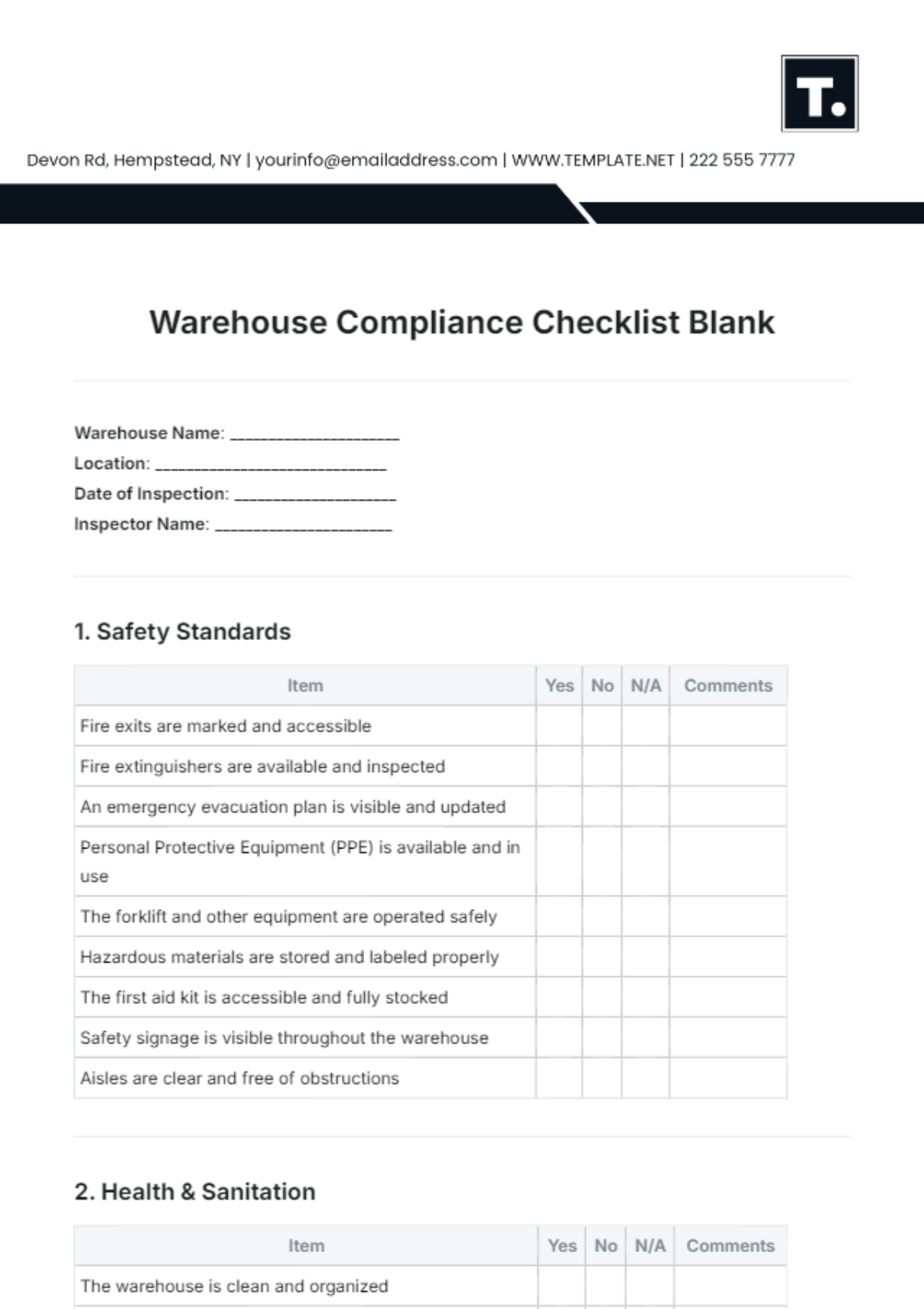
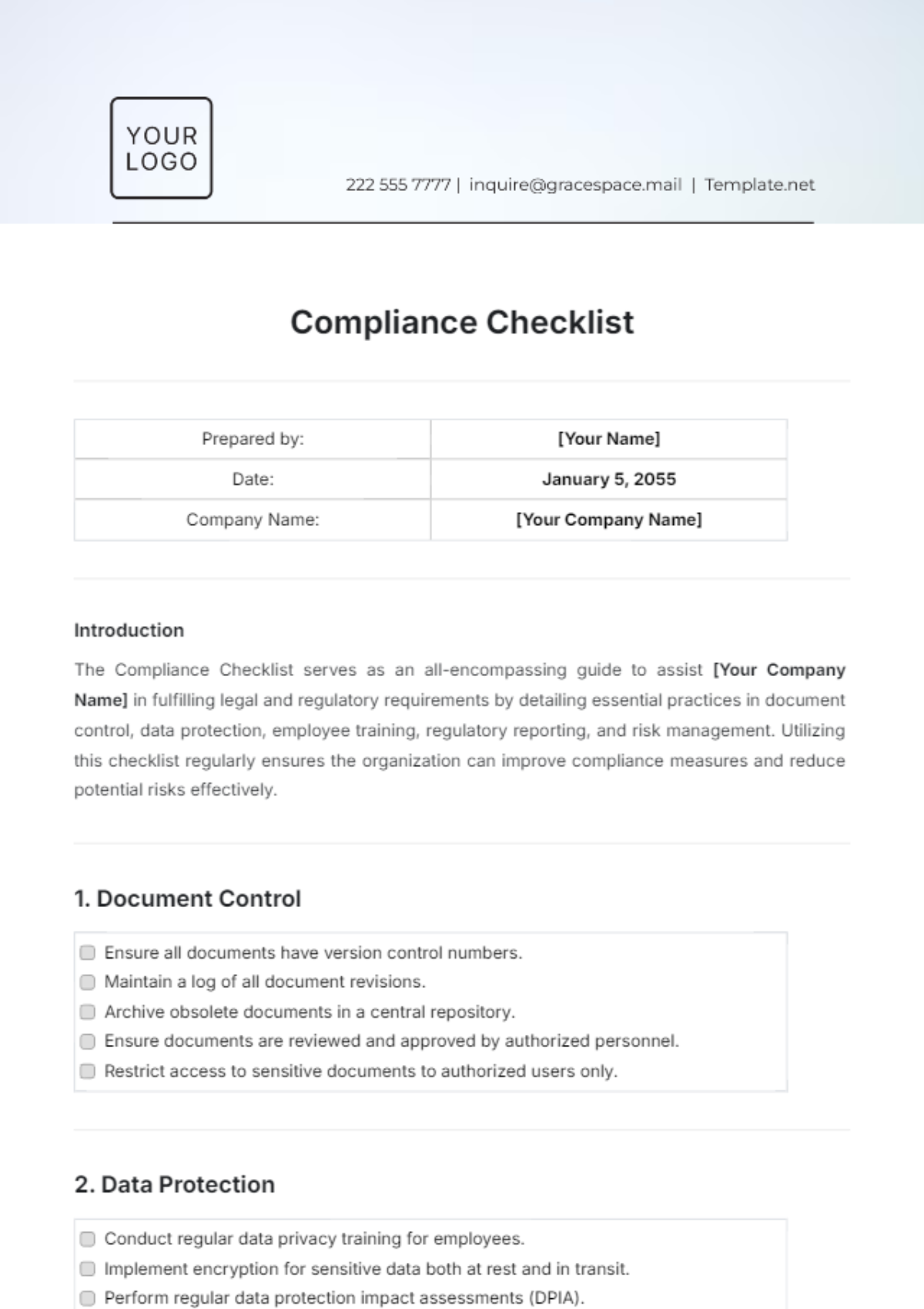
A health safety legal compliance plan Template is easiest to evaluate when its structure can be compared with real document layouts. Useful visual references show how compliance information can be organized into checklists, registers, training records, risk assessments, audit forms, and management reports. These examples should be treated as design references rather than universal legal forms. The actual content of a workplace plan should reflect the organization’s hazards, activities, workforce, locations, regulatory jurisdiction, and internal governance structure. A visually polished document is valuable only when its fields, responsibilities, evidence requirements, and review process correspond to real operational controls.
The following references illustrate different ways a health safety legal compliance plan Template can be structured. Some emphasize workplace safety inspections, while others focus on healthcare compliance, training, documentation, or periodic reporting. Comparing these layouts can help an organization decide whether its central plan should be primarily narrative, checklist-based, register-based, or a combination of these approaches. The most useful design is the one that makes responsibilities clear, supports consistent recordkeeping, connects findings to corrective action, and allows management to review whether the compliance system remains effective as conditions change.
Training Compliance Checklist
Source: Template.net
OSHA Compliance Checklist Layout
Source: Template.net
Healthcare Compliance Checklist
Source: Template.net
Compliance Documentation Checklist
Source: Template.net
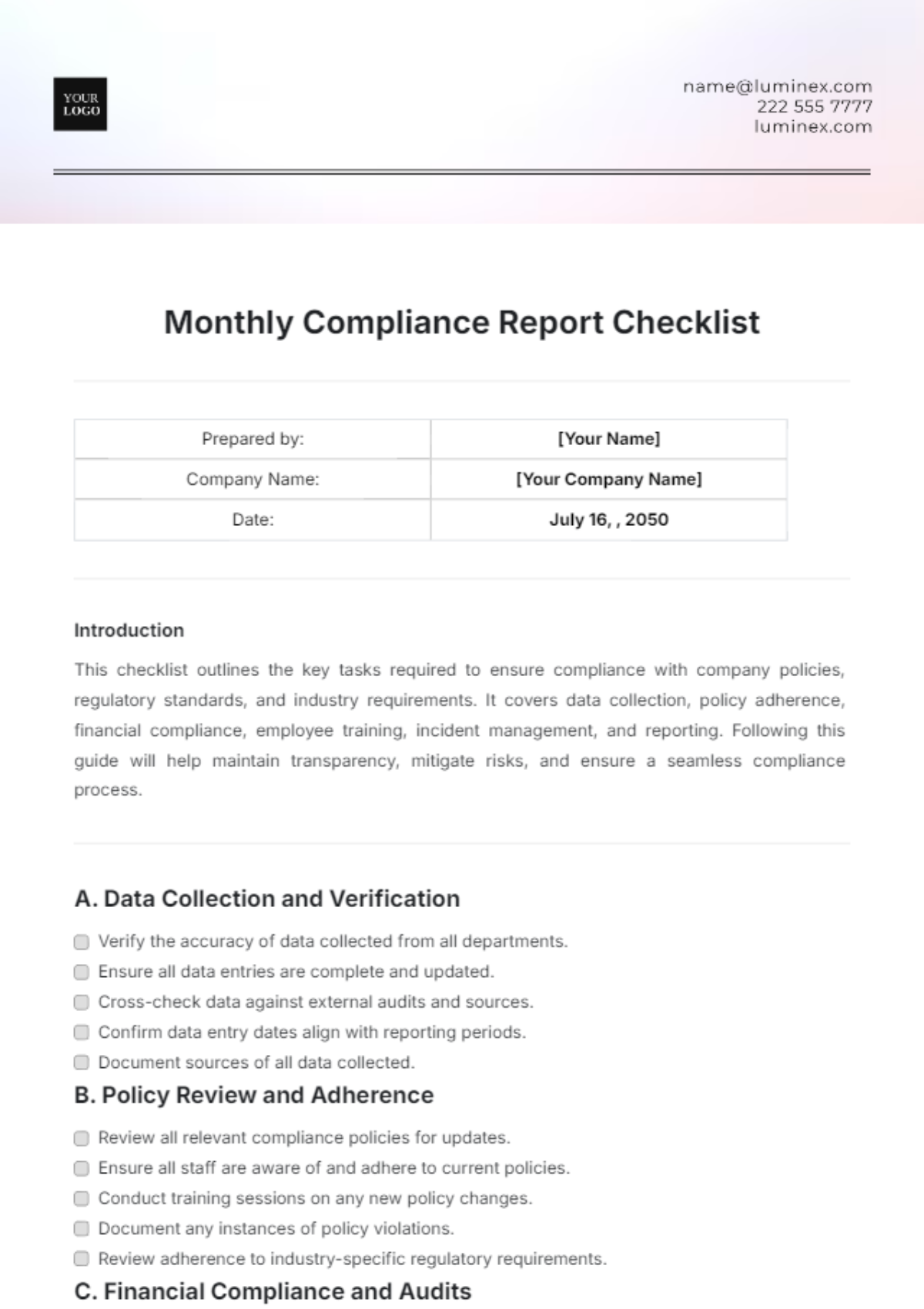
Monthly Compliance Report Checklist
Source: Template.net
