Starting a construction company requires more than technical skills, tools, and a strong work ethic. A clear startup construction company business plan gives you a structured roadmap for turning your construction idea into a sustainable and profitable business. It can help you define your services, understand your target market, plan startup costs, organize operations, and prepare for future growth.
Whether you are launching a residential contractor, commercial construction company, renovation business, or specialized construction service, a well-prepared business plan can also make it easier to communicate your strategy to potential investors, lenders, partners, and employees.
This guide explains the essential sections of a construction startup business plan and provides practical ideas you can use when creating your own document.
What Is a Startup Construction Company Business Plan?
A startup construction company business plan is a formal document that explains how a new construction business will operate, serve customers, generate revenue, manage expenses, and grow over time. It combines business strategy, market research, operational planning, and financial projections into one organized document.
A strong plan should answer several important questions:
- What construction services will the company provide?
- Who are the ideal customers?
- What geographic market will the company serve?
- How will the business attract and retain customers?
- What equipment, employees, licenses, and resources are required?
- How much money is needed to launch and operate the business?
- How will the company generate revenue and reach profitability?
The goal is not simply to create a document for investors. A business plan can serve as a practical management tool that helps the founder make better decisions as the company develops.
Key Sections of a Construction Company Business Plan
1. Executive Summary
The executive summary provides a concise overview of the entire construction business. Although it appears at the beginning of the document, many entrepreneurs find it easier to write this section after completing the rest of the plan.
Include information such as the company name, location, ownership structure, primary services, target customers, mission, competitive advantage, and financial objectives.
For example, a startup might focus on residential construction and remodeling for homeowners and property developers in a growing local market. Its competitive advantage could be based on reliable project management, transparent pricing, quality workmanship, and strong customer service.
2. Company Description
The company description explains what the construction business does and why it exists. Describe the company’s legal structure, founders, location, experience, and long-term vision.
You can also explain the specific problem your business intends to solve. Customers may be looking for contractors who communicate clearly, complete projects on schedule, provide accurate estimates, or specialize in particular types of construction.
Construction Services and Business Model
A startup construction company should clearly define the services it intends to sell. Avoid trying to serve every possible customer from the beginning. A focused service offering can make marketing, staffing, estimating, and operations easier to manage.
Potential construction services include:
- Residential construction
- Commercial construction
- Home additions and extensions
- Renovation and remodeling
- Interior construction and finishing
- Design-build services
- Property maintenance and repair
- Specialized construction services
Explain how each service will generate revenue. Depending on the business model, projects may be priced through fixed contracts, cost-plus arrangements, unit pricing, time and materials, or other contractual structures.
Clearly defining your pricing approach can help you estimate revenue and determine the resources needed for each project.
Market Analysis for a Construction Startup
Market research helps determine whether there is sufficient demand for your construction services. Your analysis should examine the local construction market, customer needs, competitors, pricing conditions, and potential growth opportunities.
Identify Your Target Market
Your target customers could include homeowners, real estate developers, property managers, commercial businesses, industrial clients, government organizations, or other contractors.
Consider factors such as location, project size, customer budget, property type, and construction needs when defining your ideal customer.
Analyze Competitors
Research established construction companies operating in your target area. Examine their services, positioning, customer reviews, project types, pricing approach where available, and marketing channels.
The objective is not necessarily to compete on price. Instead, identify opportunities to differentiate your business through specialization, customer experience, communication, speed, workmanship, technology, sustainability, or project management.
Marketing and Sales Strategy
A construction company needs a consistent system for generating qualified leads. Your marketing strategy should explain how potential customers will discover the business and how leads will become paying clients.
Useful marketing channels may include:
- A professional construction company website
- Local search engine optimization
- Business directory listings
- Social media showcasing completed projects
- Customer referrals
- Relationships with architects and property professionals
- Networking with developers and local businesses
- Targeted digital advertising
- Construction industry events and associations
Build a simple sales process around inquiry, qualification, site assessment, estimate, proposal, contract, project kickoff, completion, and follow-up. A documented process helps prevent leads from being lost and creates a more consistent customer experience.
Operations Plan
The operations plan explains how the construction company will deliver projects. This section should cover project management, procurement, subcontractor relationships, equipment, scheduling, quality control, safety procedures, and administrative processes.
Equipment and Resources
Determine which equipment should be purchased and which resources can be rented or subcontracted. Depending on your service offering, startup requirements may include vehicles, power tools, construction equipment, computers, estimating software, project management software, safety equipment, and office supplies.
Employees and Subcontractors
Define the roles required to complete projects efficiently. A growing construction company may eventually need project managers, site supervisors, skilled tradespeople, administrative staff, procurement personnel, and finance support.
Some specialized work can also be handled through qualified subcontractors. Establish clear expectations for scope, schedules, quality standards, documentation, and payment terms.
Construction Startup Costs and Financial Planning
Financial planning is one of the most important components of a startup construction company business plan. Construction businesses can require significant working capital because expenses may occur before customer payments are received.
Common startup and operating expenses include:
- Business registration and professional fees
- Licenses, permits, and insurance
- Construction tools and equipment
- Vehicles and transportation
- Office setup and technology
- Employee wages and contractor payments
- Materials and supplies
- Marketing and advertising
- Accounting and legal services
- Working capital for ongoing projects
Separate one-time startup costs from recurring monthly expenses. This makes it easier to calculate the amount of capital required before the business reaches stable revenue.
Revenue and Profit Projections
Develop realistic financial projections for at least the first three years. Estimate the number of projects, average project value, gross revenue, direct project costs, overhead, and expected profit.
It is useful to prepare multiple scenarios, such as conservative, expected, and growth cases. This can show how changes in project volume, material costs, labor expenses, or payment timing could affect cash flow.
Funding Strategy
Determine how the startup will be financed. Potential sources may include founder investment, business loans, investors, equipment financing, or retained earnings from early projects.
When seeking external financing, clearly explain how the funds will be used. Lenders and investors generally need to understand the company’s business model, financial assumptions, repayment capacity or growth strategy, and risk management approach.
Organization and Management Plan
The organization plan describes who will be responsible for major business functions. Clearly defined responsibilities reduce confusion and help the company scale.
A simple construction company structure might include:
- Founder or CEO: Oversees strategy, business development, and major decisions.
- Operations Manager: Coordinates daily operations and project execution.
- Project Manager: Manages schedules, budgets, clients, and project documentation.
- Site Supervisor: Oversees on-site activities, quality, and safety.
- Finance and Administration: Handles invoicing, bookkeeping, purchasing, and administrative tasks.
- Construction Team: Performs skilled and general construction work.
Risk Management and Safety
Construction involves operational, financial, contractual, and safety risks. A business plan should explain how the company intends to manage these risks.
Consider procedures for workplace safety, insurance coverage, contract review, project documentation, quality assurance, equipment maintenance, supplier management, and contingency planning.
Cash-flow risk is particularly important. Even a profitable project can create financial pressure if the business must pay workers and suppliers before receiving customer payments. Establishing clear payment schedules, deposits where appropriate, progress billing, and cash reserves can help manage this challenge.
Practical Tips for Writing a Better Construction Business Plan
A useful business plan should be realistic rather than overly optimistic. Use actual market research, supplier quotes, estimated labor costs, and reasonable project assumptions wherever possible.
- Keep financial assumptions clearly documented.
- Define a specific target market instead of targeting everyone.
- Separate project costs from general business overhead.
- Include working capital requirements.
- Explain how customers will be acquired.
- Identify measurable business goals.
- Review the plan regularly as the company grows.
- Update financial projections when costs or market conditions change.
Why Use a Construction Business Plan Template?
Creating a business plan from a blank document can be time-consuming. A structured construction company business plan template provides a starting framework so entrepreneurs can focus on their business information rather than formatting every section from scratch.
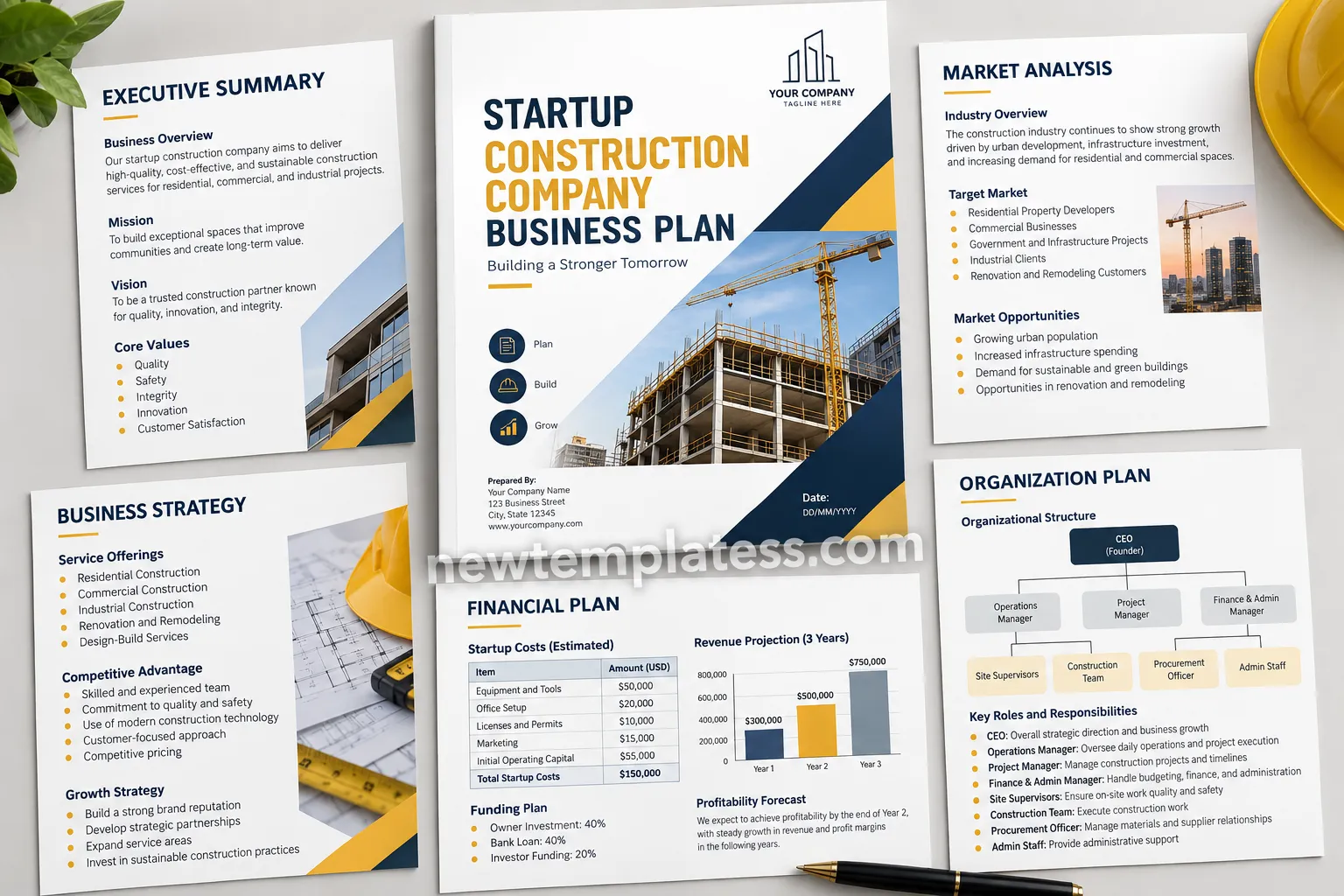
A template can help organize important areas such as the executive summary, market analysis, business strategy, organization structure, financial plan, startup costs, revenue projections, and growth strategy.
However, the template should be customized. Replace sample information with your actual services, market research, financial assumptions, management structure, and business objectives.
Conclusion
A well-developed startup construction company business plan can turn a construction business idea into a practical roadmap for launching and growing the company. By defining your target market, services, competitive strategy, operations, team structure, startup costs, marketing plan, and financial projections, you create a clearer framework for making business decisions.
The strongest plans are specific, realistic, and regularly updated. Use your business plan not only when applying for funding, but also as a working document for measuring progress, controlling costs, managing projects, and planning future expansion.
