A well-written business complaint response can turn a difficult customer interaction into an opportunity to rebuild trust. When a customer takes the time to report a problem, the way a business responds can have a lasting effect on customer satisfaction, loyalty, and reputation.
Whether the complaint involves a product, service, delivery, employee interaction, billing issue, or communication problem, a professional response should be clear, respectful, empathetic, and solution-focused. Instead of responding defensively, businesses should acknowledge the concern, explain what action is being taken, and provide a practical path forward.
Using a business complaint response template can make this process easier. A template provides a reliable structure while still allowing you to personalize each response according to the customer’s situation.
What Is a Business Complaint Response?
A business complaint response is a written message from a company to a customer who has raised a concern about a product, service, experience, or business process. It may be sent by email, letter, customer service software, or another communication channel.
The purpose of a professional complaint response is not simply to apologize. It should also demonstrate that the business has listened, understands the concern, and is taking appropriate steps to address it.
A strong response usually includes:
- Acknowledgment of the customer’s complaint
- A sincere and professional expression of concern
- A clear explanation of the situation when appropriate
- Details about corrective action or the proposed solution
- Information about next steps
- A polite closing that keeps communication open
Why a Professional Complaint Response Matters
Customer complaints can provide valuable information about weaknesses in a company’s products, services, communication, or internal processes. A thoughtful response shows customers that their feedback is being taken seriously.
Even when a business cannot provide exactly what the customer wants, a respectful response can help prevent further frustration. Customers generally want to know that someone has listened to their concerns and is making a genuine effort to resolve the situation.
A consistent complaint response process can also help businesses:
- Improve customer communication
- Identify recurring problems
- Protect customer relationships
- Reduce misunderstandings
- Improve internal service procedures
- Build a more professional brand reputation
How to Write an Effective Business Complaint Response
1. Start by Acknowledging the Complaint
The first step is to clearly acknowledge the customer’s concern. Avoid beginning with excuses, arguments, or statements that immediately shift responsibility.
For example, you could write:
“Thank you for taking the time to bring this matter to our attention. We are sorry to hear about your experience and appreciate the opportunity to review your concern.”
This opening demonstrates that the complaint has been received and that the business is taking it seriously.
2. Show Empathy
Empathy is an important part of customer complaint communication. The customer may be disappointed, inconvenienced, or frustrated, so the response should recognize the impact of the experience without becoming overly emotional.
Avoid generic phrases that sound automated. Instead, connect the acknowledgment to the specific situation whenever possible.
For example, if a customer experienced a delayed delivery, you could acknowledge the inconvenience caused by having to wait longer than expected.
3. Apologize When Appropriate
A professional apology should be sincere and relevant. You do not need to accept responsibility for something that has not been verified, but you can still acknowledge the customer’s experience.
For example:
“We sincerely apologize for the inconvenience this situation has caused.”
If the business has confirmed that an error occurred, the response can be more direct and take responsibility for the specific issue.
4. Explain What Happened Clearly
When an explanation is necessary, keep it factual and easy to understand. Customers usually do not need a long internal account of what went wrong.
Focus on information that helps answer their questions and clarify what the business is doing next. Avoid blaming individual employees, suppliers, customers, or other parties unless the information is genuinely necessary.
5. Explain the Action Taken
A complaint response becomes much more useful when it explains what the business is doing to address the problem.
Depending on the circumstances, corrective action might include:
- Replacing a defective product
- Correcting an inaccurate invoice
- Issuing an appropriate refund or adjustment
- Reviewing a service issue
- Contacting a relevant department
- Improving a business process
- Following up with the customer after an investigation
Be specific when possible. Instead of saying “We will look into it,” explain what will happen next and who will follow up if that information is available.
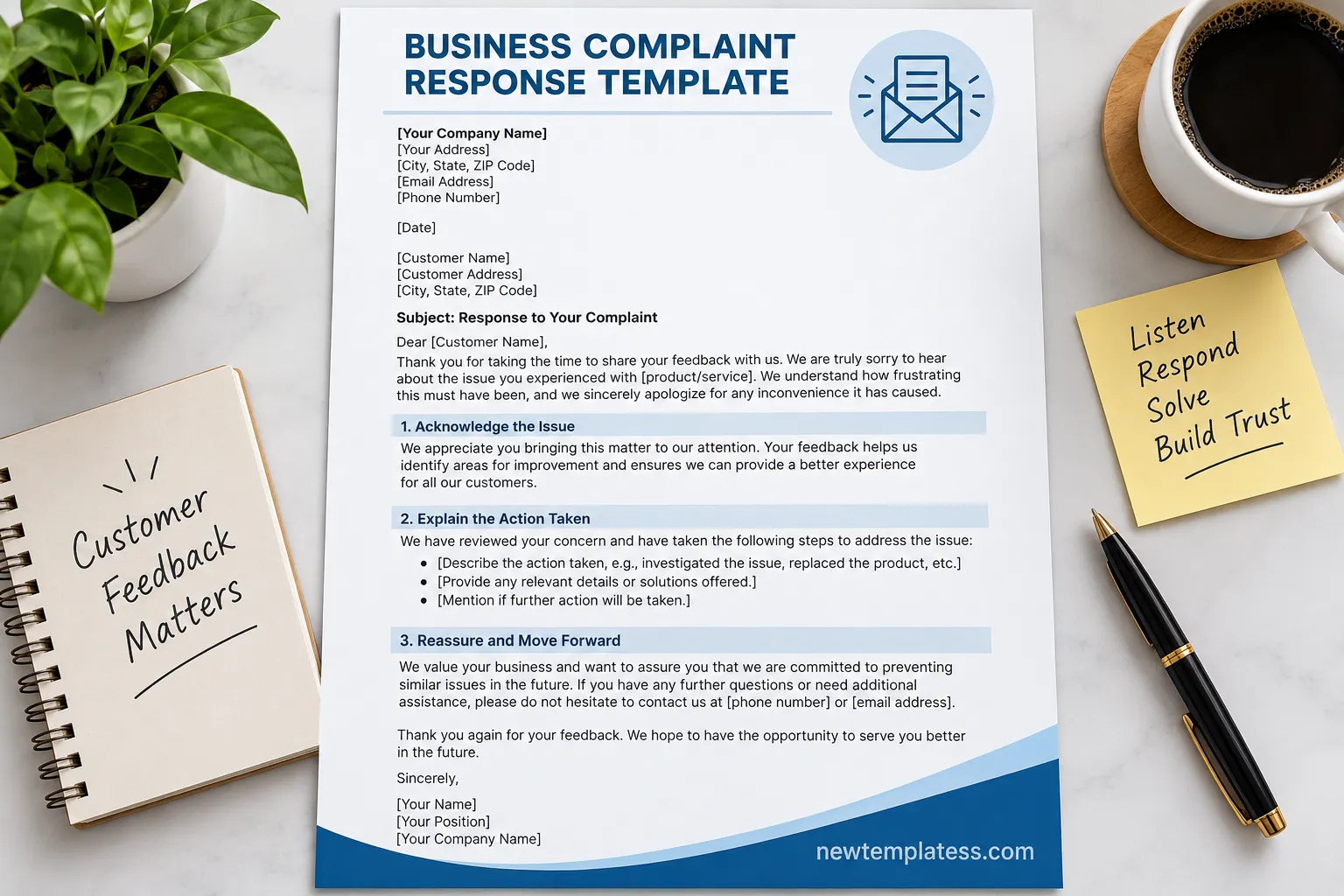
Business Complaint Response Template
The following structure can be adapted for many common customer complaints. Personalize the wording rather than sending the template unchanged.
Subject: Response to Your Complaint
Dear [Customer Name],
Thank you for contacting us regarding your recent experience with [product/service]. We are sorry to hear about the issue you encountered and understand how frustrating this situation may have been.
We appreciate you bringing this matter to our attention. We have reviewed your concern and are taking the following steps to address it:
- [Describe the action taken]
- [Explain the solution or resolution]
- [Provide any relevant next steps or timeframe]
We value your feedback and are committed to improving our service. If you have any additional questions or concerns, please contact us at [email address] or [phone number].
Thank you for giving us the opportunity to address this matter.
Sincerely,
[Your Name]
[Job Title]
[Company Name]
Best Practices for Responding to Customer Complaints
Keep the Tone Professional
The tone of a complaint response should remain calm, respectful, and professional even when the customer’s message is emotional or strongly worded.
Avoid sarcasm, defensive language, accusations, or emotional reactions. A professional tone helps keep the conversation focused on solving the problem.
Personalize the Response
A template can save time, but customers should not feel as though they have received a generic automated message. Include relevant details such as the customer’s name, order information, service date, or specific issue when appropriate.
Personalization also demonstrates that the complaint has been reviewed rather than simply copied into a standard response.
Be Clear About Next Steps
One of the most useful parts of a complaint response is a clear explanation of what happens next. If an investigation is required, explain the process and provide a realistic timeframe when possible.
For example, instead of writing “We will contact you soon,” provide a specific expectation such as “Our customer service team will review the case and contact you within two business days.”
Avoid Unnecessary Excuses
Customers are usually more interested in a solution than a long list of reasons why a problem occurred. An explanation can be helpful, but it should not overshadow the resolution.
Focus on what the business can do to correct the situation and reduce the chance of the same problem occurring again.
Common Types of Business Complaint Responses
Different complaints require different approaches. A useful complaint response template can be adapted to several common situations.
Product Complaint Response
For a defective, damaged, or incorrect product, explain how the company will handle the issue. This may include replacement instructions, return information, repair options, or another appropriate resolution.
Service Complaint Response
For complaints about service quality, acknowledge the customer’s experience and explain what steps will be taken to investigate or improve the service.
Delivery Complaint Response
For delayed or missing deliveries, provide relevant information about the order and explain what action is being taken. Avoid promising a delivery date unless it has been confirmed.
Billing Complaint Response
For incorrect charges or billing concerns, clearly identify what has been reviewed and explain any correction, refund, credit, or additional information required.
Employee or Customer Service Complaint
When a complaint involves an employee interaction, acknowledge the customer’s concern and explain that the matter will be reviewed according to the company’s internal procedures. Avoid discussing private employee information.
What to Avoid in a Complaint Response
Even a well-intentioned response can make a situation worse if the wording is inappropriate. Avoid the following mistakes:
- Blaming the customer before investigating the issue
- Using an argumentative or defensive tone
- Making promises that cannot be guaranteed
- Ignoring important details in the complaint
- Sending a completely generic response
- Providing unnecessary internal information
- Using complicated language when simple wording is sufficient
- Failing to explain what happens next
Tips for Making Complaint Responses More Effective
A strong complaint management process should go beyond individual replies. Businesses can use customer complaints as a source of operational feedback.
Keep track of recurring complaints and look for patterns. If multiple customers report the same problem, the underlying process may need to be reviewed.
It can also help to create different response templates for common situations, such as refunds, shipping delays, damaged products, billing errors, service issues, and general dissatisfaction.
However, templates should be treated as starting points rather than fixed scripts. Employees should have enough flexibility to personalize the message based on the circumstances.
How to Make a Complaint Response More Customer-Friendly
Use short paragraphs and straightforward language. Put the most important information near the beginning so the customer can quickly understand that the issue has been acknowledged.
When possible, use a simple structure: acknowledge the issue, apologize when appropriate, explain the action, provide the next step, and close professionally.
This approach makes a business complaint response easier to read and easier for customer service teams to produce consistently.
Frequently Asked Questions About Business Complaint Responses
What should a business say when responding to a complaint?
A business should acknowledge the complaint, show appropriate empathy, explain the situation when necessary, and provide clear information about the solution or next steps.
Should every business complaint response include an apology?
An apology is often appropriate when a customer has experienced inconvenience or poor service. The wording should accurately reflect what the business knows about the situation and should not make unsupported claims.
Can I use the same complaint response template for every customer?
A template can provide a consistent structure, but each response should be personalized. Including details about the specific complaint makes the communication more useful and professional.
How long should a business complaint response be?
Most complaint responses should be concise enough for customers to understand quickly while still providing all necessary information. The appropriate length depends on the complexity of the complaint.
Conclusion
A thoughtful business complaint response can help a company handle difficult customer situations professionally while creating opportunities for improvement. The most effective responses acknowledge the concern, communicate with empathy, explain relevant facts, and provide clear next steps.
Using a business complaint response template can also help customer service teams maintain consistency and save time. The key is to personalize every response and focus on resolving the customer’s actual concern rather than simply sending a standard message.
When businesses listen carefully, communicate clearly, and follow through on their commitments, customer complaints can become valuable sources of feedback and opportunities to strengthen customer relationships.
