Real estate finance is the foundation of successful property investing. Whether you are buying your first rental property, expanding a portfolio, purchasing commercial real estate, or refinancing an existing investment, understanding how property financing works can help you make more informed financial decisions.
Real estate can require significant upfront capital, but investors do not always need to fund an entire purchase with cash. Mortgages, investment property loans, commercial financing, private lending, and other financing options can help investors acquire properties while preserving capital for renovations, reserves, and future opportunities.
In this guide, you will learn the fundamentals of real estate finance, how property loans work, which costs to consider, how to evaluate cash flow, and practical steps for creating a stronger financing strategy.
What Is Real Estate Finance?
Real estate finance refers to the methods and financial strategies used to purchase, develop, refinance, or manage real estate. It includes the process of obtaining capital, comparing loan terms, calculating investment returns, and managing debt throughout the life of a property investment.
For an investor, financing is more than simply finding a lender. The financing structure can influence monthly cash flow, total interest costs, risk exposure, and the amount of capital available for other investments.
Common areas of real estate finance include:
- Residential mortgages
- Investment property loans
- Commercial real estate loans
- Construction financing
- Bridge loans
- Private and hard money financing
- Refinancing and home equity strategies
- Real estate investment analysis
The right financing approach depends on the property, investment strategy, borrower qualifications, available capital, and financial objectives.
Why Real Estate Financing Matters
Financing can have a major effect on the performance of a property investment. A property may appear attractive based on its purchase price, but the investment can produce very different results after financing costs are included.
For example, a loan with a lower interest rate may reduce monthly expenses. A longer loan term can reduce the required monthly payment, although it may increase the total interest paid over time. A larger down payment can reduce borrowing costs but also ties up more of the investor’s cash.
Before accepting a loan, investors should consider both short-term affordability and long-term financial consequences.
Common Types of Real Estate Financing
Traditional Mortgage Loans
Traditional mortgages are commonly used to finance residential properties. Borrowers typically make a down payment and repay the loan through scheduled principal and interest payments.
Lenders may evaluate income, credit history, debt obligations, assets, employment, and the property itself. Requirements vary between lenders and loan programs, so comparing multiple offers can be useful.
Investment Property Loans
Investment property financing is designed for properties purchased primarily to generate rental income or investment returns. These loans may have different qualification requirements, interest rates, down payment expectations, and reserve requirements compared with owner-occupied mortgages.
Investors should calculate expected rental income against mortgage payments, taxes, insurance, maintenance, vacancies, management fees, and other operating costs before purchasing.
Commercial Real Estate Financing
Commercial real estate loans are commonly used for office buildings, retail properties, warehouses, multifamily properties, and other income-producing assets.
Commercial lenders may place significant emphasis on the property’s financial performance. Metrics such as net operating income and debt service coverage can therefore become important parts of the financing process.
Private and Alternative Financing
Private lenders, bridge loans, and other alternative financing sources may provide faster access to capital or more flexible terms. These options can be useful in situations where conventional financing does not fit the transaction.
However, alternative financing may carry higher interest rates, fees, shorter repayment periods, or additional risks. Investors should carefully review the complete financing agreement before proceeding.
Key Numbers to Understand Before Getting a Property Loan
Good real estate finance decisions depend on more than the advertised interest rate. Investors should understand several important numbers before committing to a loan.
Down Payment
The down payment is the amount paid toward the property at closing rather than borrowed. A larger down payment generally means a smaller loan balance, but it also requires more cash upfront.
Interest Rate
The interest rate determines the cost of borrowing money. Even a modest difference in the rate can affect monthly payments and total interest over a long loan term.
Loan-to-Value Ratio
The loan-to-value ratio, or LTV, compares the loan amount with the property’s value. For example, a $240,000 loan on a property valued at $300,000 represents an 80% LTV.
A lower LTV can indicate that the borrower has more equity in the property, although lending requirements vary by property type and lender.
Debt Service Coverage Ratio
Debt service coverage ratio, or DSCR, compares a property’s operating income with its debt obligations. It is especially relevant for income-producing real estate because it helps show whether the property generates enough income to cover its debt service.
Cash Flow
Cash flow is the money remaining after property income and operating expenses are accounted for. A simple analysis should consider rental income, mortgage payments, taxes, insurance, maintenance, management, utilities, vacancy, and other recurring costs.
How to Evaluate a Real Estate Investment Before Financing
Before applying for financing, create a realistic financial projection for the property. Avoid relying only on optimistic assumptions about rent growth or property appreciation.
Start by estimating the property’s total monthly income. Then subtract recurring expenses and debt service.
- Expected rental income
- Other property income
- Mortgage payment
- Property taxes
- Insurance
- Repairs and maintenance
- Property management
- Utilities paid by the owner
- Vacancy allowance
- Capital expenditure reserves
The result provides a clearer picture of potential cash flow. Investors can then compare that result with the amount of capital required to purchase and operate the property.
Never assume that gross rent equals profit. Operating costs, financing expenses, vacancies, and unexpected repairs can materially change the investment’s financial performance.
How to Improve Your Real Estate Finance Strategy
1. Compare Multiple Loan Offers
Do not focus on the interest rate alone. Compare the complete cost of each financing option, including origination fees, closing costs, points, insurance requirements, penalties, and other charges.
A loan with a slightly lower advertised rate may not always have the lowest overall cost once all fees are included.
2. Keep Adequate Cash Reserves
Real estate investors should avoid putting every available dollar into a property. Unexpected repairs, vacancies, insurance increases, and other costs can create financial pressure.
A dedicated reserve fund can help protect the investment during periods when income is lower than expected.
3. Stress-Test Your Numbers
Use conservative assumptions when evaluating a property. Consider what could happen if rent decreases, expenses increase, the property remains vacant longer than expected, or an expensive repair occurs.
A property that only works under perfect conditions deserves additional scrutiny.
4. Understand the Loan Structure
Read the financing documents carefully. Pay attention to the interest rate, loan term, payment schedule, adjustable-rate provisions, fees, prepayment conditions, collateral requirements, and maturity date.
If a term is unclear, ask the lender or a qualified professional to explain it before signing.
5. Match Financing to Your Investment Strategy
The financing structure should support the purpose of the investment. A long-term rental investor may have different financing priorities than an investor planning to renovate and sell a property.
Consider your expected holding period, projected cash flow, risk tolerance, available capital, and exit strategy before choosing a loan.
Common Real Estate Finance Mistakes to Avoid
Even experienced investors can make financing mistakes. Some of the most common problems occur when borrowers focus on the purchase price while overlooking the complete cost of ownership.
- Ignoring closing costs: Financing and transaction costs can increase the cash required at closing.
- Underestimating maintenance: Properties require ongoing repairs and capital improvements.
- Using unrealistic rent assumptions: Expected rent should be supported by relevant market data.
- Ignoring vacancy: Rental properties may experience periods without tenants.
- Overleveraging: Excessive debt can increase financial pressure when income falls.
- Failing to compare lenders: Loan terms can vary significantly between financing providers.
- Using all available cash: Investors may need reserves after closing.
A Simple Real Estate Finance Checklist
Use the following checklist before moving forward with a property financing decision:
- Determine the property’s purchase price.
- Calculate the planned down payment.
- Estimate closing and acquisition costs.
- Compare available financing options.
- Review interest rates and loan terms.
- Calculate the expected monthly mortgage payment.
- Estimate realistic rental or operating income.
- List all recurring property expenses.
- Calculate projected monthly and annual cash flow.
- Set aside an appropriate cash reserve.
- Stress-test the investment using conservative assumptions.
- Review the loan agreement before signing.
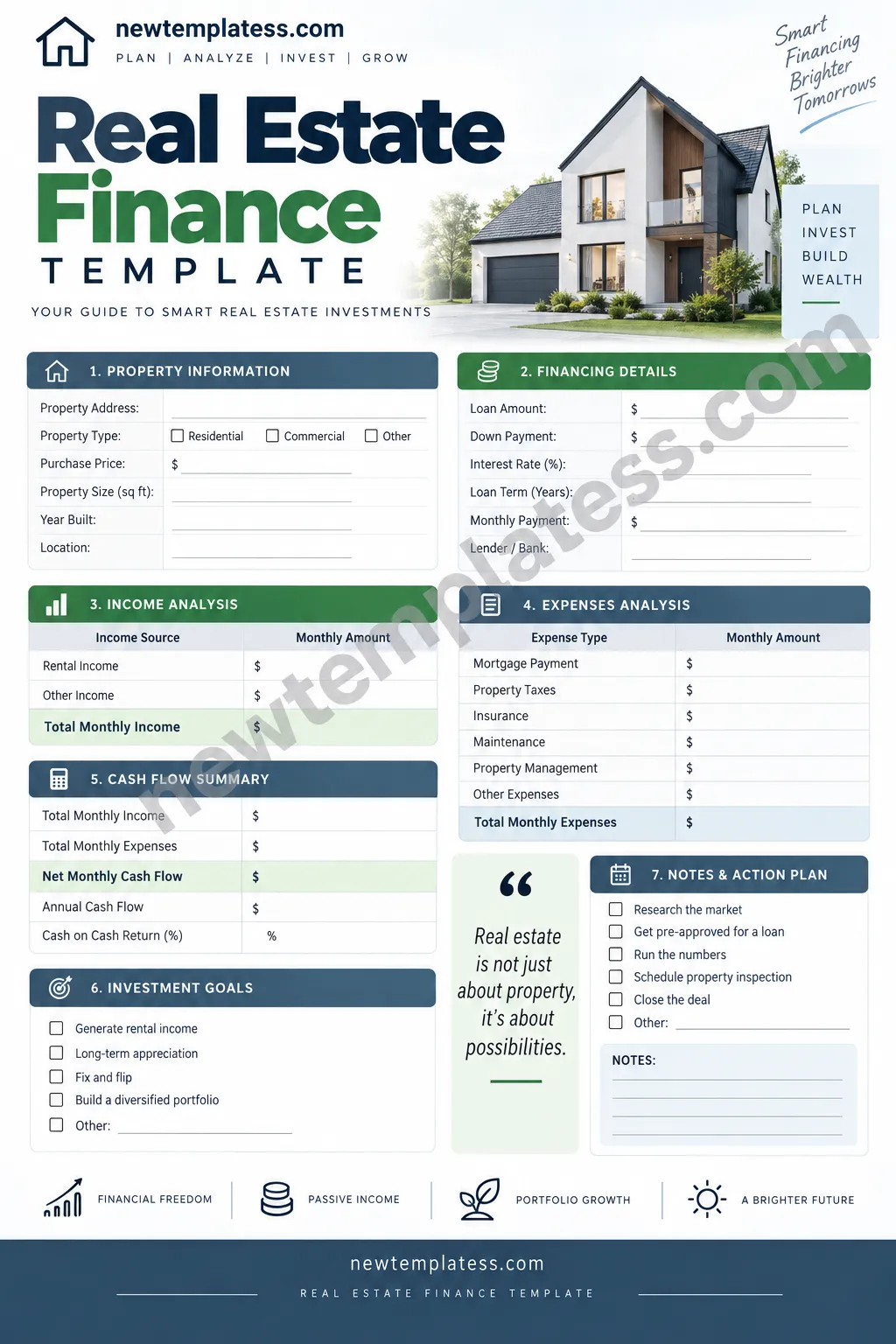
Using a Real Estate Finance Template
A structured real estate finance template can make property analysis easier. Instead of keeping loan information, property expenses, income estimates, and investment goals in separate documents, investors can organize the information in one place.
A useful template can include sections for property details, purchase price, financing terms, down payment, monthly income, operating expenses, cash flow, investment goals, notes, and action items.
This approach can also make it easier to compare multiple properties. By using the same categories for each investment, you can identify differences in financing requirements, operating costs, and projected returns more clearly.
Practical Tips for Better Property Financing Decisions
Successful real estate finance starts with preparation. Before approaching a lender, organize your financial information and understand how much capital you can comfortably commit.
Here are several practical steps:
- Review your personal or business budget.
- Know how much cash you can invest without exhausting your reserves.
- Research comparable properties and realistic rental income.
- Request financing estimates from multiple lenders.
- Calculate the complete cost of borrowing.
- Use conservative assumptions for income and expenses.
- Keep documentation organized throughout the financing process.
- Consult qualified financial, tax, legal, or real estate professionals when appropriate.
Most importantly, focus on the numbers rather than the excitement of acquiring a property. A disciplined analysis can reveal both opportunities and potential problems before money is committed.
Conclusion
Real estate finance plays a central role in buying, managing, and growing a property portfolio. Understanding loan types, interest rates, down payments, LTV, DSCR, cash flow, operating expenses, and financing costs can help investors evaluate opportunities more carefully.
The goal is not simply to obtain a loan. The goal is to create a financing structure that fits the property, investment strategy, available capital, and long-term financial plan.
By comparing financing options, maintaining adequate reserves, stress-testing investment assumptions, and tracking the numbers with a structured real estate finance template, investors can approach property decisions with greater clarity and organization.
