A rental development agreement is an important document for property owners, developers, investors, and operators who work together to develop a property for rental purposes. It establishes the rights, responsibilities, financial arrangements, development obligations, and expectations of everyone involved before significant work or investment begins.
Whether the project involves apartments, rental houses, commercial units, student accommodation, or another income-producing property, a clearly written agreement can help reduce misunderstandings and provide a practical framework for the entire development process. The right agreement should address everything from the property and development plan to funding, construction, management, revenue sharing, termination, and dispute resolution.
This guide explains what a rental development agreement should contain, why it matters, and how to prepare a useful agreement template for a property development project.
What Is a Rental Development Agreement?
A rental development agreement is a formal contract between parties who agree to develop, improve, construct, or prepare real estate for rental use. Depending on the project, the parties may include a landowner, property developer, investor, construction partner, property manager, or operating company.
The agreement defines how the project will be managed and how responsibilities, costs, risks, and potential returns will be allocated. It can also establish important milestones and procedures for handling changes to the original development plan.
Unlike a basic rental agreement between a landlord and tenant, a rental development agreement generally applies to the development and operation of rental property rather than simply the leasing of an existing unit.
Why a Rental Development Agreement Is Important
Property development projects often involve substantial money, multiple stakeholders, contractors, regulatory requirements, and long-term commitments. Verbal understandings may not provide enough protection when circumstances change.
A written agreement gives the parties a shared reference point and can help clarify questions such as:
- Who owns or controls the property?
- Who is responsible for obtaining permits and approvals?
- Who pays development and construction costs?
- How will unexpected expenses be handled?
- Who manages contractors and construction schedules?
- Who will manage the property after completion?
- How will rental income and profits be distributed?
- What happens if the project is delayed or exceeds its budget?
- Under what circumstances can the agreement be terminated?
Clear answers to these questions can reduce ambiguity and give each party a better understanding of its obligations.
Key Elements of a Rental Development Agreement
1. Identification of the Parties
The agreement should clearly identify every party involved in the project. This normally includes legal names, business names where applicable, addresses, and the capacity in which each party is acting.
For example, one party may be the property owner while another acts as the developer and another provides financing or manages the completed rental property. Clearly defining these roles at the beginning helps prevent confusion later.
2. Property Description
A detailed description of the property should be included. This may include the physical address, parcel number, legal description, current ownership information, and any relevant attachments.
If the development covers multiple parcels, buildings, or phases, each property should be identified precisely. Supporting documents such as surveys, site plans, or legal descriptions can be attached as exhibits.
3. Development Scope and Objectives
The agreement should explain exactly what the parties intend to develop. The scope might include new construction, renovation, conversion, expansion, landscaping, infrastructure, or improvements to an existing property.
A strong development section can specify:
- The type and number of rental units planned.
- Major construction or renovation work.
- Required permits and regulatory approvals.
- Target construction milestones.
- Expected completion date.
- Quality or design standards.
- Plans, specifications, and other project documents.
Specific project objectives make it easier to determine whether the development is progressing according to the parties’ expectations.
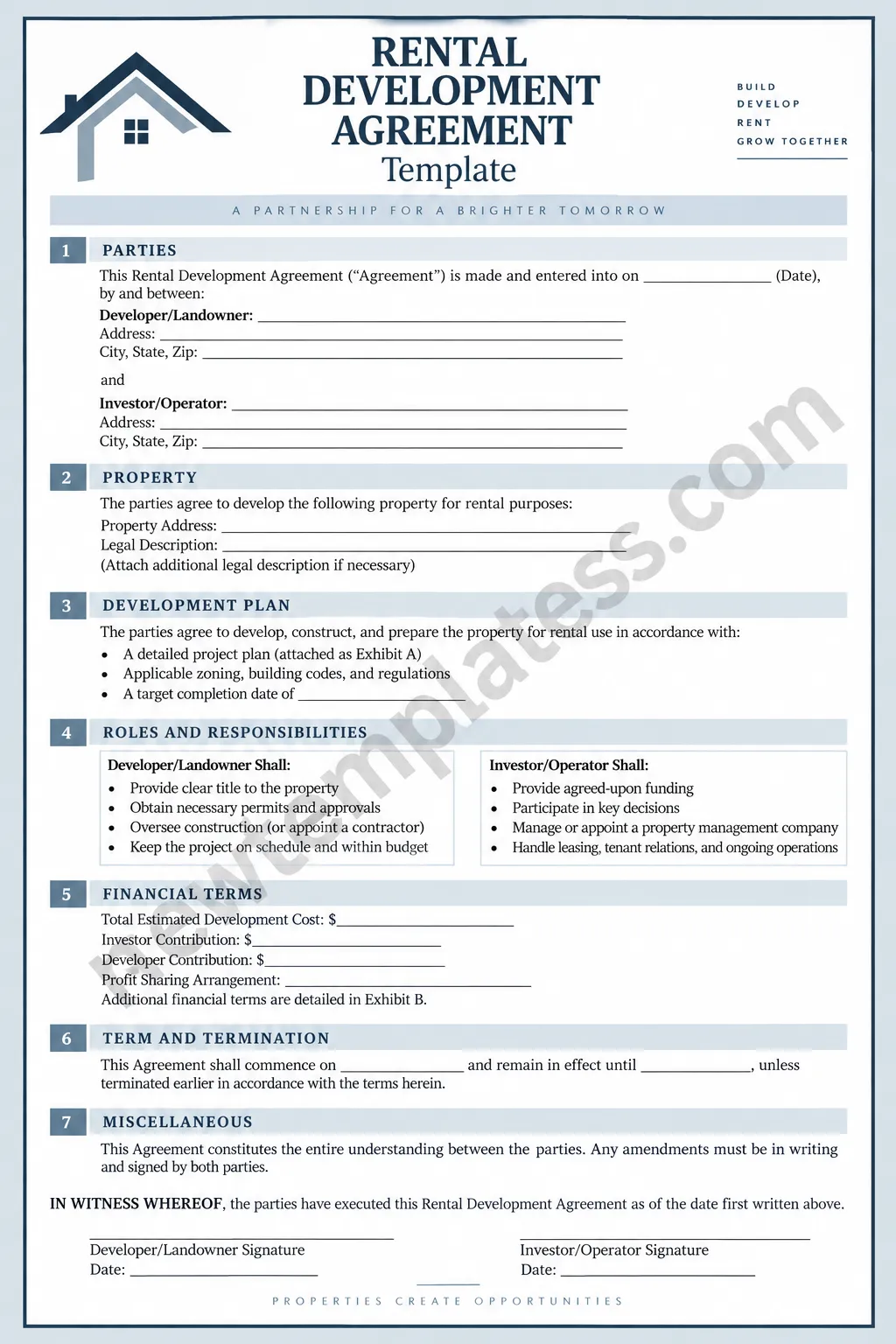
4. Roles and Responsibilities
Each party’s responsibilities should be described in practical terms. For example, a developer may be responsible for project planning, contractor coordination, construction management, budgeting, and obtaining required approvals.
The property owner may be responsible for providing access to the property, maintaining clear title, or contributing the property as part of the project. An investor may provide capital according to an agreed funding schedule, while an operator may take responsibility for leasing and property management after completion.
The agreement should avoid vague statements such as “the developer will manage the project.” Instead, important responsibilities should be listed specifically.
Financial Terms and Investment Contributions
Financial provisions are among the most important parts of a rental development agreement. The contract should explain how the project will be funded and how financial obligations are allocated.
Important financial details may include:
- Total estimated development cost.
- Initial capital contributions.
- Additional funding requirements.
- Construction payment procedures.
- Responsibility for cost overruns.
- Loans and financing arrangements.
- Operating reserves.
- Rental income allocation.
- Profit-sharing arrangements.
- Reimbursement of approved expenses.
If one party contributes land while another contributes cash, labor, expertise, or financing, the agreement should explain how those contributions are valued and reflected in the parties’ economic interests.
Rental Income and Profit Sharing
Once the property is completed and rented, the parties need a clear understanding of how rental income will be handled. The agreement may specify whether income is distributed directly, used first to pay operating expenses, or retained as reserves.
A typical arrangement might establish a sequence in which rental revenue is used to cover approved operating expenses, debt service, reserves, and other agreed costs before remaining profits are distributed.
The agreement should also define what counts as “net income” or “profit.” Without a clear definition, disagreements can arise over expenses, management fees, repairs, taxes, insurance, and other deductions.
Construction, Permits, and Compliance
Development projects must comply with applicable planning, zoning, building, environmental, safety, and rental regulations. The agreement should allocate responsibility for obtaining permits, approvals, inspections, and certificates where applicable.
It is also useful to specify who selects contractors and consultants, who approves construction contracts, and who is authorized to make changes to the approved plans.
Major changes to the project should generally require documented approval. This can help prevent one party from making substantial decisions that create unexpected costs or alter the project’s intended purpose.
Project Schedule and Delays
A rental development agreement should establish realistic milestones. These may include planning approval, financing, commencement of construction, major construction stages, inspections, practical completion, and commencement of leasing.
The contract should also explain how delays will be handled. Potential causes can include permitting delays, supply shortages, contractor issues, severe weather, changes in law, or other circumstances beyond a party’s reasonable control.
Where appropriate, the agreement can establish notice requirements and procedures for revising project deadlines.
Property Management and Leasing
After construction is complete, responsibility usually shifts from development to ongoing property operations. The agreement should identify who will manage the rental property and what authority that person or company will have.
Property management responsibilities may include:
- Marketing available rental units.
- Screening prospective tenants.
- Preparing and administering leases.
- Collecting rent.
- Coordinating maintenance and repairs.
- Managing tenant communications.
- Maintaining financial records.
- Handling routine property inspections.
If an outside property management company will be appointed, the agreement can establish the process for selecting and replacing that manager.
Insurance, Risk, and Liability
Insurance requirements should be addressed before development begins. Depending on the nature of the project, relevant coverage may include property insurance, construction insurance, liability coverage, workers’ compensation, or other policies required by applicable law or financing arrangements.
The parties should also consider how responsibility for damage, third-party claims, contractor negligence, and other project risks will be allocated. Specific indemnification provisions may be appropriate, but they should be reviewed according to the applicable jurisdiction.
Term and Termination
The agreement should state when it begins and how long it remains in effect. It should also explain circumstances that may allow one or more parties to terminate the relationship.
Possible termination events include:
- Material breach of the agreement.
- Failure to provide required funding.
- Failure to obtain necessary approvals.
- Extended project delays.
- Insolvency or bankruptcy where legally relevant.
- Mutual written agreement.
Termination provisions should also address what happens afterward, including outstanding payments, ownership of work product, project documents, debts, tenant obligations, and any continuing responsibilities.
Dispute Resolution
Even carefully drafted agreements can lead to disagreements. A dispute resolution clause can establish a process for addressing conflicts before they become more costly.
The agreement may require negotiation, mediation, arbitration, or court proceedings depending on the parties’ preferences and applicable law. It should also identify the governing law and, where appropriate, the location or jurisdiction for resolving disputes.
Practical Tips for Creating a Rental Development Agreement
Be Specific About Money
Avoid relying on general phrases such as “shared expenses” or “reasonable costs.” Identify which expenses are covered, who pays them, when payments are due, and how additional costs are approved.
Attach Supporting Documents
Important plans, budgets, property descriptions, construction schedules, specifications, and financial arrangements can be included as exhibits. Referencing these documents directly in the agreement makes the overall project framework easier to understand.
Define Decision-Making Authority
Identify which decisions require approval from all parties and which decisions can be made independently. This is particularly important when multiple people are responsible for construction, financing, leasing, or operations.
Plan for Changes
Development projects rarely proceed exactly as originally planned. Include a written change-order or amendment process so that significant modifications can be documented and approved.
Review the Agreement Professionally
A template is a useful starting point, but it should not automatically be treated as a final legal contract. Property law, construction regulations, tax rules, landlord-tenant requirements, and contract standards can vary significantly between jurisdictions.
For a real property transaction, the parties should consider having the completed agreement reviewed by a qualified attorney or other appropriate professional familiar with the applicable local laws.
Using a Rental Development Agreement Template
A rental development agreement template can save time by providing a structured starting point for the parties. Instead of creating every section from scratch, users can customize the template with project-specific information.
A useful template should provide space for the parties, property information, development plan, responsibilities, financial terms, project duration, termination provisions, and signatures.
Before signing, every placeholder should be completed and all attachments should be reviewed carefully. Any provision that does not match the actual project should be revised rather than left unchanged.
Conclusion
A well-prepared rental development agreement provides a practical framework for turning a property development plan into a clearly defined business arrangement. By documenting the property, development scope, responsibilities, funding, rental operations, income distribution, risk allocation, schedule, and termination procedures, the parties can establish clearer expectations from the beginning.
Using a rental development agreement template can make the drafting process more organized and efficient, particularly when combined with project-specific budgets, plans, schedules, and supporting documents. However, because real estate development agreements can have significant legal and financial consequences, the completed document should be reviewed for compliance with the laws and circumstances applicable to the project.
