Federal Healthcare Funding: A Practical Guide to Finding and Applying for Funding
Federal healthcare funding can help healthcare organizations, community groups, educational institutions, and public agencies expand services, improve access, support healthcare workers, and address important community needs. However, finding the right opportunity is only the first step. Applicants must also understand eligibility rules, prepare strong proposals, build realistic budgets, and meet federal application requirements.
For many organizations, the process can feel complex. The good news is that a clear funding strategy can make the work much easier. This guide explains how federal healthcare funding works, where to find opportunities, how to prepare an application, and how to manage funding after an award.
What Is Federal Healthcare Funding?
Federal healthcare funding refers to financial support provided by the U.S. federal government for healthcare, public health, medical education, community health, research, workforce development, and related programs. Funding can take different forms, including grants, cooperative agreements, contracts, and other federal assistance programs.
The U.S. Department of Health and Human Services (HHS) is a major source of federal healthcare grants. HHS explains that its funding supports states, territories, tribes, educational organizations, community organizations, and other eligible recipients. Grants.gov serves as the central federal portal for discovering and applying for many federal funding opportunities. :contentReference[oaicite:0]{index=0}
Federal healthcare funding may support projects such as:
- Primary and rural healthcare services
- Healthcare workforce development
- Community health programs
- Maternal and child health initiatives
- Health education and training
- Telehealth and technology projects
- Quality improvement programs
- Public health initiatives
- Healthcare research and innovation
- Programs serving underserved populations
Where to Find Federal Healthcare Funding Opportunities
Finding legitimate funding opportunities is essential. Applicants should rely on official federal sources instead of unverified grant advertisements or third-party websites that promise guaranteed funding.
Grants.gov
Grants.gov is the primary federal portal for discovering funding opportunities. Organizations can search by keyword, agency, eligibility, opportunity number, and other criteria. The platform also provides resources for registration, application preparation, and submission. :contentReference[oaicite:1]{index=1}
When searching Grants.gov, use specific phrases related to your project. For example, a rural clinic might search for rural healthcare, healthcare workforce, quality improvement, telehealth, or community health.
Health Resources and Services Administration
The Health Resources and Services Administration (HRSA) is another important source for healthcare-related funding. HRSA publishes funding opportunities covering areas such as primary care, rural health, healthcare workforce development, maternal and child health, and other healthcare programs. Its funding database allows applicants to review opportunities and eligibility requirements. :contentReference[oaicite:2]{index=2}
Because funding opportunities change, applicants should check official agency pages regularly. A program that was available in one fiscal year may have different eligibility requirements, deadlines, or priorities in another year.
How to Determine Whether You Are Eligible
Eligibility should be checked before spending significant time on an application. Federal funding programs can have very specific requirements.
Depending on the program, eligible applicants may include:
- State and local governments
- Nonprofit organizations
- Healthcare providers
- Hospitals and rural healthcare organizations
- Institutions of higher education
- Community organizations
- Tribal governments and tribal organizations
- Small businesses
- Other organizations identified in the funding notice
Not every organization can apply to every program. For example, HRSA funding opportunities may restrict eligibility to particular healthcare providers, educational institutions, government entities, or organizations serving specific populations. :contentReference[oaicite:3]{index=3}
Read the complete Notice of Funding Opportunity, often called a NOFO, before deciding to apply. Pay close attention to eligible applicants, project requirements, geographic restrictions, funding limits, matching requirements, and application deadlines.
How to Prepare a Strong Federal Healthcare Funding Application
A strong application connects a clearly defined healthcare need with a realistic project and measurable outcomes. Avoid starting with the amount of money you want. Start with the problem your organization is trying to solve.
1. Define the Healthcare Need
Explain the specific problem affecting your target population. Use reliable data when available. Your needs statement should show why the project matters and why federal support is relevant.
For example, instead of saying that a community needs better healthcare, identify a specific issue such as limited access to primary care, a shortage of healthcare workers, or barriers to preventive services.
2. Set Clear Project Goals
Turn the identified need into measurable goals. Strong goals are specific and connected to the purpose of the funding opportunity.
Useful objectives might describe the number of people served, training sessions completed, services delivered, screenings conducted, or improvements expected during the project period.
3. Build a Practical Work Plan
Explain what your organization will do, who will do it, and when each activity will occur. A simple timeline can make the project easier for reviewers to understand.
- Define project activities.
- Assign responsible team members.
- Set realistic milestones.
- Identify expected outcomes.
- Explain how progress will be measured.
4. Prepare a Detailed Budget
Your budget should support the project rather than simply list expenses. Each major cost should have a clear connection to the proposed activities.
Common budget categories may include personnel, equipment, supplies, technology, travel, contracted services, training, and program administration. Always follow the specific funding notice because allowable costs can vary by program.
Federal Healthcare Funding Application Checklist
Before submitting an application, review every requirement carefully. A useful checklist can prevent avoidable mistakes.
- Confirm that your organization is eligible.
- Read the complete funding announcement.
- Record the application deadline and submission time.
- Check registration requirements.
- Confirm your organization’s Unique Entity Identifier (UEI) and required federal registrations.
- Prepare the project narrative.
- Develop a detailed and justified budget.
- Gather supporting documents.
- Review page limits and formatting requirements.
- Check every required form and attachment.
- Proofread the complete application.
- Submit early enough to resolve technical problems.
Grants.gov advises applicants to determine eligibility, find opportunities that align with their work, register as required, prepare the application, and submit through the appropriate application process.
Understanding SAM.gov and Grants.gov Requirements
Federal grant applications can require more than simply creating an account on Grants.gov. Some funding opportunities require an active registration in SAM.gov and a valid UEI.
Applicants should begin registration early because administrative requirements can take time. Recent HRSA funding guidance, for example, instructs applicants to maintain an active SAM.gov registration and use Grants.gov for the application process. :contentReference[oaicite:5]{index=5}
Do not wait until the final day to address registration issues. Early preparation gives your team more time to resolve account, documentation, or submission problems.
How to Track Federal Healthcare Funding After Submission
Submitting an application does not end the funding process. Organizations should keep records of submission confirmations, application numbers, correspondence, and important deadlines.
After an award, financial and program management become equally important. Federal healthcare funding often comes with reporting, documentation, performance, and compliance responsibilities.
Track Financial Performance
Maintain organized records for expenses, invoices, payroll, contracts, and other costs related to the funded project. Your financial records should make it easy to demonstrate how federal funds were used.
Track Program Outcomes
Monitor the measures described in your approved project plan. Regular tracking can help identify problems before they become major issues.
Useful measures may include:
- Number of participants served
- Services delivered
- Training completed
- Healthcare access improvements
- Project milestones achieved
- Quality improvement indicators
- Community outcomes
HRSA provides resources for managing grants, understanding administrative and financial requirements, and meeting reporting obligations. :contentReference[oaicite:6]{index=6}
Common Mistakes to Avoid
Even a promising project can face problems when the application does not follow the funding announcement.
Watch for these common mistakes:
- Applying without confirming eligibility
- Using a generic proposal for every funding opportunity
- Ignoring specific program priorities
- Submitting an unrealistic budget
- Failing to explain measurable outcomes
- Missing required attachments
- Waiting until the deadline to submit
- Failing to monitor post-award requirements
Another important issue is grant fraud. HHS warns about scams involving fake government grant websites and social media accounts. Use official federal websites when researching and applying for funding. :contentReference[oaicite:7]{index=7}
Practical Tips for Managing Federal Healthcare Funding
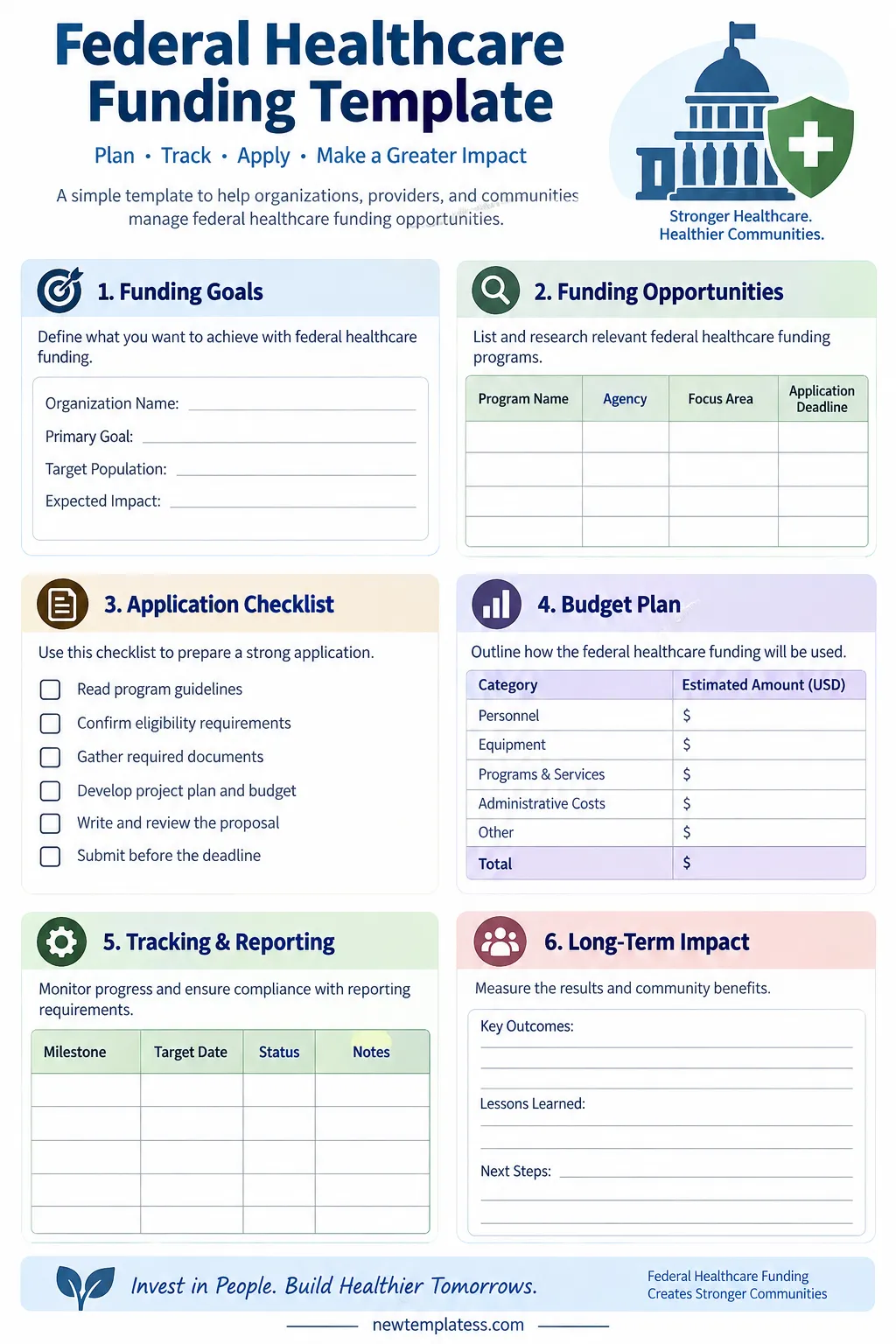
A simple system can make the funding process easier to manage. Create a central funding tracker that records each opportunity, agency, eligibility requirements, deadline, requested amount, application status, and next action.
It is also useful to maintain reusable organizational documents. These might include your organization description, leadership biographies, financial information, project history, community data, and standard organizational policies.
However, reusable content should always be customized. Reviewers need to see a clear connection between your organization, the proposed project, and the specific funding opportunity.
How a Federal Healthcare Funding Template Can Help
A structured template can help your team organize information before the formal application process begins. It can provide a simple place to define funding goals, compare opportunities, prepare a checklist, outline the budget, track milestones, and record expected outcomes.
This approach is especially helpful when multiple team members are involved. Everyone can work from the same information instead of keeping deadlines, budget figures, and project notes in separate documents.
The template can also support internal planning before you begin a formal federal application. Use it as an organizational tool, then verify every requirement against the official funding announcement.
Conclusion
Federal healthcare funding can provide important support for organizations working to improve healthcare access, strengthen communities, develop the healthcare workforce, and address public health needs. Success starts with finding an appropriate funding opportunity and confirming eligibility.
From there, focus on a clear needs statement, measurable objectives, a realistic work plan, and a well-supported budget. Keep accurate records and track project outcomes throughout the award period.
Most importantly, always use official federal sources for current requirements, deadlines, and application instructions. Funding programs can change from year to year, so verify the latest information before submitting an application.
