A legal corporate health and safety Template should be treated as a management framework rather than a decorative form. It should show how an organization identifies hazards, assigns responsibility, communicates safety expectations, manages incidents, maintains records, and checks whether controls remain effective. The exact legal content depends on the country, state, industry, workforce, and hazards involved. In the United States, OSHA recommends a proactive safety and health program built around management leadership, worker participation, and systematic hazard identification and control.
The strongest template is therefore not simply a policy statement. It connects the policy to risk assessments, inspections, training records, emergency procedures, incident investigation, corrective actions, legal requirements, and periodic review. ISO 45001:2018 similarly frames occupational health and safety management as a system involving leadership, worker participation, hazard identification, risk assessment, legal and other requirements, emergency planning, investigation, auditing, and continual improvement. ISO states that the 2018 edition remains current while a revised edition is under development.
For businesses searching for a legal corporate health and safety template pdf, Word-based format, or spreadsheet structure, the important question is not merely which file type looks professional. The more important question is whether the document accurately reflects the organization’s operations and the legal duties that apply to its location. A polished document can still be inadequate if it omits relevant hazards, responsibilities, records, or review mechanisms.

What a Legal Corporate Health and Safety Template Should Accomplish
A corporate health and safety template should establish a clear connection between leadership commitment and day-to-day safety activities. It normally begins with a policy statement that identifies the organization’s commitment to preventing work-related injury and ill health, complying with relevant obligations, providing appropriate resources, and continually improving its safety management practices. The statement should also establish who has authority for implementation rather than leaving responsibility vague.
A second purpose is consistency. When safety information is scattered across unrelated documents, managers may struggle to determine which version is current, workers may receive inconsistent instructions, and corrective actions can be difficult to track. A structured template gives the organization a common architecture. Sections can be numbered, responsibilities can be assigned, review dates can be recorded, and supporting forms can be referenced from the main policy.
A third purpose is evidence. A safety management system should generate records showing that hazards were assessed, controls were considered, training was provided, inspections occurred, incidents were investigated, and corrective actions were followed through. OSHA’s recommended practices specifically encourage systematic processes for identifying and controlling hazards and evaluating whether safety efforts are working.

Policy, procedure, and record are different documents
A common mistake is treating the corporate safety policy as if it were the entire safety program. A policy explains the organization’s commitment and overall responsibilities. A procedure explains how a particular task or process is performed. A record demonstrates what actually happened. For example, a policy may state that hazards must be reported; a hazard-reporting procedure can explain how reports are submitted and reviewed; a completed report provides evidence that a specific hazard was identified and addressed.
This distinction makes a template easier to manage. The main document can remain readable while supporting documents handle detailed processes such as hazard assessments, emergency response, contractor controls, inspection schedules, incident investigation, and training. Creative Workplaces guidance similarly notes that a health and safety policy generally communicates the organization’s overarching approach, responsibilities, consultation process, and key management systems without attempting to describe every procedure in the organization.
A useful corporate structure can therefore contain a policy statement, scope, responsibilities, hazard-management process, consultation method, training expectations, emergency arrangements, incident reporting, records management, legal requirements, performance review, and document control. The supporting forms should be referenced by name and document identifier so that users can locate the current version easily.

Core Sections to Include
The first section should define the organization’s scope. State which locations, activities, workers, contractors, visitors, equipment, and work arrangements are covered. If the organization has offices, warehouses, field operations, remote workers, laboratories, production areas, or construction sites, the scope should make clear whether separate procedures are needed for those environments.
The next section should identify responsibilities at different organizational levels. Senior leadership may approve the policy and provide resources. Managers may implement procedures and review performance. Supervisors may monitor work and respond to hazards. Workers may be responsible for following procedures, reporting hazards, participating in training, and cooperating with investigations. Contractors may have separate duties under contracts and site rules. Responsibilities should be specific enough that an individual can understand what is expected.
The document should also establish communication and consultation mechanisms. Workers often have direct knowledge of task hazards, equipment problems, workflow weaknesses, and practical barriers to safe work. OSHA’s recommended practices emphasize worker participation in developing procedures, analyzing hazards, investigating incidents, conducting inspections, and evaluating program performance.

Hazard identification and risk assessment
Hazard identification is one of the most important operational sections. A template should provide a repeatable method for identifying physical, chemical, biological, ergonomic, electrical, fire, environmental, and other relevant hazards. The method should also consider routine and non-routine work, foreseeable emergencies, equipment changes, new processes, contractors, and vulnerable work situations where relevant.
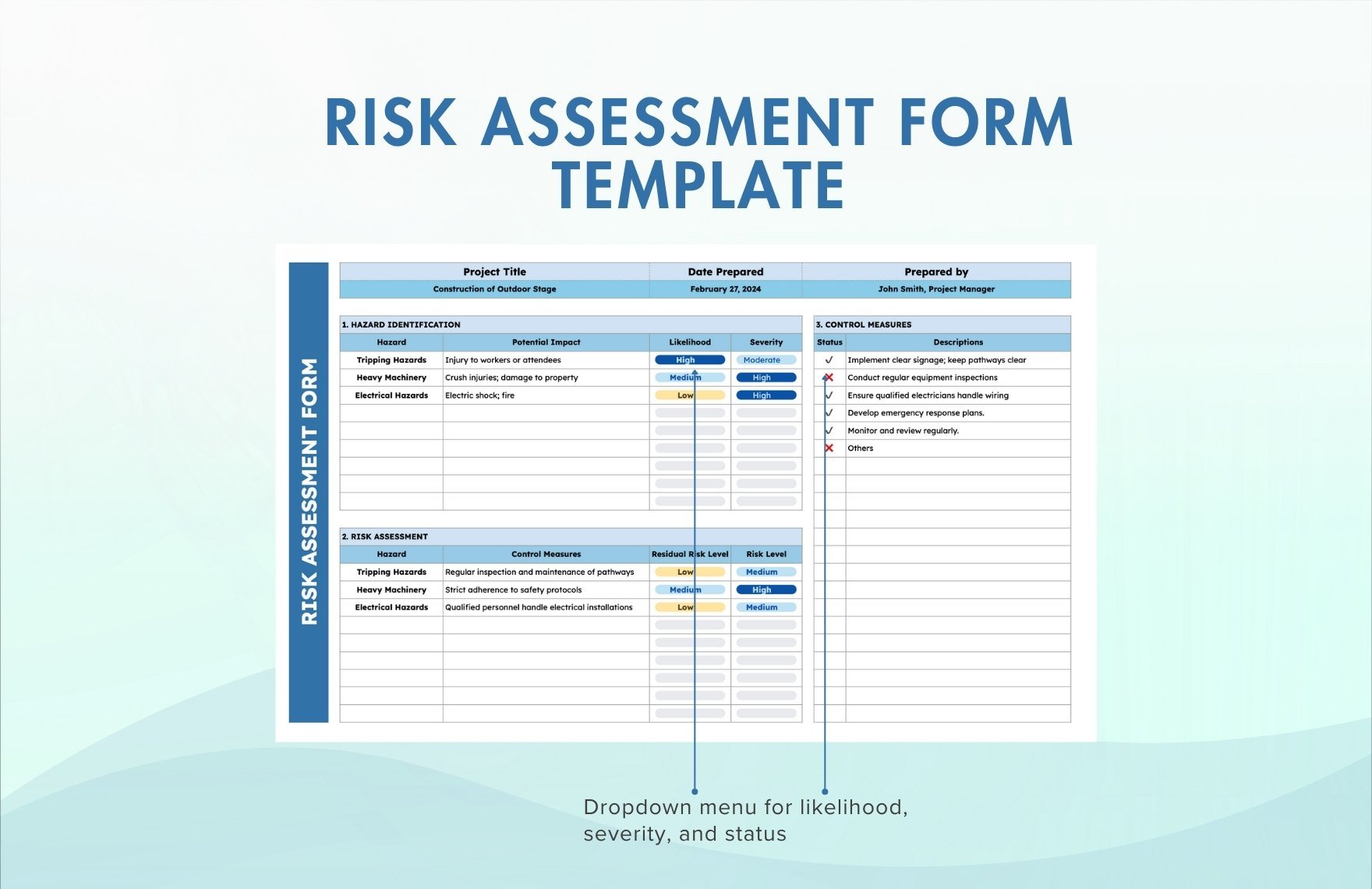
A risk assessment record can capture the task or location, hazard description, people potentially exposed, potential consequence, existing controls, risk evaluation, additional controls, responsible person, target date, and verification of completion. The template should make it difficult to record a risk without also identifying what control will be used and who will ensure that control is implemented.
The hierarchy of controls is useful when deciding how risks should be addressed. OSHA and NIOSH materials emphasize finding and fixing hazards through systematic controls rather than relying solely on worker behavior. A practical template can therefore distinguish elimination, substitution, engineering controls, administrative measures, and personal protective equipment where those categories are relevant.
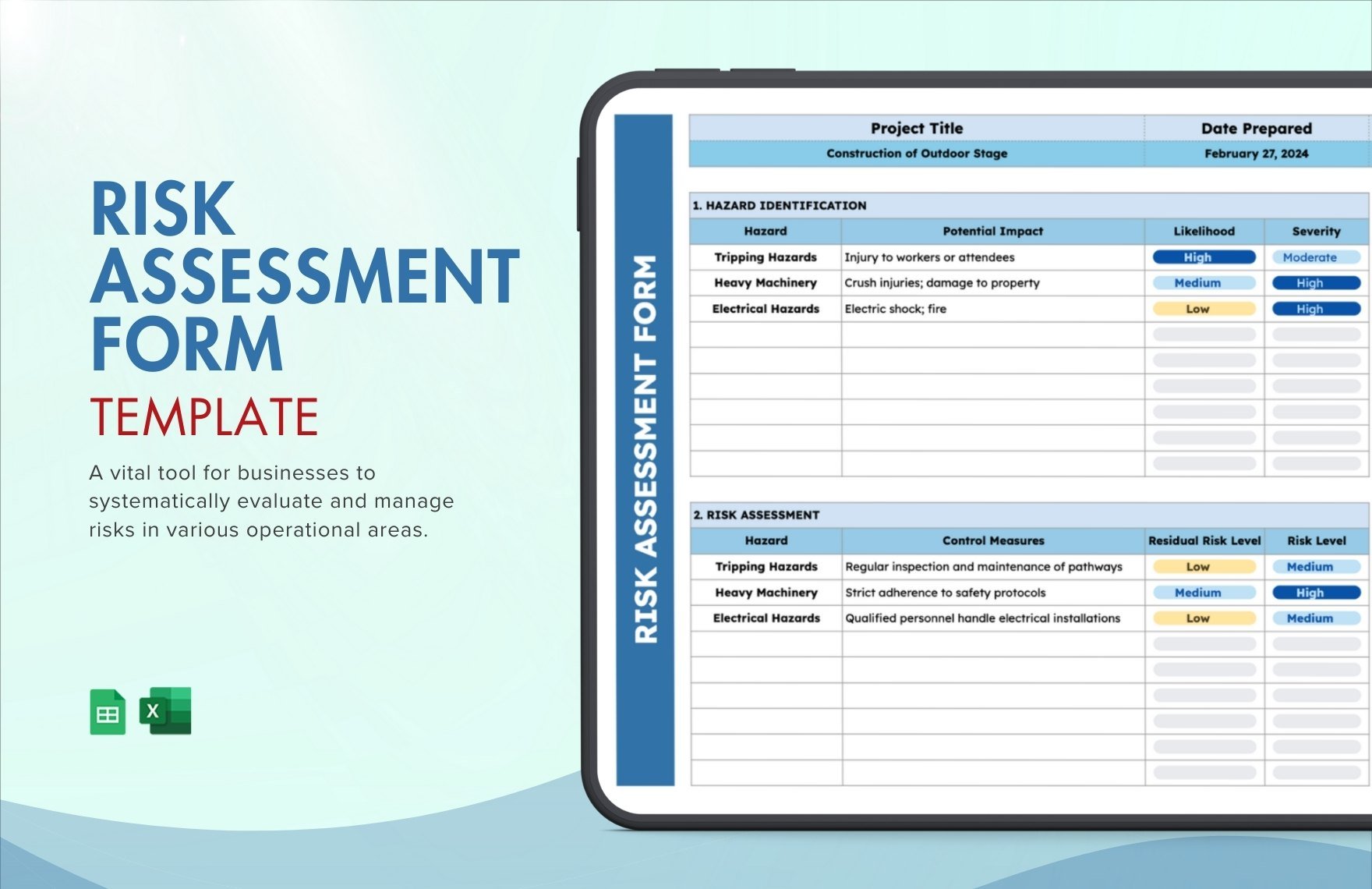
Another useful design is a risk register that can be reviewed periodically. Instead of treating an assessment as a one-time exercise, the organization can record when it was created, when it was reviewed, what changed, and whether controls remain effective. A review trigger can include an incident, near miss, process change, equipment change, new substance, new workplace, regulatory change, or evidence that an existing procedure is not working.

Risk evaluation and control actions
The numerical scoring method should be chosen carefully. Some organizations use likelihood and severity scales, while others use qualitative categories. A template should explain the organization’s chosen method instead of presenting an unexplained color matrix. If numerical ratings are used, the document should define what each level means and how the result affects the urgency of corrective action.
Corrective actions should contain enough information to create accountability. Useful fields include the action description, responsible owner, target completion date, required resources, interim controls, completion status, verification method, and closure date. This converts the assessment from a static document into an operational management record.
For larger organizations, risk records can be connected to an action register. This allows managers to see which controls are overdue, which hazards have recurring issues, and which departments have unresolved actions. A company safety and health program template becomes substantially more useful when its risk-management section connects directly to the organization’s corrective-action process.
Choosing Word, Spreadsheet, or PDF Structure
The right document format depends on how the information will be maintained. A Word-style document is generally convenient for policy statements, procedures, responsibilities, and narrative explanations. It is particularly useful when the document must be reviewed by managers, circulated for approval, and maintained as a controlled policy manual.
A spreadsheet structure can be more suitable for registers, action tracking, risk matrices, inspection schedules, training matrices, and legal requirements. For organizations researching a legal corporate health and safety template excel structure, the key advantage is the ability to sort records, filter outstanding actions, assign dates, and maintain repeatable fields. However, a spreadsheet should still have defined ownership, version control, and review rules.
A PDF is useful when the organization needs a stable published version of an approved policy or completed record. Someone searching for a legal corporate health and safety template word format may need an editable working document, while someone seeking a legal corporate health and safety template pdf may need a controlled presentation copy. These formats can serve different stages of the same document lifecycle rather than competing with one another.

The safest approach is to define a master version and controlled published versions. The master contains editable content and revision history. The published version is issued after approval. Older versions should be identifiable so that staff do not accidentally rely on obsolete instructions. Document numbers, revision dates, approval dates, and responsible owners are simple controls that can significantly improve traceability.

Action Registers and Corrective Measures
A health and safety template should not end when a hazard is identified. The organization needs a mechanism for turning findings into action. An action register can contain the source of the action, description, owner, priority, target date, completion date, verification evidence, and current status. It can be linked to inspections, risk assessments, incident investigations, audits, or management reviews.
The value of an action register is especially clear after inspections. A finding such as damaged guarding is only useful if someone is assigned to correct it, the organization knows when the correction is due, and a competent person confirms that the correction has actually been completed. The same principle applies to training gaps, emergency equipment deficiencies, document revisions, contractor issues, and recurring hazards.
A structured register can also reveal systemic problems. If the same type of corrective action appears repeatedly, the organization may need to revise a procedure, change equipment, improve training, or alter the design of the work process. This is consistent with the continual-improvement approach described by ISO 45001.

For organizations using spreadsheets, the register can include filters for department, responsible person, status, due date, hazard category, and source. A simple status structure such as open, in progress, awaiting verification, and closed can make follow-up easier without creating unnecessary complexity.

Incident Reporting and Investigation
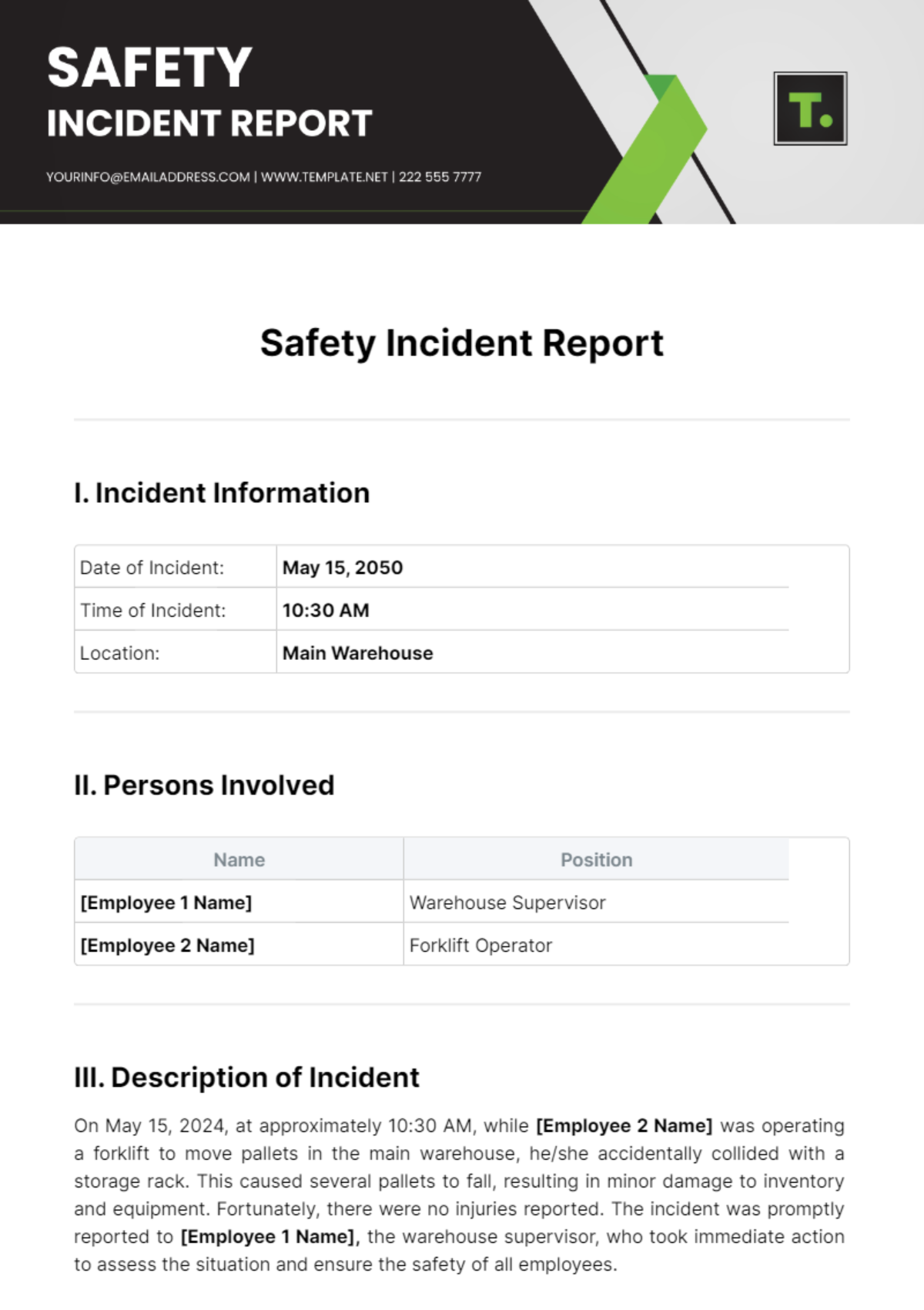
Incident documentation should be connected to the broader safety management system. A useful incident record identifies when and where an event occurred, what activity was taking place, what happened, immediate actions taken, relevant equipment or materials, witnesses or involved roles, and whether further investigation is required. The exact fields should be adapted to the organization’s activities and legal duties.
Investigation should focus on understanding contributing factors and preventing recurrence rather than merely recording the immediate event. The organization can examine equipment, procedures, training, supervision, work conditions, communication, maintenance, workload, environmental factors, and other relevant circumstances. The investigation record should then produce corrective actions that are tracked through the same action-management process used for other safety findings.
OSHA’s recommended practices identify incident investigations and program evaluation as important parts of a proactive safety system. The organization’s template should therefore make it possible to connect an incident to the relevant hazard assessment, procedure, training record, and corrective action.
A near miss can also provide useful preventive information. The reporting form should capture enough detail to identify the hazard and circumstances without creating unnecessary barriers to reporting. Management should define who reviews these reports, how urgent hazards are escalated, and how resulting actions are tracked.
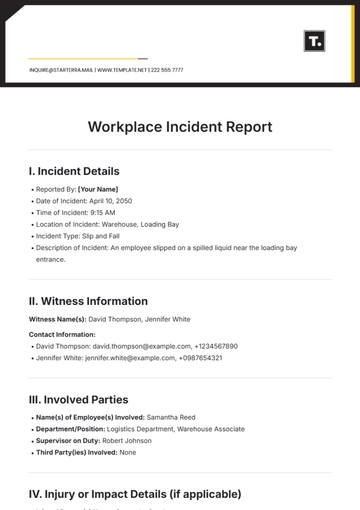
Different event types may require different records. A workplace injury, property damage event, chemical exposure, equipment failure, fire event, near miss, or contractor incident may need different information. The main policy can establish the overall reporting principle while specialized forms collect the details needed for each type of event.
Inspection, Audit, and Program Review
Routine inspections should be supported by a consistent checklist. The checklist can cover housekeeping, access routes, emergency equipment, electrical conditions, machinery, hazardous materials, PPE, storage, signage, workplace conditions, and other hazards relevant to the organization. It should include space for observations and corrective actions rather than simply producing a yes-or-no result.
An audit is different from a routine inspection. An inspection looks closely at workplace conditions and practices, while an audit can examine whether the overall management system is being implemented as intended. An audit may review policy approval, training records, risk assessments, incident investigations, corrective actions, legal requirements, inspection records, and management review.
The review cycle should be defined in the policy. A document can be reviewed on a scheduled basis and additionally when significant changes occur. WorkSafe Queensland guidance, for example, recommends reviewing safety policies and procedures following incidents, workplace changes, worker feedback, or changes in rules and regulations.

A good checklist also records who conducted the inspection, the date, the area assessed, and the status of findings. Where deficiencies are found, the organization should record the corrective action and later verify that the condition has been corrected. This creates a traceable chain from observation to resolution.

For recurring audits, the same structure can be used to compare the organization’s own records over time. The purpose is not to create a ranking system but to identify recurring weaknesses, overdue actions, incomplete records, or areas that need additional attention.
Legal Registers and Jurisdictional Adaptation
A legal register is a practical way to organize the laws, regulations, standards, permits, codes, and other obligations that are relevant to the organization’s safety activities. A health and safety legal register template can include the requirement, issuing authority, subject area, responsible department, compliance method, evidence, review date, and status.
The register should not simply copy a long list of laws. Each entry should explain why the requirement matters to the organization and how compliance is demonstrated. For example, a requirement may be connected to training records, inspection records, equipment maintenance, emergency arrangements, hazard assessments, reporting procedures, or document retention.
The legal register also needs an owner. Someone should be responsible for monitoring regulatory changes, assessing whether they affect the organization, communicating relevant changes, and updating procedures or training when necessary. ISO 45001 includes determination of legal and other requirements as part of an occupational health and safety management system.

California considerations
Organizations searching for a legal corporate health and safety template california should pay particular attention to Cal/OSHA requirements. California requires employers to establish, implement, and maintain a written Injury and Illness Prevention Program, with requirements including responsibility, employee compliance, communication, hazard assessment, accident or exposure investigation, hazard correction, training and instruction, and recordkeeping.
Cal/OSHA also publishes model programs for different employer contexts. The agency states that employers are not required to use its model program, and the model should not be assumed to match every establishment’s circumstances. This is an important principle for template users: an official model can provide a useful structural reference, but the organization still needs to tailor its safety management documentation to its actual workplace and obligations.
California training requirements can also vary by topic and job classification. Cal/OSHA publishes a training and instruction reference that directs users back to the applicable Title 8 requirements and cautions that the guide is not a substitute for the regulations or a legal interpretation. :

Florida considerations
A search for a legal corporate health and safety template florida should begin by identifying the requirements that actually govern the employer, industry, workplace, and work activities. A national template should not be treated as a state-specific compliance document without checking the relevant authorities and any industry-specific rules. The template should provide fields for the legal source, responsible owner, evidence of compliance, review date, and any local procedure required by the organization.
This jurisdictional approach is important because safety duties can differ by employer type, industry, public or private status, workplace activity, and location. A document that is appropriate for an office environment may be inadequate for manufacturing, construction, healthcare, laboratories, transportation, or other higher-hazard settings. The organization should therefore validate the legal register and operational controls before approving the document.
Where a business operates in multiple states, the central corporate policy can establish consistent principles while location-specific procedures or supplements address additional obligations. This avoids creating dozens of unrelated policies while still allowing each site to document the requirements that actually apply to it.
How to Build the Template Step by Step
Step 1: Define the organization and scope. Record the legal entity or business name, locations, operations, workforce categories, contractors, and activities covered. Identify whether separate site plans or specialized procedures are needed.
Step 2: Identify responsibilities. Assign policy ownership, operational responsibility, supervisory duties, worker responsibilities, incident-reporting authority, and document-control responsibility. Avoid generic phrases such as “management is responsible” when a named role can be identified.
Step 3: Build the hazard-management process. Explain how hazards are identified, assessed, controlled, reviewed, and communicated. Include triggers for reassessment when processes, equipment, locations, substances, or work conditions change.

Step 4: Add supporting records. Create or reference risk assessments, inspections, incident reports, training records, emergency procedures, corrective-action registers, contractor records, and legal registers. The main policy should tell users where each record belongs.
Step 5: Add document control. Include document number, revision number, approval authority, issue date, review date, document owner, and revision history. Specify how obsolete versions are withdrawn from normal use.

Step 6: Validate legal requirements. Compare the draft with the regulations and official guidance relevant to each workplace. Do not assume that a generic template satisfies every legal duty. Where the organization operates across jurisdictions, record the differences in the legal register and supporting procedures.
Step 7: Test the document in practice. Give the procedures to the people who will actually use them. Ask whether they can identify hazards, report incidents, locate emergency information, understand responsibilities, and find the required records. Worker input can expose practical problems that are not obvious during document preparation.

Practical Solution
The most practical way to implement a legal corporate health and safety Template is to build it as a controlled document system rather than a single large file. Start with one master policy containing the organization’s commitment, scope, responsibilities, consultation method, hazard-management process, incident process, emergency principles, training expectations, records requirements, legal register ownership, and review method. Then connect that policy to individual operational forms and registers.
Next, create a document map. For example, the policy can reference a risk assessment form, inspection checklist, incident investigation form, emergency response procedure, training record, contractor assessment, legal register, corrective-action register, and management review record. Each supporting document should have its own owner and revision information. This arrangement makes it easier to update one operational record without rewriting the entire policy.
For organizations that want a company health and safety policy template, the policy should remain concise enough for employees to understand while the supporting procedures carry technical detail. A template for health and safety policy should therefore focus on commitments, responsibilities, consultation, management arrangements, and references to supporting systems rather than attempting to become a manual for every possible hazard.

For implementation, establish a review calendar and assign owners before issuing the document. Review the legal register on a defined schedule, review risk assessments when conditions change, inspect workplaces according to the organization’s risk profile, review incident findings, and verify that corrective actions are actually closed. This creates a management cycle in which documents support real safety decisions rather than existing only for recordkeeping.
A health and safety template should also be tested against realistic scenarios. Consider a new machine installation, a chemical change, a contractor arriving on site, a workplace injury, a fire alarm event, or a regulatory inspection. Follow the documentation chain from the initial hazard through risk assessment, controls, training, inspection, incident response if necessary, corrective action, and review. If the chain breaks at any point, revise the system before relying on it.

Finally, treat the template as a living management system. OSHA describes safety and health programs as something organizations can begin with basic processes and develop through goals, monitoring, evaluation, and improvement. The practical solution is therefore not to make the document as long as possible. It is to make every section useful, assign ownership, connect records, review the system, and change it when evidence shows that the existing arrangement needs improvement.
Common Mistakes to Avoid
One common mistake is copying a generic policy without adapting it to the workplace. A document can contain appropriate headings yet still fail to address the actual hazards, equipment, substances, contractors, work locations, or emergency conditions of the organization. Customization should be based on real operations and documented risk assessments rather than simply changing the company name.
Another mistake is confusing policy language with legal compliance. A sentence saying that the company “will comply with all laws” does not by itself demonstrate how the organization identifies relevant requirements or maintains evidence. A legal register, assigned ownership, review process, and linked procedures provide a more practical structure for managing regulatory obligations.
A third mistake is creating forms that collect information but do not trigger action. An inspection checklist that identifies a hazard without assigning an owner or completion date may produce a record without producing a correction. Each important finding should have a clear route into corrective action and verification.

Another weakness is failing to involve workers. A policy written entirely by administrators may use language that does not reflect how work is actually performed. Worker participation can improve hazard identification and help determine whether procedures are realistic. OSHA specifically identifies worker involvement as a core element of an effective safety and health program.
Finally, avoid allowing documents to become obsolete. A policy that references old equipment, outdated roles, former locations, or superseded legal requirements can create confusion. Every controlled document should have an owner and review mechanism, and changes in operations should trigger a review rather than waiting for the scheduled date.
How to Evaluate a Template Before Adoption
Before adopting any corporate safety template, examine whether it covers the organization’s actual hazards and responsibilities. Check whether the document identifies who owns the program, how workers participate, how hazards are assessed, how controls are selected, how incidents are investigated, how emergencies are handled, and how corrective actions are verified.
Next, examine usability. A form that requires excessive narrative may discourage timely reporting, while a form with too few fields may fail to capture important evidence. The best structure balances completeness with practical use. Employees and supervisors should be able to understand what each field means and what happens after information is submitted.
Then review document control. Confirm that the template provides a clear revision process, approval mechanism, review date, owner, and location for the current version. Supporting documents should use compatible identifiers so that an auditor or manager can follow the relationship between the policy and its operational records.

For organizations comparing formats, a legal corporate health and safety template word document can work well as the controlled policy master, while a legal corporate health and safety template excel structure can support risk registers, action logs, inspection schedules, and training matrices. The two formats can be used together rather than forcing every safety record into one file type.
What a Mature Safety Document System Looks Like
A mature system normally has a clear hierarchy. At the top is the corporate safety policy. Beneath it are management procedures and operational standards. Beneath those are forms, registers, checklists, records, and evidence. The hierarchy makes it possible to understand why a procedure exists, which policy commitment it supports, what requirement it addresses, and what record demonstrates that it was followed.
For example, the policy may require systematic hazard management. The risk assessment procedure explains the process. The risk assessment form records the hazard and controls. The corrective-action register tracks outstanding work. The inspection record checks whether controls remain in place. The management review then examines whether the overall process is effective. This chain turns documentation into a management mechanism.
Organizations seeking a company safety and health program template should therefore consider the relationships between documents rather than selecting a single attractive file. OSHA’s example safety program for a fictitious small business illustrates how a written program can serve as a starting point that must be refined around the organization’s actual operations and controls.

The same principle applies to a legal corporate health and safety template florida or a California-focused structure: jurisdictional requirements should be mapped into the organization’s actual management system rather than assumed from a generic national document. For California employers, the written IIP Program requirements provide a concrete example of why responsibility, communication, hazard assessment, investigation, correction, training, and records need to be addressed explicitly.
Reference Examples
A legal corporate health and safety Template is easiest to evaluate when readers can see how policy statements, risk assessments, action registers, inspection checklists, incident records, and management plans are structured visually. The examples below represent different document patterns rather than a single legally sufficient form. A policy page may emphasize commitment and responsibilities, while a risk assessment focuses on hazards and controls, and an action register focuses on ownership and completion. These differences are useful because corporate safety management depends on several connected records rather than one universal document.
The following visual references also help illustrate why format should follow function. A controlled policy may work best as a narrative document, whereas a risk register or corrective-action record may benefit from structured fields. A legal register needs enough space to identify the requirement, responsible owner, evidence, and review status. An inspection form needs practical check points and room for corrective actions. These examples should be evaluated against the organization’s jurisdiction, industry, hazards, workforce, and internal processes before any document is adopted.

Workplace Safety Policy Template Preview
Source: Template.net

Action Plan Summary Template
Source: Template.net

Workplace Safety Audit and Inspection Checklist HR Template
Source: Template.net
Workplace Safety and Health Management Plan Template
Source: Template.net
Safety Incident Report Template
Source: Template.net
Workplace Health and Safety Policy Template
Source: V-Comply
Risk Assessment Form
Source: TypeCalendar
OSHA Job Hazard Analysis Form Template
Source: Worksheets Library
Workplace Safety Inspection Checklist

Source: Scribd
Risk Assessment Form Template
Source: Template.net
