A business planning mind map Template turns a complicated business idea into a visual structure that is easier to review, expand, and communicate. Instead of starting with long blocks of prose, you place the business concept at the center and connect major planning areas such as the company profile, customers, market, products or services, marketing, operations, management, risks, and financial planning. This approach is particularly useful when an entrepreneur has many ideas but needs a logical framework before writing a formal business plan.
Modern business-planning resources show a common pattern: the central business concept is surrounded by major branches, while each branch contains progressively more specific information. Miro, XMind, Moqups, Venngage, ConceptDraw, and other established providers illustrate variations of this structure, although the number and names of branches differ according to the purpose of the plan. A useful map should therefore be treated as a planning framework rather than a rigid document format.
The strongest business planning mind map Template is not necessarily the most complicated one. It is the one that helps you identify assumptions, organize evidence, connect decisions, and see what still needs research. You can use a compact version for an early-stage idea or expand it into a detailed planning map for an investor discussion, internal strategy review, classroom project, or business expansion exercise.

What a Business Planning Mind Map Is and Why It Matters
A business plan mind map is a visual representation of the main elements that need to be considered when developing a business. The central node normally contains the business name, business concept, or planning objective. Major branches then represent areas such as executive summary, company description, target market, products and services, strategy, management, operations, and financial information. Smaller branches provide the evidence, questions, assumptions, and actions belonging to each area.
The visual structure matters because business planning is rarely linear. A decision about pricing can affect the target customer, which can influence the marketing channel, which can change operating costs and ultimately affect financial projections. A traditional document often presents these topics one after another, while a mind map makes their relationships easier to see. This makes the map particularly useful during brainstorming, planning meetings, strategic reviews, and early-stage business validation.
It is also important to understand what a mind map does not do. It does not automatically prove that a business idea is viable, replace market research, or make financial assumptions accurate. Instead, it gives those activities a clear place within the planning process. A well-built map exposes missing information and encourages the planner to ask better questions before turning the visual outline into a detailed business plan.

Core Branches to Include in a Business Planning Mind Map
The first major branch is usually the business overview. It should answer basic questions about what the business does, who it serves, where it operates, what problem it addresses, and what makes the concept distinctive. For an existing company, this branch can also contain its mission, ownership structure, current position, strategic priorities, and important operating facts. Keeping these details close to the center prevents the rest of the map from becoming disconnected from the actual business.
The second group of branches should describe the market and customer. Include target customer segments, customer needs, buying behavior, competitors, market trends, positioning, and evidence supporting demand. The objective is not to fill every node with assumptions. A better approach is to distinguish between information already supported by research and questions that still need validation. This distinction becomes especially important when the mind map is being used to prepare an investor-facing plan.
The third group covers products, services, business model, and strategy. Describe the core offering, value proposition, pricing logic, revenue streams, sales channels, partnerships, resources, and major strategic choices. A product branch should explain what is being offered, while a business-model branch should explain how the organization expects to create and capture value. Keeping these concepts separate can prevent a common planning problem in which a strong product idea is mistaken for a complete business model.

Executive Summary and Company Profile
The executive-summary branch should contain the small number of ideas that explain the entire business. Typical nodes can include the mission, vision, business opportunity, primary objectives, customer problem, solution, competitive position, and major financial requirement. Even if the formal executive summary will eventually become a written section, mapping it first helps establish the logic of the wider plan.
The company-profile branch should provide context. Depending on the business, it can include ownership, location, legal structure, history, facilities, capabilities, intellectual property, key relationships, and management responsibilities. For a new venture, many of these fields may be future-oriented rather than historical. In that situation, label assumptions clearly instead of presenting proposed arrangements as established facts.
A useful test is to look at the company-profile branch and ask whether another reader could understand what the business is, what it currently has, and what it still needs. If the answer is unclear, the branch is probably mixing strategic goals with basic company information. Separating current conditions from future plans makes later sections more precise.
Market Analysis and Customer Segmentation
Market analysis is one of the most valuable parts of a business planning mind map because it gives the strategy an external reference point. Useful branches include industry conditions, customer segments, competitors, customer needs, purchasing behavior, market trends, and positioning. The map should make it possible to see how the chosen customer relates to the problem being solved and the value being offered.
Customer segmentation should go beyond broad labels such as “everyone” or “small businesses.” A useful segment has characteristics that affect buying behavior or the way the offering is delivered. Depending on the business, relevant characteristics might include company size, use case, location, budget range, job role, purchase frequency, business maturity, or operational need. The precise variables should be selected according to the business rather than copied from a generic template.
Competitor analysis can be mapped beside customer analysis rather than hidden in a separate document. Record direct competitors, alternatives, their positioning, pricing approach, strengths, weaknesses, distribution channels, and notable differences. The purpose is not simply to list competitors. It is to identify where the proposed business can create meaningful value and where the strategy may need adjustment.

Products, Services, and Value Proposition
The product or service branch should make the offering understandable without requiring a long explanation. Start with the core offer, then add features, benefits, delivery method, quality considerations, supporting services, and possible future extensions. A business planning map can also distinguish between the customer problem and the proposed solution, which helps prevent features from becoming the focus when customer outcomes are more important.
The value proposition should connect the offer to the customer need. Ask what problem is being addressed, what outcome the customer expects, why the proposed solution is useful, and why the customer might choose it over alternatives. These questions can be connected to customer evidence, competitor observations, and product decisions so that the value proposition remains grounded in the broader business strategy.
Pricing belongs in this discussion because it affects positioning, revenue, customer expectations, and financial planning. A simple pricing node can branch into pricing method, customer segment, cost considerations, perceived value, promotional rules, and revenue implications. The mind map should not pretend that a pricing number is correct simply because it has been entered. Treat early pricing as a hypothesis until it has appropriate support.

Business Model and Financial Planning
A strong business planning mind map should show how the business generates revenue and what resources are required to deliver the offer. The business-model branch can contain customer segments, value proposition, channels, customer relationships, key activities, key resources, key partners, cost structure, and revenue streams. This creates a useful bridge between strategic thinking and financial planning.
Financial planning should be sufficiently detailed to expose the economic logic of the business. Relevant nodes can include startup costs, operating costs, revenue assumptions, cash flow, profit and loss, balance-sheet considerations, funding needs, break-even analysis, and financial milestones. Not every business requires the same level of financial detail in the mind map, but the assumptions behind important figures should be visible and traceable.
A financial branch becomes much more useful when assumptions are connected to the operational branches that generate them. For example, projected revenue might depend on customer volume, average transaction value, conversion assumptions, capacity, and sales channels. Costs might depend on staffing, materials, facilities, technology, logistics, marketing, and financing. This connected structure helps identify which assumptions deserve additional investigation.

Choosing the Right Template Format
People searching for a business planning mind map template free often want a starting structure rather than a completely finished business plan. The most useful choice depends on the stage of planning. A blank map is appropriate when the business concept is still being explored, while a structured map is better when the major planning categories are already known. A structured template can reduce setup time, but a blank structure can encourage more original thinking.
Some readers specifically look for a business planning mind map template free download because they want an offline copy or a file they can keep with their planning documents. Before relying on a particular resource, check the provider’s current format, access conditions, editing capabilities, and licensing terms. Availability can change, so an article should not assume that a particular file format or distribution method remains available indefinitely.
For people who prefer a document-oriented workflow, a business planning mind map template pdf can be useful for printing, annotation, review, or inclusion in a planning package. A PDF is especially useful when the goal is to preserve a fixed visual structure. However, it is less convenient when the map needs frequent structural changes, because branches and nodes are not always easy to reorganize in a fixed document.

Spreadsheet, Document, and Presentation Formats
A business planning mind map template excel approach can be useful when the planning process needs calculations, assumptions, budgets, or structured data alongside the visual outline. Spreadsheet software is particularly useful for financial projections and scenario analysis. The mind-map logic can be represented using worksheets, grouped cells, diagrams, or linked sections, but a spreadsheet should not be forced into a radial diagram if the result becomes difficult to maintain.
A business planning mind map template word format is more suitable when the visual outline will eventually become a formal written plan. The map can serve as an outline for sections such as company description, market analysis, marketing strategy, operations, and financial planning. This workflow works well when the visual structure is used during early planning and the final document is written only after the core assumptions have been reviewed.
For collaborative editing and browser-based document workflows, a business planning mind map template google docs can be considered when the planning group already works inside shared documents. Google Docs is naturally better suited to linear text than complex radial diagrams, so the map may need to be represented as an outline or supported by a separate diagram. The important principle is to preserve the relationships between the planning areas rather than forcing a particular tool to behave like dedicated mind-mapping software.

A business planning mind map template powerpoint can be especially useful when the purpose is presentation. A presentation version should prioritize high-level branches and concise points rather than attempting to display every research note. One slide can show the complete map, while additional slides can explain market assumptions, product strategy, operations, financial logic, and implementation priorities in more detail.
For students, a business planning mind map template for students can help turn a broad assignment into manageable research categories. Students can place the business concept at the center and then create branches for customer research, competitors, value proposition, marketing, operations, financial assumptions, risks, and sources. This method also makes it easier to identify which sections still require evidence before writing the final assignment.
A mind map template blank is valuable when the planner wants maximum flexibility. Start with only the central business idea and a small number of branches, then add nodes as questions arise. This prevents the template from dictating the strategy too early. A blank structure is particularly useful during brainstorming because it allows unexpected relationships to emerge instead of forcing every idea into predetermined categories.

How to Build a Business Planning Mind Map Step by Step
Begin with a precise central statement. Instead of simply writing “business,” use the business name, business concept, product launch, expansion project, or specific planning objective. A precise center gives every branch a clear reference point. If the map is being created for a new venture, the center might contain the proposed business concept and target customer. If it is for an established company, it might contain a strategic objective such as entering a new market.
Next, create the first-level branches. A practical starting set is company, customer and market, products and services, business model, marketing and sales, operations, management, financials, risks, and action plan. You do not need every branch immediately. Add only the categories that help answer the questions currently facing the business, then expand the map as the planning process develops.
After the first-level branches are established, add second-level nodes that turn broad topics into specific questions. For example, “Market” can branch into target customers, competitors, trends, demand evidence, and positioning. “Financials” can branch into revenue assumptions, costs, cash flow, funding, and break-even considerations. The goal is to make each node specific enough that someone knows what information belongs there.

Once the branches are populated, review the connections between them. Ask whether the target customer matches the product, whether the pricing fits the positioning, whether the marketing channels can reach the chosen audience, and whether the operating model can deliver the promised experience. Then compare those assumptions with the financial model. A strong mind map should expose these relationships rather than simply act as a visual list.
The final step is prioritization. Not every node deserves equal attention. Mark the assumptions that could significantly change the business decision, then identify what evidence is needed to test them. For example, uncertain customer demand may deserve more research than a minor branding decision. Likewise, uncertain delivery costs may deserve attention before detailed promotional planning. The map becomes more valuable when it helps determine what should happen next.

Using Mind Maps for Different Business Planning Situations
For a startup, the map can begin with the problem, customer, solution, market, business model, competitive environment, team, operating requirements, and financial assumptions. Startup planning benefits from keeping assumptions visible because many important decisions are still uncertain. A mind map can therefore serve as a working hypothesis rather than a polished statement of certainty.
For an established business, the structure can shift toward performance, growth opportunities, market expansion, product development, operational capacity, organizational capability, and financial priorities. The center can represent the strategic initiative rather than the company itself. This makes the same visual technique useful for expansion, product launches, repositioning, new channels, or internal transformation.
For education, the map can function as a research organizer. A student can start with a hypothetical business and use branches to organize industry information, customer profiles, competitors, marketing strategy, operational requirements, and financial assumptions. The map can also make it easier to identify which statements require supporting evidence and which statements are simply proposed scenarios.

Common Mistakes to Avoid
One common mistake is putting too much information into the map. A mind map should provide structure and relationships, not become a wall of miniature paragraphs. If a node requires a long explanation, move the detailed material into a supporting document and keep the map focused on the essential point. This makes the visual easier to review and keeps the hierarchy meaningful.
Another mistake is confusing assumptions with evidence. For example, writing “customers want this product” is not the same as documenting customer feedback, observed demand, market research, or other supporting evidence. Use labels such as assumption, evidence, question, decision, or action when helpful. This creates a stronger distinction between what is known and what still needs validation.
A third mistake is treating the financial branch as an isolated section. Financial assumptions often depend on customer acquisition, pricing, staffing, production, logistics, capacity, and sales activity. If the financial branch is disconnected from those operational assumptions, the map can look complete while still containing major logical gaps.

Practical Solution
The most practical way to use a business planning mind map Template is to treat it as a living planning framework. Start with the central business concept and create ten or fewer high-level branches. Populate only the information you already understand, then add questions wherever information is missing. This produces a map that reflects the actual state of the business instead of creating the illusion that every planning decision has already been solved.
Next, divide each important branch into three categories: evidence, assumptions, and actions. Evidence represents information that has already been verified or collected. Assumptions represent statements that currently guide the plan but still require testing. Actions identify the next practical steps required to improve the plan. This simple distinction turns the mind map from a brainstorming picture into a decision-support tool.
Finally, review the map from left to right or from center outward and test the logic. Does the customer problem lead naturally to the proposed solution? Does the solution fit the business model? Does the business model produce a plausible revenue mechanism? Can operations deliver the offer? Can marketing reach the intended customers? Do the financial assumptions reflect those operating choices? When the answers are unclear, revise the branches before expanding the document into a formal business plan.
For a working team, establish a review cycle in which the map is updated whenever important evidence changes. A new competitor, pricing discovery, customer insight, supplier constraint, operational limitation, or financial assumption can affect several branches at once. Updating connected branches keeps the plan internally consistent and reduces the risk of maintaining separate documents that no longer agree with one another.
When a formal deliverable is required, use the mind map as the structural foundation rather than the final document itself. Convert the major branches into sections, expand the evidence behind each decision, document financial assumptions, and clearly distinguish projections from historical facts. The visual map remains useful as a high-level overview, while the written plan supplies the detail needed for deeper review.
How to Evaluate a Good Business Planning Mind Map
A good map should pass a clarity test. Someone unfamiliar with the planning process should be able to identify the business concept, major customer group, offer, strategy, operating model, and financial logic without reading a separate explanation first. If the central idea is difficult to find or the branches have no obvious hierarchy, simplify the structure before adding more content.
It should also pass a completeness test. The map does not need every possible business-planning topic, but it should contain the areas that materially affect the decision being made. For a startup, that may mean customer validation and business-model assumptions. For expansion, it may mean market opportunity, operational capacity, resources, and financial requirements. For an academic project, it may mean research evidence, assumptions, analysis, and implementation.
Finally, evaluate whether the map leads to action. A visually attractive diagram that does not clarify decisions has limited practical value. The strongest maps show what has been established, what remains uncertain, what evidence is required, which decisions have been made, and what should happen next. That is the point at which visual planning becomes a useful management practice rather than simply a presentation technique.
Reference Examples
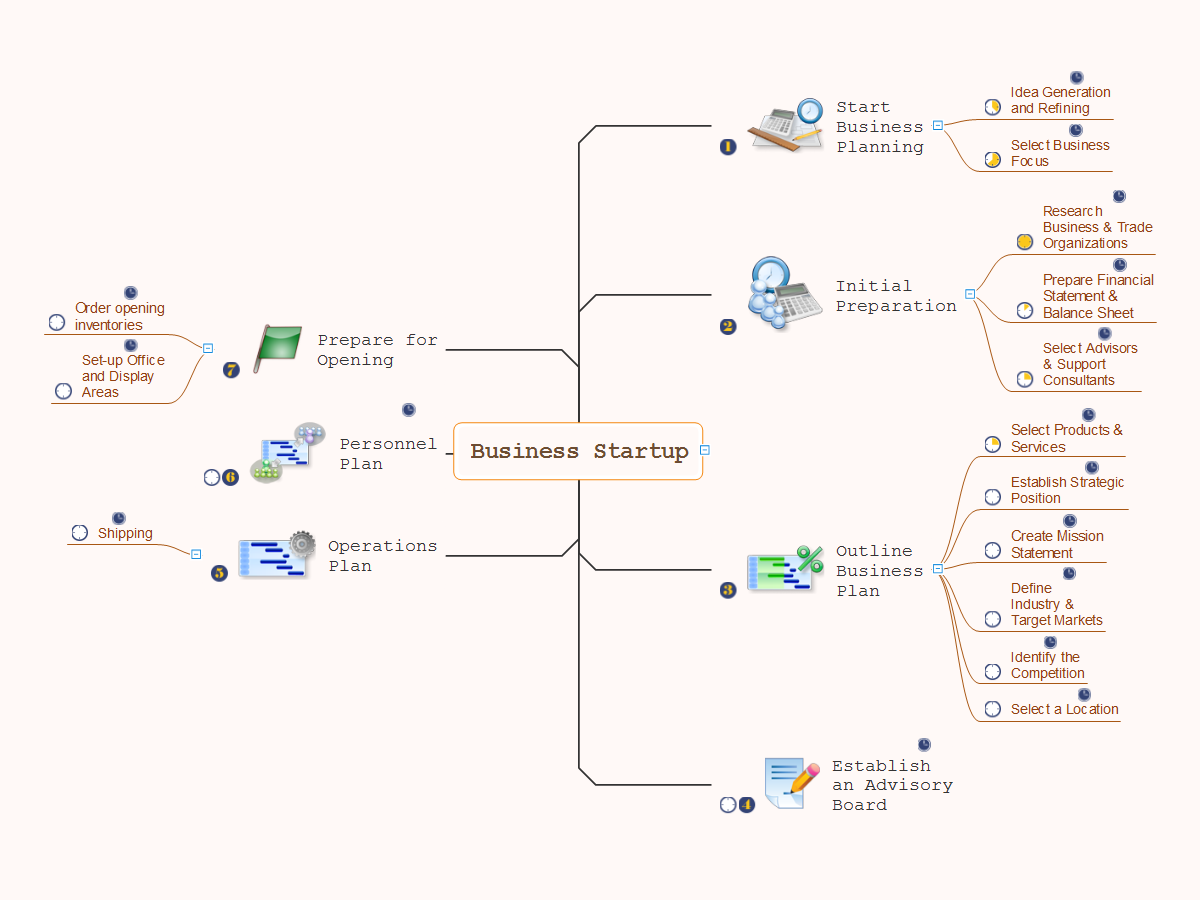
A business planning mind map Template is easiest to understand when readers can compare several genuine visual structures. Existing examples show that there is no single universal layout. Some maps use a central business node with radial branches, while others use a more hierarchical structure in which strategic areas lead into increasingly specific planning questions. Common branches include executive summary, company description, market analysis, products and services, marketing, operations, management, finance, and strategy. These examples demonstrate how a visual plan can turn a large collection of business questions into an organized hierarchy that can be reviewed before detailed written planning begins.
The following references are useful for comparing structure, hierarchy, visual emphasis, and the amount of detail placed at each level. When evaluating them, focus less on copying colors or graphic decoration and more on the underlying planning logic. Look at how each example identifies the central concept, separates major business areas, groups related information, and creates a path from broad strategy to specific decisions. That comparison can help you decide whether your own map should be compact and presentation-oriented, highly detailed for research, or deliberately blank so that the structure develops around the needs of the business.
Business Plan from XMind 8 Templates
Source: XMind
Business Plan Mind Map Template
Source: Venngage
Business Startup Mind Map
Source: ConceptDraw
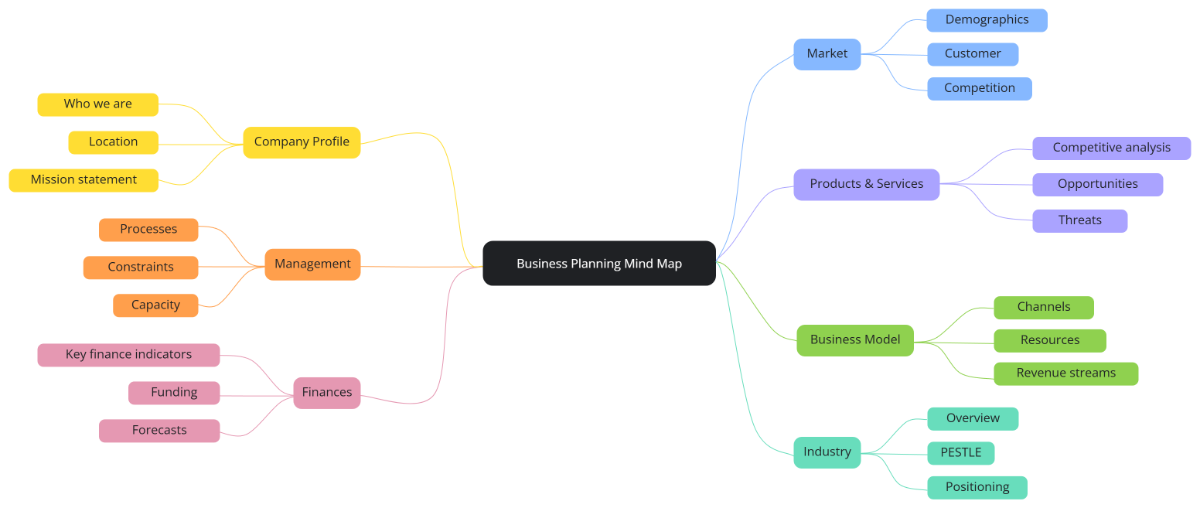
Business Planning Mind Map Template
Source: Template.net
Basic Business Plan Mind Map Template
Source: Visme
Business Planning Mind Map
Source: Venngage
Professional Business Strategy Mindmap Template
Source: Venngage
Business Strategy Mind Map Template
Source: Venngage
Business Model for Innovation
Source: Venngage
Business Model Canvas Mindmap
Source: Venngage
Pricing Model Mind Map Template
Source: Venngage
